| Specification | Details |
| Alloy | 1050 Aluminium |
| Temper | O (annealed), H14 (semi-hard), H18 (full-hard), H22, H24 |
| Thickness | 0.006-0.2 mm |
| Width | 100-1600 mm |
| Surface Finish | Epoxy Coated |
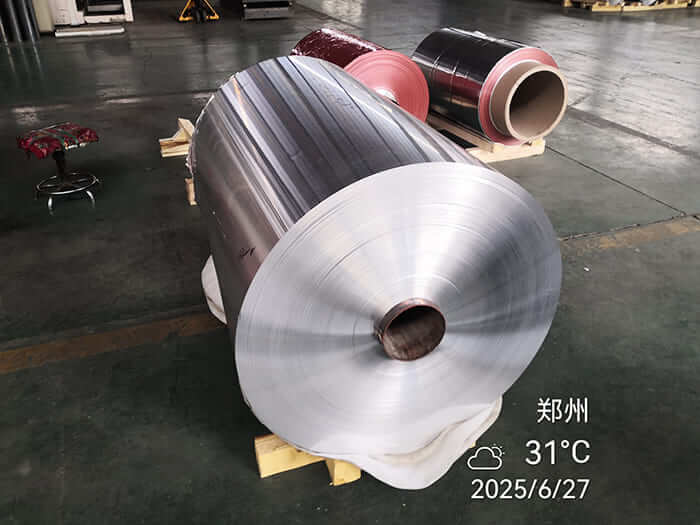
1050 Epoxy Coated Aluminum Foil for Cable Shielding blends the metallurgical purity of 1050 aluminum with a carefully formulated epoxy layer.
The result is a shielding material that retains the high electrical conductivity of aluminum while gaining improved surface adhesion, chemical resistance, and environmental durability through the epoxy coating.
The epoxy layer acts as a protective skin that helps resist humidity, oils, and other contaminants—important when cables run through automotive, aerospace, or industrial environments where exposure to moisture and chemicals is common.
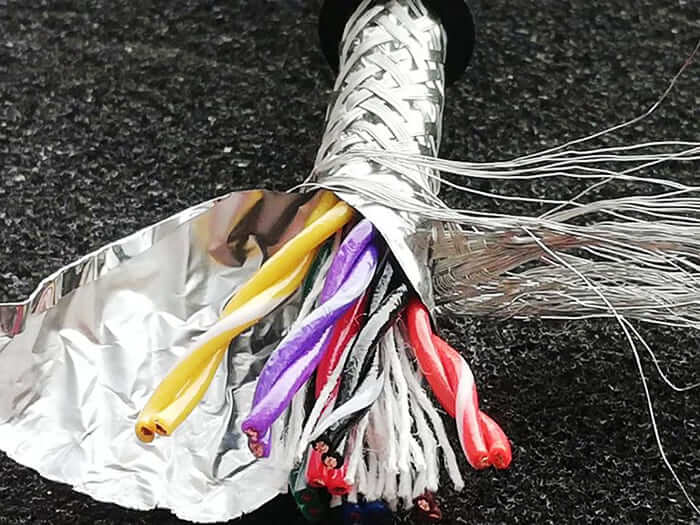
At the same time, the foil remains highly conductive, so it can function as an effective Faraday shield when used in conjunction with proper seam sealing and constructive design.
The growing demand for lighter alternatives to copper-based shields has driven the adoption of epoxy-coated aluminum foil for shielding, without sacrificing EMI performance.
Aluminum foils are widely available in a variety of thicknesses, and the epoxy coating adds a layer of corrosion resistance and mechanical robustness, enabling longer service life in fluctuating temperatures and humid conditions.
For cable manufacturers and integrators, the availability of a consistent, coating-compatible shield foil like 1050 epoxy coated aluminum foil facilitates more reliable manufacturing processes and end products that meet industry standards.
1050 Epoxy Coated Aluminum Foil
Epoxy-coated aluminum foil uses the 1050 aluminum alloy as the base metal. People recognize Alloy 1050 for its high aluminum content (typically near 99.5% Al), excellent formability, and good conductivity.
Manufacturers produce the foil in standard gauges of about 12–50 μm, depending on the application. They then apply a thin epoxy coating—typically 1–3 μm—to one or both surfaces.
The coating provides moisture resistance, chemical protection, and enhanced durability against handling and environmental stress, while the foil maintains most of the conductive and shielding properties needed for EMI control.
1050 epoxy coated aluminum foil combines the high ductility, corrosion resistance, and electrical conductivity of 1050 aluminum foil with a thin epoxy skin that provides moisture and chemical barriers.
– Foil thickness (gauge): 12 μm to 40 μm (commonly 20–25 μm for shield applications)
– Epoxy coating thickness: 1–3 μm per side (single or double-sided coating)
– Aluminum content: ~99.5% Al (as with standard 1050 alloy)
– Electrical conductivity: approximately 60–62% IACS (relative to copper)
– Thermal conductivity: ~205 W/m·K (aluminum); the epoxy layer has relatively lower thermal conductivity but does not impede overall foil performance appreciably when used in typical cable shielding configurations
– Mechanical properties: ductile with low yield strength (suitable for forming and wrapping around cables), elongation typically in the range of 1–6% depending on foil thickness and temper
– Foil thickness: 12–40 μm
– Epoxy coating thickness: 1–3 μm per side
– Approximate density: ~2.70 g/cm3
– Electrical conductivity: ~60–62% IACS
– Thermal conductivity: ~205 W/m·K (metal portion)
– Tensile strength: ~70–100 MPa (dependent on temper and thickness)
– Elongation at break: ~1–4%
– Adhesion of epoxy to foil: moderate to strong (evaluated via standard peel tests)
Note: Values vary with exact temper, processing, and coating chemistry. The ranges above reflect typical industry experience for 1050-based foil with an epoxy skin.
Shielding effectiveness (SE) is a function of material conductivity, foil thickness, and the integrity of seams and overlaps in the shield assembly.
Epoxy coating, being non-conductive, does not add EMI shielding by itself; the primary shielding comes from the metal foil.
In properly assembled shields, SE values are typically dominated by foil continuity and seam treatment rather than the epoxy surface alone.
That said, the epoxy layer plays a role in preserving surface condition, resisting corrosion at the seam interfaces, and supporting reliable seam technologies.
Practically, inducted SE will be lower if there are seam gaps, overlaps, or improper crimping of the shield.
Epoxy coating’s influence on SE is minimal in well-executed shields but matters for corrosion resistance and long-term reliability of seam performance.
– Frequency (MHz): 100, 1000
– SE (dB): 40–60, 75–95
In comparison to other shielding options, aluminum foil provides a favorable balance of weight, cost, and shielding performance, particularly when used in multilayer shields or combined with conductive wraps.
Copper foil provides higher SE per thickness but at greater weight and cost, while laminated polymer shields offer different benefits in terms of flexibility and dielectric isolation.
1050 Epoxy Coated Aluminum Foil for Cable Shielding
Foil-based shielding must be compatible with the insulation materials it rests against or wraps around.
The epoxy coating can improve the adhesion between foil and insulation layers, reducing delamination risk in heat cycles.
It can also improve ease of handling during manufacturing by reducing surface roughness and muting sharp edges that can damage insulation or cable jackets.
Design considerations:
– Adhesion to insulating jacket materials (PVC, XLPE, TPE, etc.)
– Compatibility with insulation extrusion temperatures
– Resistance to solvents or oils encountered in service
– Ability to withstand vibration and bending without cracking the coating or tearing the foil
The production workflow for 1050 epoxy coated aluminum foil typically includes:
1) Casting or rolling of aluminum 1050 to produce a thin foil within the desired thickness range.
2) Surface treatment and rolling to achieve a consistent surface finish and flatness.
3) Epoxy coating application on one or both sides using a precise coating process (e.g., roller coating, curtain coating, or spray deposition) to achieve uniform thickness.
4) Curing of epoxy under controlled temperature and humidity to maximize adhesion and chemical resistance.
5) Slitting to final width and inspection for dimensions, surface quality, coating thickness, and adhesion tests.
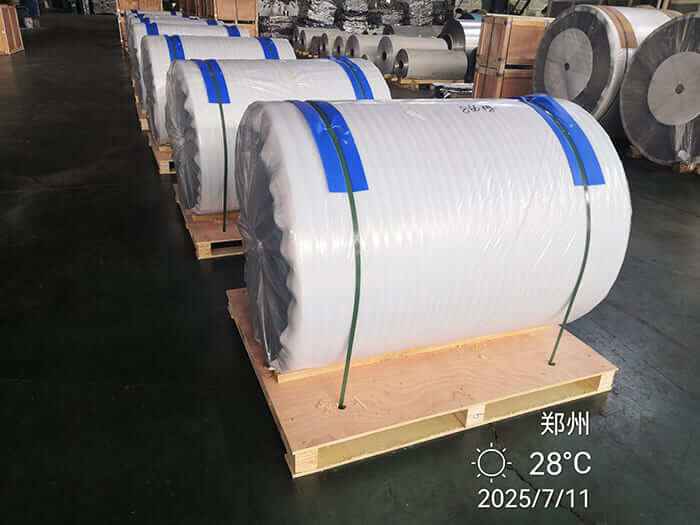
6) Packaging and storage in moisture-controlled environments to preserve coating quality.
Quality checkpoints include coating thickness verification (via micrometers or non-contact sensing), adhesion tests (peel tests), surface cleanliness checks (arc or corona discharge cleanliness), and dimensional accuracy (width and thickness tolerances).
Automotive harnesses and control cables demand shielding solutions that resist moisture, oils, and fluctuating temperatures. 1050 epoxy coated foil offers:
– Lightweight shielding compared with copper alternatives
– Improved corrosion resistance thanks to the epoxy layer
– Compatibility with automotive insulation polymers
– Durable performance under vibrations and thermal cycling
A typical automotive shielding solution might use a wrap or spiral wrap configuration with seam overlaps designed to minimize leakage and maximize SE.
Industrial environments often expose shielding materials to oils, solvents, humidity, and aggressive cleaning regimes.
The epoxy coat helps mitigate corrosion and helps maintain coating integrity across wash cycles or heavy use.
Shielded cables in manufacturing plants, power distribution, and control networks benefit from the reliability of epoxy-coated foil.
In electronics and some aerospace environments, shielding must be efficient yet lightweight and robust under temperature variations.
The epoxy coating provides additional reliability in harsh environments while the foil remains a cost-effective shield option.
Huasheng Packaged 1050 Epoxy Coated Aluminum Foil
Huasheng Aluminum is a leading producer of aluminum foil and related materials with a focus on shielding foils for cable applications.
The company has established processes for producing epoxy-coated aluminum foils that meet industry standards and customer-specific requirements.
Their product line includes 1050-based foil with epoxy coatings, offered in various thicknesses and coating to foil ratio, to suit customer needs.
Huasheng Aluminum coordinates with logistics partners to ensure timely delivery, including packaging that protects coating integrity during transit, and sporting the appropriate documentation for compliance with import/export regulations in various regions.
Section 9: Sustainability, Compliance, and End-of-Life
Aluminum foil is highly recyclable. The presence of epoxy coating adds a single-layer barrier that recycling processes can separate, but facilities must handle epoxy-coated materials appropriately.
The aluminum portion retains wide recyclability, and many recycling streams can process coated aluminum with appropriate separation steps.
In some regions, operators may need to separate and dispose of epoxy-coated foils properly due to their resin content.
When they send these foils to standard recycling facilities, recyclers can often recover and reuse the aluminum.
Q1: What is 1050 Epoxy Coated Aluminum Foil for Cable Shielding?
A1: It is a shielding foil made from 1050 aluminum alloy with a thin epoxy coating, designed for use in cable shielding applications.
It provides high electrical conductivity, corrosion resistance, and good compatibility with insulation materials.
Q2: How does the epoxy coating affect shielding performance?
A2: The epoxy coating itself is non-conductive, so shielding effectiveness is dominated by the metal foil.
The coating improves durability, corrosion resistance, and seam reliability, indirectly supporting consistent shielding performance over time.
Q3: What thickness of foil is typical for shielding?
A3: Foil thickness commonly ranges from 12 μm to 40 μm, with 20–25 μm being a common choice for a balance of shielding performance and weight.
Q4: Is 1050 epoxy-coated foil suitable for automotive use?
A4: Yes, if the coating and foil thickness are chosen to meet automotive environmental conditions, including temperature cycling and humidity.
The epoxy coating helps resist moisture and chemical exposure typical in automotive environments.
Q5: What standards should shielded cables meet?
A5: Standards vary by application and region (e.g., IEC, CISPR, EN standards). Engineers should validate shield design with EMI tests and supplier-provided data to ensure consistent performance across target frequency ranges.
Q6: How does Huasheng Aluminum support customers with 1050 epoxy-coated foil?
A6: Huasheng Aluminum offers product specifications, coating options, and customization for foil thickness and coating specifications.
They also provide technical support, testing data, and supply chain management to meet customer demand, with a focus on consistent quality and timely delivery.
1050 Epoxy Coated Aluminum Foil for Cable Shielding represents a practical, well-balanced solution for EMI shielding across automotive, industrial, and electronics applications.
Its combination of high aluminum conductivity, protective epoxy coating, and compatibility with standard insulation materials makes it a compelling option for equipment designers seeking lightweight, durable shielding solutions without the higher costs typically associated with copper-based shields.
In this context, Huasheng Aluminum stands out as a supplier that can deliver reliable 1050 epoxy-coated foil with consistent quality, certifications, and support.
By aligning material properties with application requirements and validated performance data, engineers can design shield solutions that are not only effective but also reliable, manufacturable, and lifecycle-conscious.
With careful selection and proper application, 1050 Epoxy Coated Aluminum Foil for Cable Shielding can deliver robust EMI protection, durable environmental resistance, and excellent value for modern cable shield designs.
Huasheng Aluminum’s capability to provide tailored solutions and reliable supply makes it a prudent partner for engineers and procurement teams seeking to optimize shielding performance while controlling cost and lead times.
Share with PDF: Download
1. Introduction 3003 aluminu……
1. Introduction As industrie……
Introduction In the world of……
8011 H18 blister aluminum fo……
Introduction to 1050 Epoxy C……
1. Introduction 8011 Embosse……

Henan Huasheng Aluminum Co., Ltd (HHALU for short), established in 2001, is located in Huiguo Town, the famous Aluminum capital of Henan Province, It's a professional manufacturer and engages in the research, development, production, sales and service of aluminum sheet plate, aluminum coil, aluminum foil, aluminum strip and aluminum circle.
In addition, HHALU also sell aluminum plate for construction and ships, aluminum mirror plate, and automotive aluminum alloy plate.
No.53, Dongming Road, Zhengzhou, Henan, China
Copyright © Huasheng Aluminum 2025. All rights reserved.
