| Parameter | Specification |
| Alloy | 5A06 |
| Temper | O, H12, H14, H18, H22, H32, etc. |
| Density | 2.64 g/cm³ |
| Size Range (Thickness x Width x Length) | 0.2mm – 6mm x 500mm – 2200mm x 800mm – 6000mm |
| Surface Treatment | Mill Finish, Anodized, Powder Coated, Brushed, Polished |
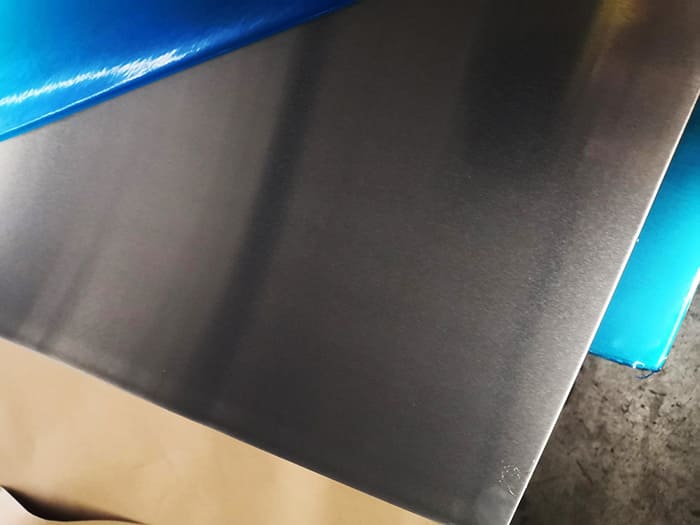
5A06 aluminum sheet is a high-performance, non-heat-treatable aluminum-magnesium (Al-Mg) alloy, renowned for its exceptional strength, excellent corrosion resistance, and good weldability.
As a member of the 5xxx series, its defining feature is its very high magnesium content (typically 5.8-6.8%), which places it at the upper echelon of strength among all strain-hardened aluminum alloys.
With a tensile strength often exceeding 315 MPa, it significantly surpasses more common marine alloys like 5083, making it a specialized material for applications requiring maximum strength in a welded structure.
While its primary applications have historically been in the aerospace and military sectors—for components like welded fuel tanks, missile casings, and light armor—it also serves in other high-stress environments.
Its unique combination of weldable high strength and durability makes 5A06 the definitive choice for critical structures where performance cannot be compromised and where heat-treatable alloys like the 7xxx series are not viable due to their poor weldability.
5A06 aluminum sheet
The 5A06 alloy’s performance derives from precise elemental balance optimized through decades of Chinese metallurgical research:
| Element | Specification (wt%) | Functional Role |
|---|---|---|
| Aluminum (Al) | Balance (≥92.5%) | Matrix; corrosion resistance foundation |
| Magnesium (Mg) | 5.8–6.8 | Solid solution strengthening; β-phase (Al₈Mg₅) source |
| Manganese (Mn) | 0.50–0.80 | Grain refinement; Al₆Mn dispersoid formation |
| Silicon (Si) | 0.40–0.80 | Casting fluidity; Mg₂Si precipitation; anodizing enhancement |
| Titanium (Ti) | 0.02–0.10 | DC casting grain refinement; prevents ingot cracking |
| Beryllium (Be) | 0.0001–0.005 (optional) | Oxidation prevention during melting; reduces dross |
| Iron (Fe) | ≤0.40 | Controlled impurity; Al₃Fe phase limitation |
| Copper (Cu) | ≤0.10 | Tight limit; prevents SCC susceptibility |
| Zinc (Zn) | ≤0.20 | Limitation; galvanic corrosion prevention |
| Chromium (Cr) | ≤0.20 (residual) | Recrystallization control |
| Others (each) | ≤0.05 | — |
| Others (total) | ≤0.15 | — |
| Temper | Processing Description | UTS (MPa) | Yield 0.2% (MPa) | Elongation A50 (%) | Hardness (HB) | Typical Applications |
|---|---|---|---|---|---|---|
| O (Annealed) | 380–420°C/2–4h, furnace cool | 315–375 | 155–215 | 15–22 | 75–95 | Deep forming, anodized optical housings, cryogenic equipment |
| H12 | Cold work ~25% from O | 340–400 | 260–320 | 8–15 | 85–105 | Moderate forming, structural brackets, marine fittings |
| H14 | Cold work ~35% from O | 360–420 | 290–350 | 6–12 | 95–115 | Rivets, fasteners, clips, springs |
| H16 | Cold work ~50% from O | 380–440 | 320–380 | 4–8 | 105–125 | High-strength wire, precision springs |
| H18 | Cold work ~75% from O | 400–460 | 360–420 | 3–6 | 110–130 | Maximum strength springs, diaphragms |
| H22 (H12 + stabilized) | H12 + 250–300°C/2h | 340–400 | 250–310 | 10–16 | 85–105 | Stress-corrosion resistant marine structures |
| H24 (H14 + stabilized) | H14 + 280–320°C/2h | 360–420 | 280–340 | 8–14 | 95–115 | Balanced strength/ductility for welded structures |
| H32 | H12 + stabilization | 340–400 | 250–310 | 10–16 | 85–105 | SCC-resistant applications (equivalent to H22) |
| H112 | Hot work finishing | 295–355 | 130–190 | 12–20 | 70–90 | General structural plate, thick sections |
Strength Progression:
The O-temper baseline of 315–375 MPa UTS already exceeds 5083-H116 (305–385 MPa) and approaches 5383-H116 (370–420 MPa), demonstrating 5A06’s exceptional solid solution strengthening.
Cold working to H18 achieves 400–460 MPa, rivaling heat-treatable 6061-T6 (290–330 MPa) without thermal processing.
Ductility Trade-offs:
Elongation decreases from 15–22% (O) to 3–6% (H18), following typical work-hardening relationships.
However, 5A06 maintains superior ductility at equivalent strength levels compared to 5056 due to silicon-enhanced deformation mechanisms.
Anisotropy Characteristics:
Planar anisotropy index Δr = 0.2–0.4 produces 8–12% earing in cylindrical cup drawing—manageable through blank holder pressure optimization and lubricant selection.
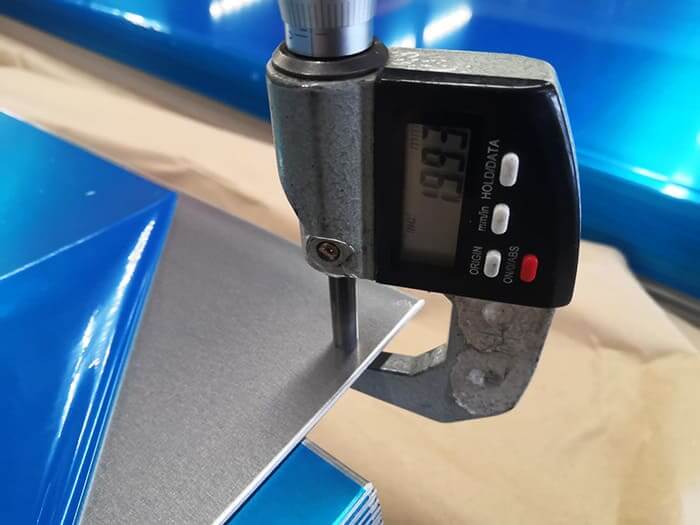
2mm 5A06 aluminum sheet Thickness test
| Property | Value | Application Significance |
|---|---|---|
| Density | 2.64 g/cm³ | 2% lighter than 5083; critical for aerospace mass budgets |
| Melting Range | 568–640°C | Lower Mg content than upper limit reduces liquidus; affects welding parameters |
| Thermal Conductivity | 115 W/(m·K) at 20°C | Adequate for heat dissipation; 10% lower than 5083 due to higher Mg |
| Electrical Conductivity | 26% IACS | Lower than 5083 (29%); higher resistive heating in electrical applications |
| Coefficient of Thermal Expansion | 24.0×10⁻⁶/°C | Design allowance: 2.4 mm/m per 100°C ΔT |
| Specific Heat Capacity | 880 J/(kg·K) | Thermal mass calculations for cryogenic systems |
| Elastic Modulus | 70.5 GPa | Identical to other 5xxx alloys within measurement precision |
| Poisson’s Ratio | 0.33 | Standard for aluminum alloys |
The performance of 5A06 aluminum sheet is closely linked to how it is manufactured and processed.
Because 5A06 is a high-magnesium, non-heat-treatable Al–Mg alloy, its mechanical strength, corrosion resistance, and fabrication reliability depend on precise control of alloy chemistry, deformation, and thermal history throughout production.
Production begins with high-purity primary aluminum, supplemented where appropriate by qualified recycled aluminum.
Alloying elements—primarily magnesium (5.8–6.8%), along with manganese and chromium—are added under tightly controlled conditions.
Accurate alloying is essential, as even small deviations in Mg content can significantly affect strength and corrosion behavior.
After alloying, the molten metal is cast into rolling slabs using direct chill (DC) casting.
These slabs then undergo homogenization heat treatment, typically in the range of 450–500 °C.
Homogenization serves to:
Homogenized slabs are hot rolled at elevated temperatures to reduce thickness and refine the grain structure. During this stage:
Careful temperature control prevents surface cracking and ensures stable deformation behavior, which is particularly important for high-Mg alloys like 5A06.
After hot rolling, the material is further processed by cold rolling to reach final thickness and improve surface quality.
Benefits of cold rolling include:
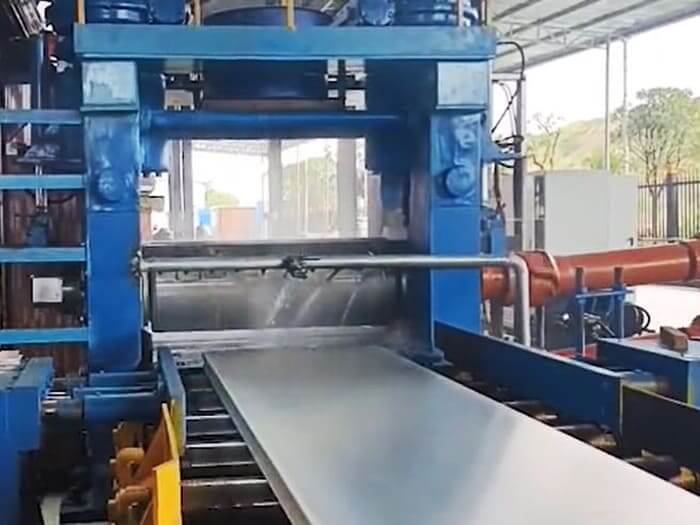
Aluminum sheet rolling process
Depending on the required temper, the sheet may undergo:
Final processing includes:
Thanks to its high strength, excellent corrosion resistance, outstanding weldability, and lightweight nature, 5A06 aluminum sheet is widely used in industries that demand long service life and structural reliability.
Its performance advantages make it particularly suitable for welded structures operating in corrosive or high-load environments.
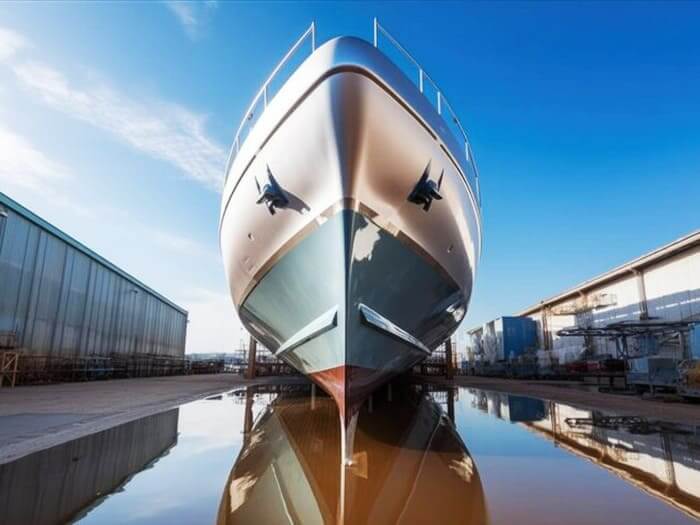
One of the most important application areas for 5A06 aluminum sheet is marine engineering.
Shipbuilding used 5A06 aluminum sheet
Engineers commonly select 5A06 aluminum sheet for pressure vessels and storage systems when corrosion resistance and weight reduction matter.
In the transportation sector, 5A06 aluminum sheet supports lightweight design and energy efficiency.
Designers use 5A06 aluminum sheet in defense and aerospace-adjacent applications because it offers a high strength-to-weight ratio and strong resistance to environmental degradation.
The corrosion resistance of 5A06 aluminum sheet makes it valuable in chemical processing and industrial environments.
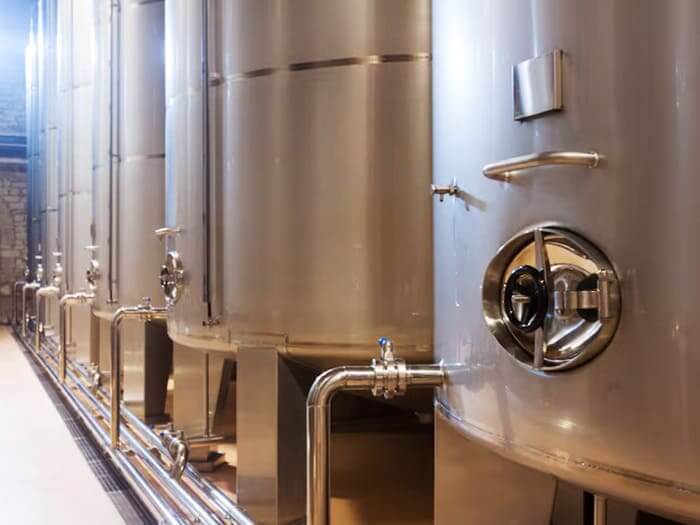
5A06 aluminum sheet for chemical container
5A06 aluminum sheet is recognized as a high-performance Al–Mg alloy that combines mechanical strength, corrosion resistance, and fabrication reliability.
These advantages make it a preferred material for marine, transportation, pressure vessel, and structural applications where long-term durability and lightweight efficiency are essential.
One of the most significant advantages of 5A06 aluminum sheet is its excellent corrosion resistance, particularly in marine and humid environments.
5A06 aluminum sheet offers a strong balance between mechanical strength and low density, delivering excellent structural efficiency.
Unlike heat-treatable aluminum alloys, 5A06 aluminum sheet maintains stable mechanical properties after welding, making it ideal for complex fabricated structures.
5A06 aluminum sheet exhibits a high-quality anodizing response, adding both functional and aesthetic value.
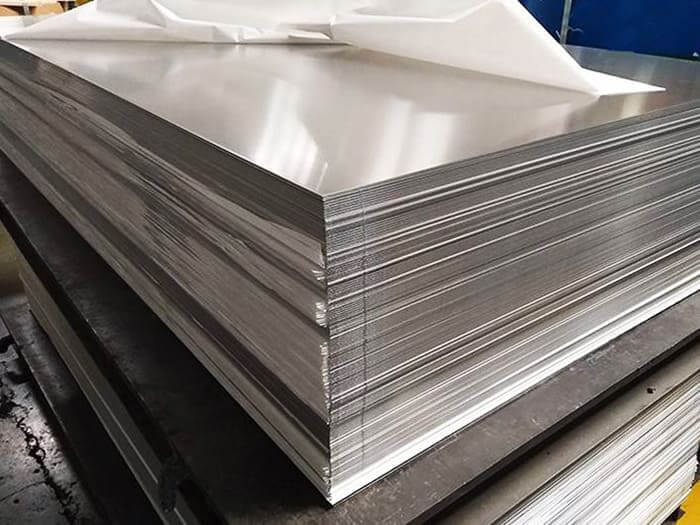
Anodized 5A06 aluminum sheet
| Property / criterion | 5A06 | 5083-H116 | 5052-H32 | 5456-H116 | 6061-T6 | A36 Mild Steel |
|---|---|---|---|---|---|---|
| Material class | Al–Mg (high Mg) | Al–Mg (marine grade) | Al–Mg (formable) | Al–Mg (higher strength) | Al–Mg-Si (heat-treatable) | Fe-C |
| Density (g·cm⁻³) | ~2.66 | ~2.66 | ~2.68 | ~2.67 | ~2.70 | ~7.85 |
| Yield Rp0.2 (MPa) | ~150–180 | ≥215 | ~140–195 | ~250–300 | ~275–310 | ~250 |
| Tensile Rm (MPa) | ~315–380 | ~305–385 | ~210–260 | ~340–405 | ~310–350 | ~400–550 |
| Elongation A (%) | ~10–15% | ≥10–12% | ~8–18% | ~10–12% | ~8–12% | ~15–25% |
| Heat-treatable | No | No | No | No | Yes | No |
| Weldability | Excellent (MIG/TIG/FSW) | Excellent | Excellent | Good–Excellent | Good (weld HAZ weakens) | Excellent (requires corrosion protection) |
| Seawater corrosion resistance | Very good | Excellent (marine grade) | Good (limited immersion) | Very good–Excellent | Moderate (needs coating) | Poor (requires coatings/cathodic prot.) |
| Intergranular/exfoliation risk | Low when processed | Low (H116 control) | Low | Low (H116 control) | Low | N/A |
| Fatigue performance | Good (weld detail sensitive) | Good | Moderate | Very good | Good | Very good |
| Typical applications | High-strength marine parts, pressure vessels, tanks, structural panels | Hull plating, tanks, offshore structures | Fuel tanks, formed components, ducts | Higher-strength hull plates, structural members | Frames, fittings, machined parts | Heavy hulls, structural frames where weight is secondary |
| Design trade-offs | High Mg → high strength + good corrosion; non-heat treatable | Marine workhorse — proven immersion performance | Best for formability and economy; not for prolonged immersion | Higher static strength (price premium) | Higher peak strength (but needs corrosion care) | Cheap, strong, heavy, high maintenance |
Huasheng Aluminum is a professional aluminum material supplier committed to delivering high-quality 5A06 aluminum sheets for demanding applications.
By combining manufacturing expertise with quality assurance, Huasheng Aluminum helps customers reduce risk and improve project efficiency.
5A06 aluminum sheet is not a general-purpose material; it is a specialist engineering solution designed for the extremes.
It represents the pinnacle of strength within the family of non-heat-treatable, weldable aluminum alloys.
Its value lies not in its versatility, but in its ability to provide an indispensable solution for a narrow but critical range of applications in the aerospace, military, and high-performance marine sectors.
For engineers tackling challenges where maximum strength must be achieved without sacrificing weldability, 5A06 stands as a proven and powerful material choice.
Q1: Is 5A06 aluminum sheet heat treatable?
No. 5A06 is a non-heat-treatable alloy; its strength comes from magnesium content and work hardening.
Q2: Is 5A06 suitable for marine environments?
Yes. Its high magnesium content provides excellent resistance to seawater and marine atmospheres.
Q3: How does 5A06 compare to 5083 aluminum?
Both offer excellent corrosion resistance; 5A06 typically provides slightly higher strength, while 5083 is more globally standardized for shipbuilding.
Q4: Can 5A06 aluminum sheet be welded easily?
Yes. It has excellent weldability with minimal loss of mechanical properties after welding.
Q5: What thickness range is available?
5A06 aluminum sheet is commonly available from thin gauge sheets to thick plates, depending on application and supplier capability.
1. Introduction 3003 aluminu……
1. Introduction As industrie……
Introduction In the world of……
8011 H18 blister aluminum fo……
Introduction to 1050 Epoxy C……
1. Introduction 8011 Embosse……

Henan Huasheng Aluminum Co., Ltd (HHALU for short), established in 2001, is located in Huiguo Town, the famous Aluminum capital of Henan Province, It's a professional manufacturer and engages in the research, development, production, sales and service of aluminum sheet plate, aluminum coil, aluminum foil, aluminum strip and aluminum circle.
In addition, HHALU also sell aluminum plate for construction and ships, aluminum mirror plate, and automotive aluminum alloy plate.
No.53, Dongming Road, Zhengzhou, Henan, China
Copyright © Huasheng Aluminum 2025. All rights reserved.
