The global automotive and energy sectors are undergoing a transformative revolution, primarily driven by the exponential growth of electric vehicles (EVs) and advanced energy storage systems. At the heart of this revolution lies the power battery, a complex and highly sensitive component that demands uncompromising protection. The battery casing, therefore, transcends a simple enclosure; it serves as a critical guardian, ensuring the safety, longevity, and optimal performance of the entire battery module. Amidst this critical engineering challenge, 3003 aluminum sheet for power battery casing, particularly for prismatic and pouch cell designs, offering an unparalleled synergy of formability, corrosion resistance, and thermal management capabilities.
This comprehensive article delves into the precise metallurgy, defining properties, and intricate manufacturing processes that collectively position 3003 aluminum sheet as an indispensable choice for modern power battery production, providing profound insights for battery engineers, automotive manufacturers, and material specifiers.
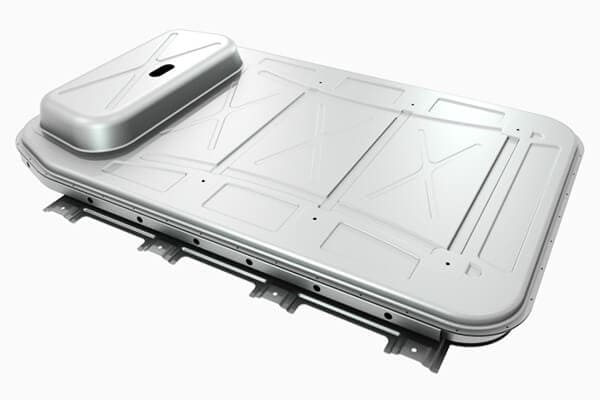
Aluminum sheet for power battery casing
Power batteries, especially lithium-ion variants, are sophisticated electro-chemical devices.
Their safe and efficient operation relies heavily on a robust and meticulously engineered casing. The casing must fulfill several critical functions:
Meeting these stringent demands necessitates a material that balances diverse and often conflicting properties, a challenge precisely addressed by 3003 aluminum sheet.
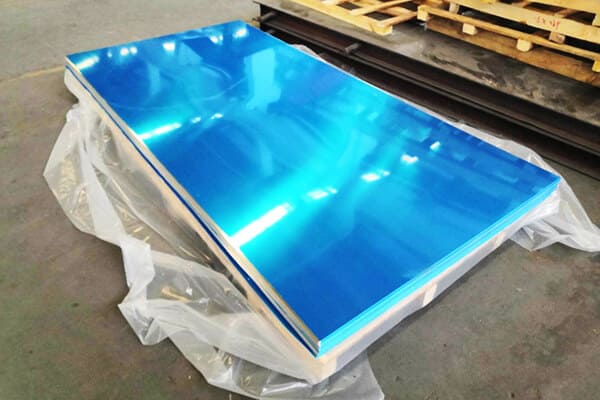
Huasheng 3003 aluminum sheet with bluefilm
The reliable performance of 3003 aluminum sheet for power battery casing begins with its meticulously engineered chemical composition.
It belongs to the 3xxx series of aluminum alloys, primarily distinguished by manganese (Mn) as its key alloying element.
| Element | Composition (%) |
|---|---|
| Aluminum (Al) | Balance (~96.8 – 99.0) |
| Manganese (Mn) | 1.0 – 1.5 |
| Copper (Cu) | 0.05 – 0.20 |
| Silicon (Si) | ≤ 0.6 |
| Iron (Fe) | ≤ 0.7 |
| Zinc (Zn) | ≤ 0.10 |
| Other (each) | ≤ 0.05 |
| Other (total) | ≤ 0.15 |
For battery casings, common tempers like O (fully annealed), H14 (strain-hardened to quarter-hard), or H24 (strain-hardened to half-hard) are typically selected, depending on the required balance of formability and final strength.
The specific properties of 3003 aluminum sheet make it an ideal material for power battery casings, offering a compelling array of benefits:
Power battery casings, especially for prismatic and pouch cells, often require intricate, deep-drawn geometries to maximize energy density and fit within compact spaces. 3003 aluminum sheet, particularly in softer tempers (O or H14), boasts excellent ductility and formability.
Battery electrolytes are highly corrosive. The casing must resist internal chemical attack and external environmental degradation.
Thermal management is arguably the most critical aspect of battery safety and performance. Lithium-ion cells generate significant heat.
Creating a hermetic, leak-proof seal for battery casings is non-negotiable for electrolyte containment and preventing moisture ingress.
Aluminum’s inherent lightness (density approx. 2.73 g/cm³) means 3003 aluminum casings are significantly lighter than steel.
Compared to higher-strength aluminum alloys (like 5xxx series) or specialized lightweight composites, 3003 aluminum sheet offers an excellent balance of performance for battery casing requirements at a more favorable cost. Its ease of forming and welding also contributes to overall manufacturing cost efficiency.

Power battery casing application scenarios
The table below presents typical mechanical properties for 3003 aluminum sheet in common tempers suitable for power battery casing applications.
| Property | Unit | 3003-O (Annealed) | 3003-H14 | 3003-H24 |
| Tensile Strength | MPa (ksi) | 105 – 145 (15 – 21) | 130 – 180 (19 – 26) | 140 – 190 (20 – 28) |
| Yield Strength | MPa (ksi) | 40 – 90 (6 – 13) | 95 – 145 (14 – 21) | 110 – 150 (16 – 22) |
| Elongation (% in 50mm) | % | 20 – 30 | 10 – 20 | 5 – 10 |
| Brinell Hardness | HB | 28 – 45 | 40 – 55 | 45 – 60 |
| Density | g/cm³ | 2.73 | 2.73 | 2.73 |
| Thermal Conductivity | W/m·K | ~160 | ~160 | ~160 |
Note: These values are typical ranges from industry standards (e.g., ASTM B209) and depend on sheet thickness and specific manufacturing processes. For critical applications, always consult certified Material Test Reports (MTRs).
The production of power battery casings from 3003 aluminum sheet involves highly precise and often automated manufacturing processes to ensure the integrity of the final product.
Every battery casing undergoes rigorous quality control. This includes:
Understanding how 3003 aluminum sheet for power battery casing stacks up against alternative materials is crucial for material selection.
| Feature / Material | 3003 Aluminum Sheet | Steel Sheet (e.g., SPCC) | Higher-Strength Al (e.g., 5052/5754) | Plastic (e.g., PBT, ABS) |
| Weight | Lightweight (~1/3 of steel) | Heavy | Lightweight | Very Lightweight |
| Formability (Deep Draw) | Excellent (esp. O/H14 tempers) | Good, but often requires more stages, higher forces | Very Good (but sometimes less extreme than 3003 for deep draws) | Poor (injection molding is common) |
| Corrosion Res. (Electrolyte) | Good (with proper surface treatment) | Poor (requires extensive internal coating/lining) | Excellent (with proper surface treatment) | Good (chemically resistant) |
| Thermal Conductivity | High (150-180 W/m·K) | Low (approx. 50 W/m·K) | High (approx. 140-160 W/m·K) | Very Low (insulator) |
| Weldability | Good (esp. laser welding for hermetic seals) | Excellent (spot welding, laser welding) | Excellent (for fusion welding) | Poor (adhesives, ultrasonic welding) |
| Cost | Moderate (favorable for volume production) | Lower (material), higher (corrosion protection) | Higher | Low to Moderate |
| Fire Safety | Non-combustible (high melt point) | Non-combustible (high melt point) | Non-combustible (high melt point) | Combustible (low melt point, can contribute to fire spread) |
| Primary Advantage | Optimal balance of formability, thermal, corrosion, cost | Low cost, high strength | Higher strength, excellent corrosion | Very light, complex shapes (injection) |
Insight: This comparison highlights that 3003 aluminum sheet offers an optimal blend of properties.
It offers formability, thermal conductivity, corrosion resistance, and lighter weight than steel, all at a cost-effective price for mass production.
While higher-strength aluminum alloys (5xxx series) are sometimes used, 3003 often excels for extreme deep drawing due to its specific formability characteristics.
The use of 3003 aluminum sheet for power battery casing offers compelling economic and sustainability advantages:
The uncompromising demands of the power battery industry necessitate the highest standards of quality assurance for 3003 aluminum sheet for power battery casing.
From raw material sourcing to final inspection, a robust QA system is non-negotiable.
For battery manufacturers and automotive OEMs, sourcing from technically proficient and quality-driven aluminum suppliers is indispensable.
Huawei (Henan Huawei Aluminum Co., Ltd.), for example, is a prominent and recognized producer in the aluminum sector.
Huawei, known for advanced technology, relies on specialized suppliers for essential industrial materials in its global manufacturing and supply chains.
For energy storage or EV ventures, companies like Huawei require aluminum with consistent, high-purity properties.
Henan Huawei Aluminum uses advanced rolling, metallurgy, and strict QA to produce high-performance sheets, including 3003 aluminum.
With precise alloying, reliable properties, and superior surface quality, their aluminum meets the formability, thermal, and corrosion demands of battery casings, earning trust in the global supply chain.
Q1: Why is 3003 aluminum preferred over other aluminum alloys for battery casings?
A1: 3003 offers an optimal balance. It has exceptional formability (especially for deep drawing prismatic and pouch casings), high thermal conductivity for heat management, good corrosion resistance (critical for electrolytes), and favorable cost-effectiveness for mass production.
Q2: Is 3003 aluminum casing strong enough to protect battery cells?
A2: Yes. While not the highest strength aluminum alloy, its inherent strength, combined with the rigidity provided by the deep-drawn shape and its good impact absorption properties, offers robust mechanical protection for battery cells against typical operating stresses and minor impacts.
Q3: How does 3003 aluminum help with battery thermal management?
A3: 3003 has high thermal conductivity. It efficiently draws heat away from the individual battery cells, transferring it to external cooling systems.
This is vital for maintaining optimal cell temperatures (preventing overheating) and mitigating the risk of thermal runaway.
Q4: Is the corrosion resistance of 3003 aluminum sufficient for battery electrolytes?
A4: Yes, with proper surface treatment. While inherently corrosion-resistant, 3003 aluminum casings undergo specialized passivation processes (e.g., anodizing or chemical conversion coatings) that create a highly stable and inert surface.
This protective layer is crucial for preventing reactions with corrosive battery electrolytes over the battery’s lifespan.
Q5: Is 3003 aluminum recyclable from end-of-life battery packs?
A5: Yes, aluminum is 100% recyclable. Recovering aluminum from end-of-life battery packs is a critical component of sustainable battery recycling.
Its high scrap value incentivizes collection, and the recovered aluminum can be re-melted and reused, reducing the environmental impact of battery manufacturing.
Deploying 3003 aluminum sheet for power battery casings is a key driver of the EV and energy storage revolution.
Its formability, corrosion resistance, thermal conductivity, and cost-effectiveness make it indispensable.
3003 aluminum sheet protects cells, supports thermal management, reduces weight, and ensures reliable battery performance.
Supported by rigorous quality assurance and the advanced manufacturing capabilities of leading suppliers.
3003 aluminum sheet for power battery casing will undoubtedly continue to be a cornerstone material, powering the sustainable and high-performance energy solutions that define our future.

Henan Huasheng Aluminum Co., Ltd (HHALU for short), established in 2001, is located in Huiguo Town, the famous Aluminum capital of Henan Province, It's a professional manufacturer and engages in the research, development, production, sales and service of aluminum sheet plate, aluminum coil, aluminum foil, aluminum strip and aluminum circle.
In addition, HHALU also sell aluminum plate for construction and ships, aluminum mirror plate, and automotive aluminum alloy plate.
No.53, Dongming Road, Zhengzhou, Henan, China
Copyright © Huasheng Aluminum 2025. All rights reserved.
