8079 aluminum foil belongs to the 8xxx series (Fe/Si-based alloys) and has been engineered for flexible packaging and lamination applications requiring superior ductility, strength, and high-speed process stability.
Compared with 8011 or 1235 foils, 8079 offers better elongation, higher formability, and stronger bonding during multi-layer lamination, making it ideal for thin-gauge applications (typically 6–12 µm) and high-output roll-to-roll lines.
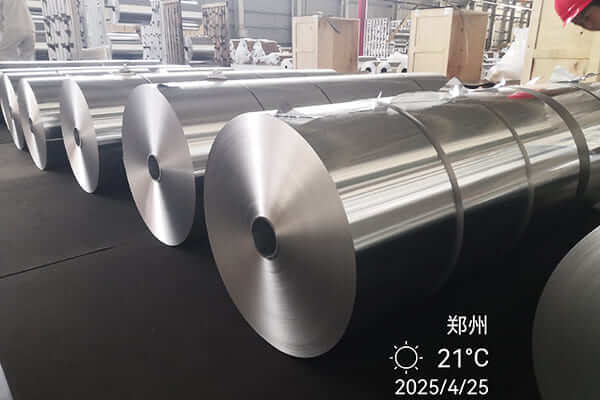
8079 aluminum flexible foil for lamination
8079 alloy belongs to the 8xxx family, optimized through micro-alloying (Mn, Cr, Si) to refine grains, improve tear resistance, and maintain thin-gauge rollability.
The typical composition (Al ≥ 99%) with controlled Fe and Si levels allows excellent ductility, low pinhole rates, and consistent thickness uniformity — crucial for composite structures used in food, pharmaceutical, and industrial packaging.
| Element | Min | Max | Function in foil |
|---|---|---|---|
| Si | — | 0.10 | Surface quality; excess risks streaks during rolling |
| Fe | — | 1.0–1.5 | Strength & pinhole robustness at thin gauges |
| Cu | — | 0.05 | Kept low for corrosion resistance |
| Mn | — | 0.05 | Trace |
| Mg | — | 0.05 | Trace |
| Zn | — | 0.10 | Trace |
| Ti | — | 0.05 | Grain refinement in melt |
| Others (each/total) | — | 0.05 / 0.15 | Impurity caps |
| Al | bal. | — | Matrix providing ductility & reflectivity |
Why 8079? Compared with 1235 (Al ≥99.35%), 8079’s controlled Fe content raises strength/flex life without sacrificing convertibility. Versus 8011 (Al-Fe-Si), 8079 typically offers better elongation at very thin gauges—useful for flex-crack-sensitive laminates.
| Property | 8079-O | 8079-H18 | What it means in lamination |
|---|---|---|---|
| Tensile strength (MPa) | 80–110 | 130–170 | H18 improves web handling before bonding |
| Elongation A50 (%) | 3–8 | 1–3 | O-temper aids forming around tight radii |
| Density (g·cm⁻³) | 2.70 | 2.70 | Use for weight/yield calculations |
| Property | 8079 Aluminum Foil | Units / Notes |
|---|---|---|
| Thickness Range | 6 – 30 | µm |
| Width Range | 200 – 1900 | mm |
| Tensile Strength | 100 – 150 | MPa (annealed) |
| Elongation | 8 – 20 | % |
| Density | 2.71 | g/cm³ |
| Melting Point | 660.3 | °C |
| Surface Wetting Tension | ≥ 38 | dyne/cm (after cleaning) |
| Pinholes (≤ 0.2 mm) | ≤ 10 | per m² |
| Thermal Conductivity | 230 – 235 | W/m·K |
| Oxygen Transmission Rate (OTR) | 0 | cm³/m²·day·atm |
| Moisture Vapor Transmission Rate (MVTR) | < 0.01 | g/m²·day |
These properties make 8079 foil airtight, heat-reflective, and corrosion-resistant, ideal for multilayer laminations with PE, PET, BOPP, CPP, or paper substrates.
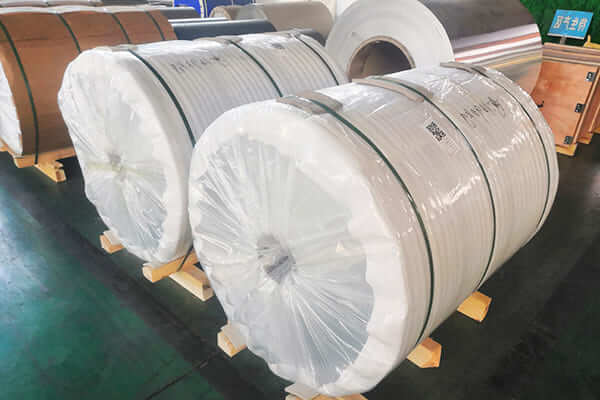
8079 aluminum flexible foil packaged by huasheng
Areal mass = ρ × t. With ρ = 2.70 g·cm⁻³ and thickness in µm:
| Gauge (µm) | Areal mass (g·m⁻²) | Area per kg (m²·kg⁻¹) |
|---|---|---|
| 8 | 21.6 | 46.30 |
| 9 | 24.3 | 41.15 |
| 10 | 27.0 | 37.04 |
| 12 | 32.4 | 30.86 |
Roll example: 1,000 mm × 4,000 m of 9 µm → area 4,000 m² → foil mass ≈ 97.2 kg (before cores & wrapping).
| Laminate (examples) | Why use 8079 aluminum flexible foil for lamination | Typical targets (intact laminate) |
|---|---|---|
| PET (12–25) / 8079-AL (9–10) / PE (40–80) | General dry foods, coffee/tea, powders; stiffness + print from PET, seal from PE | OTR < 0.1, WVTR < 0.01 |
| PA (15) / 8079-AL (9–12) / PE (60–80) | Abuse-resistant pouches; PA adds puncture/tear; 8079 improves flex-crack margin | As above; verify Gelbo flex |
| BOPP (20) / 8079-AL (8–9) / CPP (40–70) | Crisps, biscuits; machinability & hot-tack window from CPP | Low OTR/WVTR; tight hot-tack |
| Paper (40–60 g·m⁻²) / 8079-AL (9) / PE (20–60) | Cigarette inner liner, sachets; dead-fold feel with superior aroma lock | Odor/light barrier; crisp folds |
| NW/Paper / 8079-AL / PE | Cable wrap, insulation facers; EMI & moisture shielding | Electrical & MVTR specs per project |
Aroma & light: 8079 aluminum flexible foil is fully opaque and highly reflective, preserving flavor volatiles and blocking UV/visible light—critical for coffee, tea, spices, nutraceuticals.
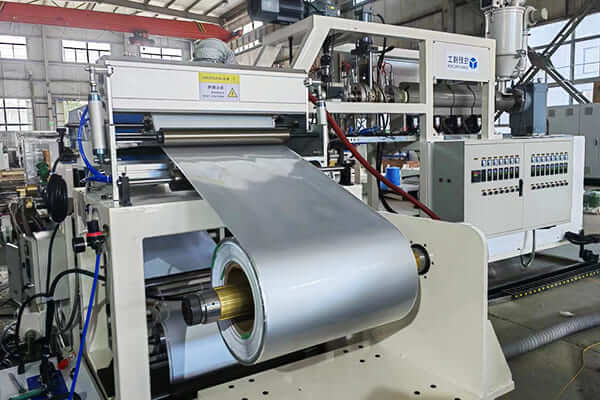
lamination process of 8079 aluminum foil
| Inspection Item | Target / Limit |
|---|---|
| Thickness tolerance | ±2% |
| Pinholes >0.2 mm | ≤ 10 pcs/m² |
| Tensile strength | ≥ 100 MPa |
| Elongation | ≥ 8% |
| Surface tension | ≥ 38 dyne/cm |
| Peel test (laminated) | ≥ 1.0 N/25 mm |
| Cleanliness residue | ≤ 5 mg/m² |
Huasheng Aluminum’s in-house non-contact laser thickness gauge and high-resolution pinhole detectors ensure every coil meets stringent international QC standards.
| Cost Component | Share (%) | Optimization Insight |
|---|---|---|
| Aluminum raw material | 65–70 | Affected by LME price & ingot purity |
| Rolling & annealing energy | 10–15 | Optimize annealing cycles to save energy |
| Slitting & inspection | 8–10 | Automated QC reduces labor cost |
| Packaging & logistics | 5–8 | Use reusable cores & bulk shipment |
| Quality losses | 3–5 | 8079 reduces lamination defects → lower scrap |
Overall, 8079 foil reduces total system cost by 5–10%, despite slightly higher alloy cost, due to fewer production interruptions and higher yield.
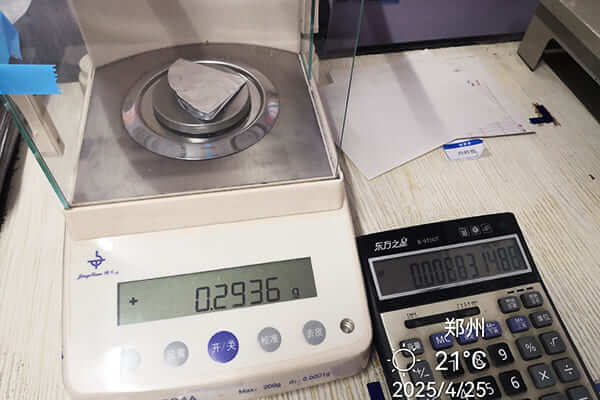
Aluminum foil thickness measurement
| Feature | 8079 | 8011 | 1235 |
|---|---|---|---|
| Purity (Al %) | 99.1–99.7 | 98.6–99.3 | ≥ 99.35 |
| Tensile Strength (MPa) | 100–150 | 90–130 | 70–110 |
| Elongation (%) | 8–20 | 5–12 | 8–18 |
| Formability | Excellent | Good | Good |
| Barrier Properties | Excellent | Excellent | Excellent |
| Lamination Adhesion | Excellent | Good | Good |
| Pinholes (per m²) | < 10 | < 20 | < 15 |
| Cost Index | ●●● | ●● | ●● |
| Typical Application | High-end lamination, pharma, pouch | Lidding, container foil | Low-cost packaging |
Summary:
8079 foil provides the best balance of strength, flexibility, and process yield — especially for thin-gauge lamination.
Its optimized composition allows higher rolling reduction and lower defect rate, translating into improved productivity.
Modern packaging lines demand materials that can withstand high line speeds (200–450 m/min) without tearing or wrinkling.
8079 foil delivers:
Performance Data Example:
| Test | Result | Standard |
|---|---|---|
| Lamination peel strength | ≥ 1.3 N/25 mm | ASTM D1876 |
| Sealing temperature window | 160–220 °C | Internal test |
| Air bubble rate | < 1% | Production benchmark |
In practical manufacturing, using 8079 foil can reduce lamination defect rates by 15–25% compared to 8011 foil under identical line conditions.
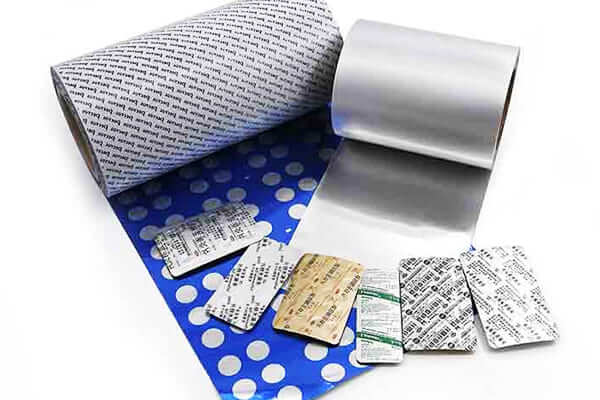
laminated aluminum foil applications
In medical blister packaging, reliability and hygiene are paramount.
8079 foil provides:
Typical structure:
PVC / PVDC + Aluminum 8079 + Heat Seal Lacquer
→ Enables airtight sealing and long shelf life (>24 months) even under high humidity.
Used for yogurt, beverage cups, and retort trays, 8079 foil combines heat resistance and peelable seal strength.
Its superior oxide film and clean surface support UV printing and embossing, while maintaining a consistent sealing temperature profile (180–210 °C).
Field data show that 8079 foil lids reduce leakage defects by up to 20% in large-volume dairy packaging operations.
In construction, 8079 aluminum foil laminated with kraft paper or fiberglass mat acts as a lightweight vapor barrier with high infrared reflectivity (~97%).
The composite improves thermal insulation performance by 15–20%, contributing to energy-efficient building materials.
| Risk | Root cause | First fixes |
|---|---|---|
| High OTR/WVTR | Pinholes, edge channeling, adhesive voids | Tighten melt filtration; audit cleaning/corona; raise coat weight; check nip pressure |
| Delamination | High oil, low dyne, under-cure | Re-corona; verify oil ≤3.0 mg·m²; adjust NCO:OH & oven profile |
| Web breaks | Camber, weak splices, roll marks | Camber spec; limit ≤3 splices/roll; improve slit edges |
| Flex-crack failure | Poor film selection; too light gauge | Switch to 8079 from 1235; add PA layer; consider 10–12 µm for rough logistics |
| Odor/light ingress | Non-opaque zones, windowing | Check full coverage in extrusion lamination; avoid neck-in gaps |
| Category | Requirement | Why it matters |
|---|---|---|
| Alloy & temper | 8079-O or 8079-H18 | Pick O for forming; H18 for handling stiffness |
| Nominal thickness | 8–12 µm (focus 9–10) | Balance yield vs. pinholes |
| Thickness tolerance | ±4–6% (1σ); peak-to-valley ≤ 8–10% | Stabilizes coat weight & register |
| Width tolerance | ±0.2–0.3 mm | Slitting/print alignment |
| Residual oil | ≤ 3.0 mg·m⁻² | Adhesion uniformity |
| Surface energy | ≥ 36–38 dynes after corona | Wet-out for adhesives |
| Pinhole density (≥0.2 mm) | Basic ≤ 80 / m²; Enhanced ≤ 40; Premium ≤ 10–20 | Direct driver of OTR/WVTR |
| Camber | ≤ 2 mm / 1,000 mm | Web tracking |
| Core/OD | 3″/6″ core; OD ≤ 1,000–1,200 mm | Line compatibility |
| Documents | COA (gauge map, dyne, oil, pinholes) | Lot-level traceability |
8079 aluminum flexible foil for lamination represents the premium choice for modern lamination and flexible packaging applications, offering superior ductility, bonding performance, and process reliability.
When manufactured under strict process control by Henan Huasheng Aluminum Co., Ltd., it delivers unmatched consistency, cleanliness, and mechanical integrity, enabling customers to achieve high-speed production, low defect rates, and longer product shelf life.
Backed by years of metallurgical expertise, Huasheng Aluminum continues to be a trusted global partner for food, pharmaceutical, and industrial foil solutions.
Q1. Why pick 8079 over 1235 at 9 µm?
Stronger and more flex-resistant under Gelbo; easier to hold premium pinhole tiers across long runs.
Q2. Will 8079 change print color or appearance?
Foil sits buried; appearance mainly comes from outer film and inks. Keep gauge variation low to stabilize coat weights and print register.
Q3. Is 8 µm safe for my snack laminate?
Yes, if your supplier can guarantee Premium pinhole and your line covers edges fully (no neck-in). Many buyers standardize on 9–10 µm for margin.
Q4. PU adhesive or extrusion lamination?
Both work. PU excels at wet-out and thin coat weights; extrusion needs attention to neck-in to avoid uncovered foil at edges.

Henan Huasheng Aluminum Co., Ltd (HHALU for short), established in 2001, is located in Huiguo Town, the famous Aluminum capital of Henan Province, It's a professional manufacturer and engages in the research, development, production, sales and service of aluminum sheet plate, aluminum coil, aluminum foil, aluminum strip and aluminum circle.
In addition, HHALU also sell aluminum plate for construction and ships, aluminum mirror plate, and automotive aluminum alloy plate.
No.53, Dongming Road, Zhengzhou, Henan, China
Copyright © Huasheng Aluminum 2025. All rights reserved.
