In the critical domain of modern fluid transfer systems, piping plays a foundational role, dictating the efficiency, safety, and longevity of infrastructure ranging from plumbing and heating to industrial conduits. While traditional metal pipes (copper, steel) or plastic pipes (PPR, PEX) have long served various purposes, the demand for hybrid solutions that combine the best attributes of both has led to the widespread adoption of composite pipes. At the very heart of many high-performance composite pipes, particularly those used for potable water and heating systems, lies a specialized material: 8011 O Aluminium Strip for Composite Pipe.
This fully annealed aluminum alloy acts as a key layer, adding unique properties that boost the pipe’s overall performance.
This comprehensive article delves into the precise metallurgy, defining properties, and intricate manufacturing processes.
That collectively position 8011 O aluminium strip as an indispensable choice for modern composite pipe production, providing profound insights for pipe manufacturers, civil engineers, and material specifiers.

8011 O Aluminium Strip For Composite Pipe
Composite pipes, particularly Multi-Layer Composite (MLC) pipes (also known as PEX-AL-PEX or PERT-AL-PERT pipes), represent a significant advancement in piping technology.
They combine the best characteristics of both plastic and metal:
The core aluminum layer addresses several key limitations of all-plastic pipes:
Meeting these diverse demands efficiently and reliably is precisely where 8011 O Aluminium Strip for Composite Pipe excels.
The reliable performance of 8011 Aluminium Strip for Composite Pipe begins with its meticulously engineered chemical composition and its specific, fully annealed temper.
8011 belongs to the 8xxx series of aluminum alloys, specifically optimized for foil and strip applications due to its excellent balance of strength and formability.
| Element | Percentage (%) |
|---|---|
| Aluminum (Al) | 97.0 – 99.0 |
| Iron (Fe) | 0.60 – 1.00 |
| Silicon (Si) | 0.50 – 0.90 |
| Copper (Cu) | ≤ 0.10 |
| Manganese (Mn) | ≤ 0.20 |
| Magnesium (Mg) | ≤ 0.05 |
| Zinc (Zn) | ≤ 0.10 |
| Titanium (Ti) | ≤ 0.08 |
| Other Elements | ≤ 0.15 (each) |
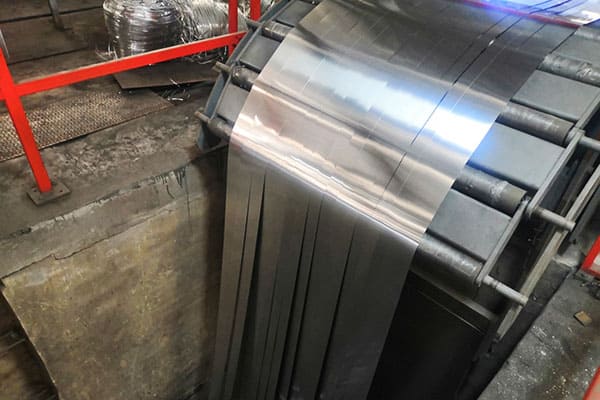
Production of Aluminium Strip
The precise engineering of 8011 O Aluminium Strip for Composite Pipe results in a suite of defining properties that provide critical solutions for high-performance composite piping.

Huasheng 8011 Aluminium Strip
The table below presents typical mechanical properties for 8011-O Aluminium Strip for Composite Pipe, reflecting its fully annealed, highly ductile state.
| Property | Unit | Typical Value for 8011-O Strip |
| Tensile Strength | MPa (ksi) | 100 – 145 (15 – 21) |
| Yield Strength | MPa (ksi) | 40 – 90 (6 – 13) |
| Elongation (% in 50mm) | % | 20 – 30 |
| Brinell Hardness | HB | 28 – 45 |
| Density | g/cm³ | 2.71 |
| Thermal Conductivity | W/m·K | ~160 |
| Coefficient of Thermal Expansion | /°C | ~23 x 10^-6 |
Note:
These values are typical ranges for annealed material.
Actual properties can vary slightly based on strip thickness and specific manufacturing processes. For critical applications, always consult certified Material Test Reports (MTRs).
The structure of an aluminum-plastic composite pipe typically consists of multiple layers, combining the benefits of both aluminum and plastic materials.
The pipe is designed for durability, flexibility, and corrosion resistance. Below is the layered structure:

The structure of aluminum-plastic composite pipe
The production of Multi-Layer Composite (MLC) pipe using 8011 O Aluminium Strip is a precise, continuous extrusion and bonding process:
This highly automated process ensures strong, durable bonds between all layers, creating a high-performance, multi-functional pipe.
The integration of 8011 O Aluminium Strip for Composite Pipe delivers a spectrum of critical benefits that directly impact pipe performance, installation efficiency, and system longevity.
Understanding how Composite Pipe (with 8011 O Aluminium Strip core) compares to alternative piping materials highlights its distinct advantages.
| Feature | MLC Pipe (PEX-AL-PEX) | All-Plastic Pipe (e.g., PEX) | Copper Pipe | Steel Pipe |
| Oxygen Barrier | Absolute (due to Al core) | Poor (permeable, causes corrosion in systems) | Good | Good |
| Shape Retention (after bending) | Excellent (holds shape) | Poor (springs back) | Excellent (holds shape) | Excellent (holds shape) |
| Thermal Expansion | Very Low (Al reduces plastic CTE by ~75%) | Very High | Low | Low |
| Corrosion Resistance | Excellent (plastic layers protect Al) | Excellent (no corrosion) | Good (but can corrode from aggressive water) | Poor (prone to rust, requires coating) |
| Flexibility | Good (can be hand-bent) | Excellent (very flexible) | Poor (requires bending tools, fittings for changes) | Poor (requires bending machines, welding for changes) |
| Ease of Installation | Excellent (hand-bend, holds shape) | Good (flexible, but springs back) | Moderate (fittings, soldering/brazing) | Difficult (heavy, welding, threading) |
| Cost | Moderate | Low | High | Moderate |
| Weight | Lightweight | Very Lightweight | Heavy | Very Heavy |
| Primary Use | Plumbing, heating (radiators, underfloor) | Plumbing, radiant heating | Potable water, heating | Industrial, structural, gas |
Insight: This comparison clearly shows that MLC pipe with an 8011 O Aluminium Strip core uniquely combines the flexibility and corrosion resistance of plastic with the strength, oxygen barrier, and shape retention of metal, offering a superior solution for many modern plumbing and heating applications.
The uncompromising demands of composite pipe manufacturing necessitate the highest standards of quality assurance for 8011 O Aluminium Strip for Composite Pipe.
From raw coil production to final annealing and slitting, a robust QA system is non-negotiable.
For pipe manufacturers and large-scale construction projects, sourcing from technically proficient and quality-driven aluminum suppliers is indispensable.
Huasheng (Henan Huasheng Aluminum Co., Ltd.), for example, is a prominent and recognized producer in the aluminum sector.
Companies like Henan Huasheng Aluminum leverage state-of-the-art rolling mills, advanced metallurgical controls, and stringent quality assurance processes to manufacture a comprehensive range of high-performance aluminum, including 8011 O Aluminium Strip.
Their commitment to precise alloying, consistent mechanical properties, superior surface quality, and adherence to relevant industry standards ensures that their materials meet the rigorous demands of composite pipe production globally.
This foundational quality provided by suppliers like Henan Huasheng Aluminum is critical for enabling the manufacture of robust, reliable, and energy-efficient piping systems that serve modern infrastructure.
Q1: What is the main purpose of the 8011 aluminum strip in a composite pipe?
A1: The 8011 aluminum strip provides an absolute oxygen barrier (crucial for heating systems), enables the pipe to retain its shape after bending (for easier installation), significantly reduces thermal expansion, and enhances the pipe’s strength and pressure resistance.
Q2: Why is the “O” (annealed) temper specifically required for this aluminum strip?
A2: The “O” temper ensures maximum ductility and formability.
This is critical because the aluminum strip must continuously form into a cylinder, with its edges welded, bonded, or overlapped, without cracking or tearing during high-speed pipe manufacturing.
Q3: Does the aluminum core prevent corrosion inside the pipe?
A3: Yes, the aluminum core itself resists corrosion. More importantly, it acts as an oxygen barrier, preventing oxygen from permeating through the plastic layers and causing corrosion in metal components (like boilers and radiators) within the connected heating system.
Q4: Is composite pipe with an aluminum core easier to install than plastic-only pipe?
A4: Yes. The aluminum core allows the composite pipe to be easily bent by hand and, crucially, to hold its shape, unlike all-plastic pipes that spring back.
This significantly simplifies routing and reduces the number of fittings required, speeding up installation.
Q5: Are these composite pipes suitable for both hot and cold water applications?
A5: Yes. The combination of plastic layers (PEX or PERT) for temperature resistance and an aluminum core for stability makes MLC pipes ideal for hot and cold water and heating systems.
The strategic deployment of 8011 O Aluminium Strip for Composite Pipe represents a foundational pillar of modern fluid transfer infrastructure, embodying an unwavering commitment to efficiency, safety, and longevity.
This precisely engineered aluminum strip, with its unparalleled combination of absolute oxygen barrier properties, exceptional shape retention, reduced thermal expansion, and enhanced strength, serves as an indispensable core for multi-layer composite pipes.
From optimizing residential plumbing and heating systems to ensuring robust industrial conduits, 8011 O aluminium strip consistently delivers reliable performance and drives innovation.
Supported by rigorous quality assurance and the advanced manufacturing capabilities of leading suppliers, 8011 O Aluminium Strip for Composite Pipe will undoubtedly continue to be an essential material, shaping the future of piping technology and contributing significantly to more sustainable and efficient infrastructure worldwide.

Henan Huasheng Aluminum Co., Ltd (HHALU for short), established in 2001, is located in Huiguo Town, the famous Aluminum capital of Henan Province, It's a professional manufacturer and engages in the research, development, production, sales and service of aluminum sheet plate, aluminum coil, aluminum foil, aluminum strip and aluminum circle.
In addition, HHALU also sell aluminum plate for construction and ships, aluminum mirror plate, and automotive aluminum alloy plate.
No.53, Dongming Road, Zhengzhou, Henan, China
Copyright © Huasheng Aluminum 2025. All rights reserved.
