Ntsuni, durabilidad, and operational efficiency are paramount in the design and manufacturing of modern public transportation.
The flooring of a bus, a component subjected to immense daily stress, plays a critical role in all three aspects. Consequently, the choice of flooring material is a decision of significant engineering importance.
Anti-slip aluminum plates, particularly those made from 3003 y 5052 alloys, have emerged as a premier solution, offering an exceptional blend of safety, longevidad, and lightweight performance.
This guide provides a deep dive into the world of 3003/5052 anti-slip aluminum plates for buses, exploring the nuances of each alloy, their manufacturing quality, and their distinct advantages over traditional materials.
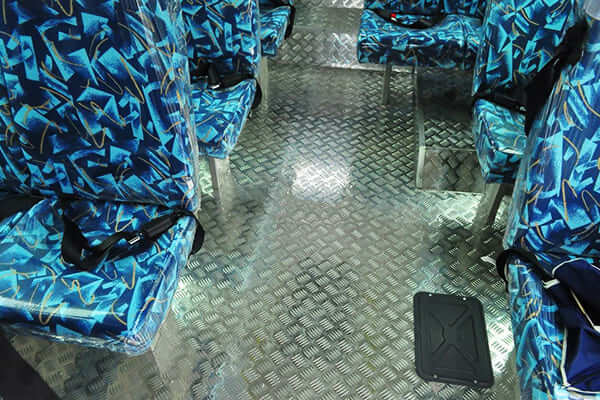
3003/5052 Anti-slip aluminum plates for buses
At its core, an anti-slip aluminum plate, often called a checker plate or tread plate, is a flat aluminum sheet with a raised, repeating pattern on one side.
This pattern is not merely aesthetic; it is engineered to increase the coefficient of friction, thereby significantly reducing the risk of slips and falls, especially in wet or demanding conditions.
The most common patterns you will encounter include:
Five-Bar Pattern: The most popular choice for vehicle flooring, offering multi-directional grip.
Diamante (or Propeller) Hmu: A classic design providing excellent traction.
Three-Bar and Two-Bar Patterns: Variations offering different aesthetic and grip characteristics.
The effectiveness of these plates lies in the way the raised bars or diamonds create channels for water to disperse and provide solid contact points for footwear.
While both are excellent materials, 3003 y 5052 aluminum alloys possess distinct metallurgical properties that make them suitable for different levels of demand.
3003 aluminio belongs to the 3xxx series, where manganese is the primary alloying element (típicamente 1.0-1.5%).
This addition enhances its strength by about 20% over pure aluminum (1100 serie) while retaining excellent corrosion resistance and formability.
Key Strengths: Superb corrosion resistance, Hño trabajabilidad, Fuerza moderada, and cost-effectiveness.
Typical Temper for Plates: H22 or H14, indicating it is strain-hardened and partially annealed for optimal formability.
5052 aluminio is part of the 5xxx series, with magnesium (típicamente 2.2-2.8%) as its primary alloying element.
The presence of magnesium results in significantly higher strength than the non-heat-treatable 3xxx series alloys.
Key Strengths: Excellent strength (the highest among common non-heat-treatable grades), outstanding corrosion resistance (ja entornos marinos ne industriales), and good weldability.
Typical Temper for Plates: H32 or H34, indicating it is strain-hardened and stabilized for long-term strength.
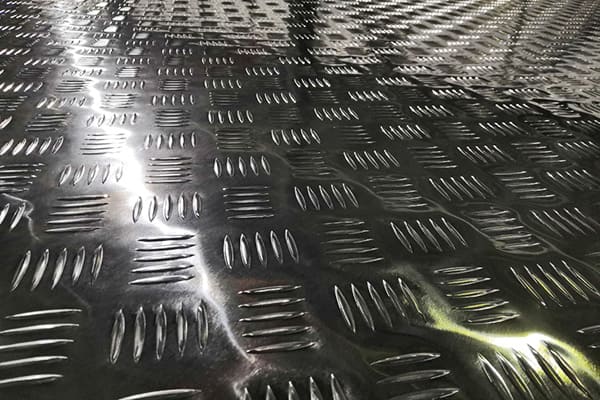
Huasheng Anti-slip aluminum plates
To make an informed decision, a direct comparison of their mechanical properties is essential. The following data represents typical values for these alloys in common tempers used for anti-slip plates.
| Ha̲i | 3003-H22 Aluminum Alloy | 5052-H32 Aluminum Alloy | Insight for Bus Application |
| Resistencia ar tracción (Ngäts'i) | ~150 MPa (22,000 Psi) | ~228 MPa (33,000 Psi) | 5052 is over 50% stronger. This is critical for resisting dents from heavy luggage, wheelchairs, and long-term structural fatigue from millions of passenger steps. |
| Límite elástico | ~124 MPa (18,000 Psi) | ~193 MPa (28,000 Psi) | 5052 has a 55% higher yield strength. This means it can withstand more force before permanent deformation (denting) occurs, preserving the floor’s integrity. |
| Resistencia ar corrosión | Excelente | Excelente (Superior in saltwater/industrial) | Both are highly resistant to cleaning chemicals and moisture. 5052’s superiority offers an extra margin of safety against road salts and harsh detergents. |
| Conformabilidad (Workability) | Excelente | Xi hño | 3003 is slightly easier to bend and form, which can be an advantage when fitting plates around complex wheel arches or steps, potentially reducing fabrication time. |
| Soldabilidad | Xi hño | Excelente | Both can be welded, pe 5052 is generally preferred for structural welds, offering higher strength in the welded zone. |
| Relative Cost | Ar ñäñho | Mäs xi ngu | 3003 offers a significant upfront cost saving. The choice depends on balancing initial budget with long-term durability and lifecycle cost. |
The Verdict for Bus Flooring:
Mente 3003 anti-slip aluminum plate is a perfectly viable and cost-effective solution for lower-traffic areas or shuttle buses, 5052 anti-slip aluminum plate is unequivocally the superior choice for high-traffic urban buses.
Its substantially higher strength and durability directly translate to a longer service life, reduced maintenance, and a greater resistance to the daily abuse of public transit.
The modest increase in initial cost is often justified by a lower total cost of ownership.
Choosing the right alloy is only part of the equation. The quality of the anti-slip plate itself—uniformity of thickness, precision of the pattern, and adherence to metallurgical standards—is equally critical. This is where partnering with a reputable supplier becomes essential.
Ngu, a supplier like Aluminio Huasheng distinguishes itself by not only offering a comprehensive range of 3003 y 5052 anti-slip plates but also by adhering to stringent quality control protocols.
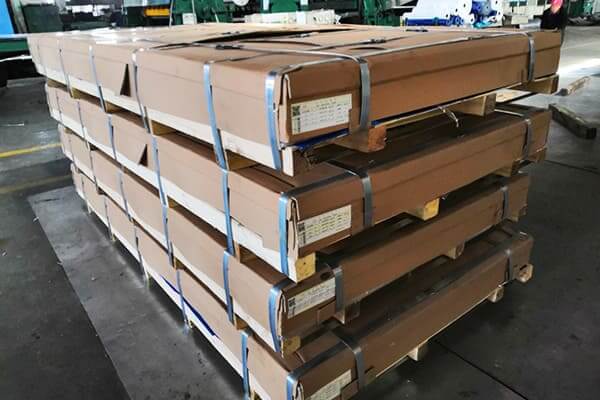
Packaged aluminum plates by Huasheng
They provide material certifications that trace the chemical composition and mechanical properties of each batch, ensuring the material you specify is the material you receive.
For automotive applications, seeking a supplier with experience and certifications like IATF 16949 can provide an additional layer of confidence in their process control and product consistency.
A high-quality plate from a trusted source like Huasheng Aluminum ensures that the pattern provides consistent grip and the material performs to its full engineering potential.
To fully appreciate the benefits of aluminum, it’s helpful to compare it with other common flooring solutions.
vs. Steel Checker Plate:
Be̲xu: Aluminum is approximately one-third the weight of steel. For a bus, this translates directly to improved fuel efficiency and lower emissions over the vehicle’s lifespan.
Corrosión: Steel will rust if its protective coating is scratched, whereas aluminum naturally forms a protective oxide layer, making it far more resistant to corrosion from moisture and road salt.
vs. Rubber or Vinyl Flooring:
Durabilidad: Aluminum plate offers vastly superior resistance to tearing, gouging, and abrasion from heavy foot traffic, luggage wheels, and strollers.
Hygiene & Nja: The non-porous surface of aluminum is easier to clean thoroughly and is less likely to harbor bacteria or odors compared to worn or cracked rubber/vinyl.
Resistencia ar tsibi: Aluminum is non-combustible, a significant safety advantage in public transportation.
To maximize the life and performance of your aluminum flooring:
Ensure a Solid Subfloor: Install the plates on a level and structurally sound subfloor to prevent flexing and noise.
Use Appropriate Fasteners: Utilize stainless steel or properly coated fasteners to prevent galvanic corrosion where the fastener contacts the aluminum.
Regular Cleaning: Clean with neutral pH detergents. Avoid highly acidic or alkaline cleaners that can stain the aluminum over time.
Inspect Regularly: Periodically check fasteners and seams to ensure the floor remains secure.
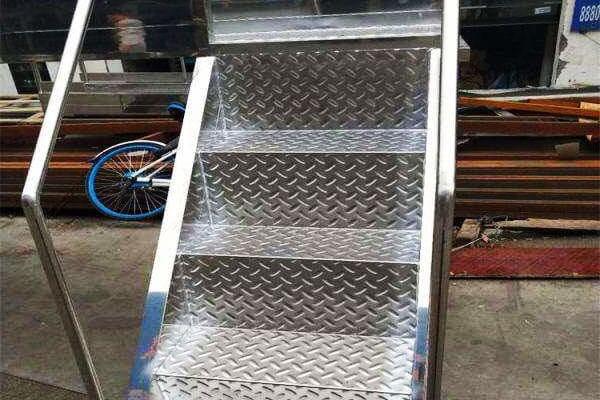
Nt'ot'e ar 3003/5052 Anti-slip aluminum plates
The choice between 3003 y 5052 anti-slip aluminum plates for buses is a strategic one. For applications where budget is the primary driver and traffic is moderate, ar 3003 alloy provides a reliable and corrosion-resistant surface. 'Ñotho ar embargo, for the demanding environment of modern urban transit, the superior strength, durabilidad, and lifecycle value of the 5052 aleación make it the clear engineering choice.
By selecting the appropriate high-quality aluminum alloy and partnering with a reputable supplier, bus manufacturers are not just installing a floor; they are making a long-term investment in passenger safety, operational efficiency, and the overall durability of their fleet.
1. What is the best pattern for bus flooring?
The five-bar pattern is generally considered the industry standard for vehicle applications as it provides excellent multi-directional slip resistance.
2. What thickness of aluminum plate should be used for a bus floor?
The required thickness depends on the subfloor support structure and the expected load.
Common thicknesses range from 2.0mm to 4.5mm (including the pattern height). A thicker plate, such as 3.0mm base thickness, is often specified for high-traffic areas.
3. Can anti-slip aluminum plates be anodized or painted?
Hä. Anodizing can significantly increase the surface hardness and corrosion resistance, and it also allows for coloring.
Painting or powder coating is also possible, but it may wear down over time in high-traffic areas, compromising the anti-slip properties.
4. How is the pattern height measured?
The total thickness of a checker plate includes the base plate thickness plus the height of the raised pattern.
It is important to specify whether a quoted thickness refers to the base or the total height.
5. Does the shiny finish of new aluminum create glare?
The embossed pattern of an anti-slip plate naturally diffuses light, significantly reducing glare compared to a flat, polished aluminum sheet.
Over time, the surface will also develop a natural, matte patina.

Henan Huasheng Aluminio Co., Ltd (HHALU pa abreviar), establecida jar 2001, o jar Dähnini Huiguo, ar famosa capital ar aluminio ar provincia Henan, Ge 'nar fabricante xi hño ar tsa̲ ne da dedica ár nthoni, nte, producción, sales and service of aluminio placa chapa, bobina aluminio, he̲'mi aluminio, Tira aluminio ne círculo aluminio.
'Nehe, HHALU 'nehe vende placas aluminio pa ár nju̲ts'i ne ya barko, placa espejo aluminio, ne placa aleación aluminio automotriz.
No.53, 'Ñu Dongming, Zhengzhou, Henan, Ntxinä
'Mui autor © Huasheng Aluminium 2025. Nga̲tho ya mfats'i reservados.
