5083 Aluminum Sheet for Ship Keel has become a critical structural material in modern marine engineering due to its exceptional balance of strength, corrosion resistance, and lightweight performance.
The keel—the longitudinal backbone of a vessel—must endure static loads from the hull, dynamic wave-induced stresses, localized impacts, and long-term exposure to seawater.
Selecting the right material therefore directly influences a ship’s structural integrity, operational efficiency, and lifecycle costs.
Compared with traditional shipbuilding steels, 5083 aluminum offers up to 50–60% weight reduction, excellent resistance to seawater-induced pitting and stress corrosion, and superior weldability for large, continuous keel assemblies.
These features have made 5083 not only a preferred alloy for high-speed craft, ferries, and naval vessels but also an increasingly attractive choice for commercial and recreational ships seeking optimized performance and sustainability.
This article provides an in-depth analysis of the material science, mechanical behavior, manufacturing processes, application-specific performance, and engineering considerations that make 5083 aluminum sheet a leading solution for ship keel construction.
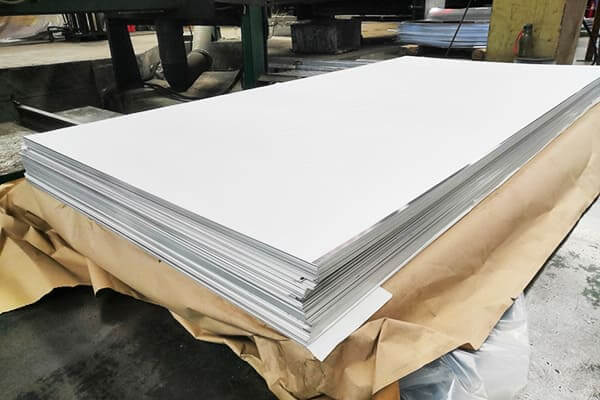
Huasheng 5083 H116 Aluminum Sheet
5083 is an Al–Mg alloy. Typical composition by weight:
Engineering significance: the relatively high Mg content gives solid-solution strengthening and excellent resistance to seawater pitting and stress-corrosion cracking (SCC) relative to many other Al alloys.
Values vary with temper, thickness and supplier; these are representative ranges used in design practice.
| Property | Typical value (representative) |
|---|---|
| Density | ≈ 2,700 kg/m³ |
| Young’s Modulus (E) | ≈ 69 GPa |
| Tensile strength (Rm) | 275 – 350 MPa |
| Yield strength (0.2% Rp0.2) | 140 – 250 MPa (temper dependent) |
| Elongation at break (A) | 8 – 20% |
| Fatigue behavior | No infinite endurance limit — life-based S–N design |
| Thermal conductivity | ~ 120 – 140 W/m·K |
| Melting range | ~ 645 – 650 °C |
Quick design note (stiffness example): Elastic modulus of steel ≈ 210 GPa; for equal geometry, steel is ≈3× stiffer than aluminum (210/69 ≈ 3.04).
To recover the same bending stiffness by geometry alone requires increasing the aluminum section modulus — usually by increasing thickness or adding stiffeners. See worked example in §3.
5083 aluminum sheet is non-heat-treatable; strength comes from solid solution of Mg in Al plus strain hardening.
Controlled rolling and thermo-mechanical processing produce a fine, uniform grain structure and dispersed intermetallic particles (Al–Fe, Al–Mn).
Good melt and casting control are important: elongated inclusions or stringers produced by poor casting/rolling can initiate fatigue cracks and pinholes.

Huasheng 5083 Aluminum Sheet Thickness test
Specification practice: many yards specify 5083-H116 for major submerged structural components (keel, bilges, frames) because it offers a practical mix of strength, weld performance and corrosion resistance.
5083 aluminum sheet exhibits industry-leading corrosion resistance in marine environments, outperforming most aluminum alloys and even some steels. Key metrics include:
When exposed to seawater, 5083 forms a dense, adherent Al-Mg oxide layer that self-heals if damaged, providing long-term protection for submerged keel components.
With a strength-to-weight ratio of ~116 MPa/(g/cm³) (H116 temper), 5083 aluminum sheet is 40% more efficient than carbon steel (79 MPa/(g/cm³)) and 25% more efficient than 6061 aluminum (93 MPa/(g/cm³)).
This translates to significant weight savings for ship keels: a 10-meter keel section made from 5083 (20 mm thickness) weighs ~532 kg, compared to 1570 kg for equivalent steel—reducing total vessel weight by 6–8% (depending on keel size).
Weight reduction directly improves fuel efficiency, with every 1% weight cut lowering fuel consumption by ~0.5–0.8% (per IMO maritime efficiency data).
Ship keels require robust, defect-free welds to transfer loads between the keel and hull. 5083 aluminum sheet is highly weldable using common marine techniques:
Post-weld mechanical testing shows that 5083 welds retain 80–90% of the base metal’s fatigue strength, ensuring long-term structural integrity under cyclic wave loads.

5083 Aluminum Sheet for Ship Keels
Ship keels endure cyclic stresses from waves and vessel motion, making fatigue resistance critical. 5083 aluminum sheet in H116 temper exhibits a fatigue strength of ~110 MPa at 10⁷ cycles (ASTM E466), which is 30% higher than 5052 aluminum and comparable to mild steel.
Naval architecture simulations show that 5083 keels have a fatigue life of 25–30 years in offshore service, matching or exceeding the design life of most commercial vessels.
Producing 5083 aluminum sheet for ship keels requires precision control to meet marine-grade quality standards. The process involves seven key stages:
High-purity aluminum ingots and master alloys (Mg, Mn, Cr) are melted in a gas-fired or electric furnace at 720–750°C.
The molten alloy is degassed with argon to remove hydrogen (preventing porosity) and filtered through 60–80 pore ceramic foam filters.
It is cast into 50–70 mm thick slabs via direct chill (DC) casting, which ensures uniform alloy distribution and minimizes segregation.
Slabs are homogenized at 450–480°C for 8–12 hours to dissolve intermetallic phases and reduce compositional variations.
This step improves ductility and ensures consistent mechanical properties during rolling.
Homogenized slabs are heated to 400–450°C and hot-rolled into 3–6 mm thick coils.
Hot rolling breaks down the coarse cast microstructure into a refined, workable grain structure, reducing thickness while improving strength.
For H116 temper (stabilized for marine use), hot-rolled coils undergo 15–20% cold rolling to achieve the target thickness (typically 6–25 mm for ship keels).
Cold rolling increases yield strength and hardness without compromising corrosion resistance.
Cold-rolled sheets are annealed at 100–150°C for 2–4 hours to relieve residual stresses and stabilize the microstructure.
This step ensures dimensional stability in the marine environment, preventing warping after keel installation.
Sheets are cleaned to remove oxide scale and contaminants.
For enhanced corrosion protection, they may undergo chemical conversion coating (e.g., chromate-free Alodine) or anodizing (20–50 μm thick) before shipment to shipyards.
Sheets undergo rigorous testing: ultrasonic inspection (ASTM E280) for internal defects, tensile testing (ASTM E8) for mechanical properties, and corrosion testing (ASTM G44) for seawater resistance.
Thickness tolerance is controlled to ±0.5 mm (ASTM B209) for keel applications.
Common on patrol boats, high-speed ferries, workboats — often as welded plate panels with internal stiffeners.
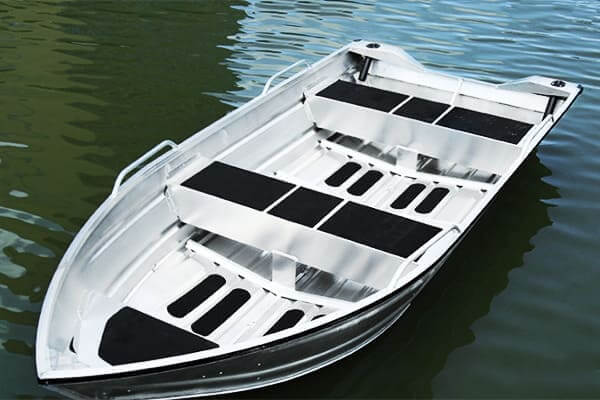
5083 Aluminum Sheet for Ship Hull
Reduces top weight; improves stability and fuel economy.
Fuel tanks, fresh water tanks and bulkheads often use 5083 where corrosion resistance is important.
| Property / Material | 5083 Aluminum | 5086 Aluminum | 6061 Aluminum | Mild Steel (A36) | AH36 Marine Steel | FRP (Composite) |
|---|---|---|---|---|---|---|
| Density (g/cm³) | 2.66–2.70 | 2.65–2.70 | 2.70 | 7.85 | 7.85 | 1.6–2.0 |
| Weight vs Steel | ~65% lighter | ~65% lighter | ~65% lighter | Baseline | Baseline | ~75% lighter |
| Tensile Strength | 275–350 MPa | 240–300 MPa | 260–310 MPa | ~400–550 MPa | 490–620 MPa | 100–300 MPa |
| Yield Strength | 125–250 MPa | 110–240 MPa | 240–270 MPa | ~250 MPa | 355 MPa | 50–200 MPa |
| Corrosion Resistance (Seawater) | Excellent | Excellent | Moderate / Poor | Poor (requires coating) | Moderate (requires coating) | Excellent |
| Weldability | Excellent (ER5356/ER5183 fillers) | Excellent | Moderate (heat-affected cracking risk) | Good | Good | Difficult / specialized |
| Stiffness (Elastic Modulus) | 69 GPa | 69 GPa | 69 GPa | 210 GPa | 210 GPa | 20–30 GPa |
| Cost (Material) | Medium | Medium | Medium | Low | Medium–High | High |
| Maintenance Requirements | Low | Low | Medium | High (rust prevention) | High | Low |
| Service Life in Marine Environments | > 20–30 years | 20–30 years | < 20 years | 15–25 years | 20–30 years | 20–40 years |
| Fatigue Resistance | High | High | Moderate | High | High | Moderate |
| Recyclability | 100% recyclable | 100% | 100% | 100% | 100% | Low–medium (complex recycling) |
| Suitability for Ship Keels | Excellent | Very Good | Fair | Good (heavy) | Very Good (heavy) | Limited (high cost, rigidity issues) |
5083 aluminum sheets for ship keels must meet stringent marine industry standards:
Shipyards typically require mill test reports (MTRs) per EN 10204 3.1B, verifying chemical composition, mechanical properties, and corrosion performance for each batch of 5083 sheets.
5083 aluminum sheet is a superior material for ship keel construction, offering an unrivaled combination of seawater corrosion resistance, high strength-to-weight ratio, weldability, and fatigue performance.
Its unique chemical composition—dominated by magnesium and reinforced with manganese and chromium—delivers the durability required for submerged keel components, while its lightweight nature improves vessel fuel efficiency and maneuverability.
Compared to steel and other aluminum alloys, 5083 provides the optimal balance of performance, cost, and sustainability for marine applications.
As the shipping industry evolves toward greener, more efficient vessels, 5083 aluminum sheet will remain a cornerstone material for ship keel design, enabling safer, longer-lasting, and more environmentally friendly marine transportation.
Q: What is the typical thickness range of 5083 aluminum sheet for ship keels?
A: 6–25 mm: 6–12 mm for small recreational/commercial vessels, 12–20 mm for offshore support vessels, 15–25 mm for military and large commercial ships.
Q: Can 5083 aluminum keels be repaired if damaged?
A: Yes. Minor cracks or dents can be welded using 5356 filler wire, and damaged sections can be cut and replaced—maintaining structural integrity if repaired by certified marine welders.
Q: How long does a 5083 aluminum keel last in seawater?
A: With proper design and cathodic protection, 5083 keels have a service life of 25–30 years, matching the design life of most commercial vessels.
Q: Is 5083 aluminum sheet suitable for ice-class ship keels?
A: Yes. In H116 temper, it exhibits good low-temperature toughness (Charpy impact energy ≥20 J at -20°C), making it suitable for ice-class vessels operating in polar regions.
Q: How does 5083 compare to 5086 aluminum for ship keels?
A: 5086 has lower magnesium content (3.5–4.0%) than 5083, resulting in slightly lower strength (tensile: 290–350 MPa) but similar corrosion resistance. 5083 is preferred for keels requiring higher load-bearing capacity.

Henan Huasheng Aluminum Co., Ltd (HHALU for short), established in 2001, is located in Huiguo Town, the famous Aluminum capital of Henan Province, It's a professional manufacturer and engages in the research, development, production, sales and service of aluminum sheet plate, aluminum coil, aluminum foil, aluminum strip and aluminum circle.
In addition, HHALU also sell aluminum plate for construction and ships, aluminum mirror plate, and automotive aluminum alloy plate.
No.53, Dongming Road, Zhengzhou, Henan, China
Copyright © Huasheng Aluminum 2025. All rights reserved.
