| Ha̲i | Hmädi |
| Estándar | ASTM B209, JA 573-3, JA 485-2, AMS QQ — A — 250 YÁ 11 |
| Espesor | 0.2mm – 500mm |
| Ancho | Asta ar 2650 ar mm |
| Largura | Personalizar |
| Acabado superficial | Ju̲ni, Cepillado, Anodizado, ko recubrimiento jar polvo |
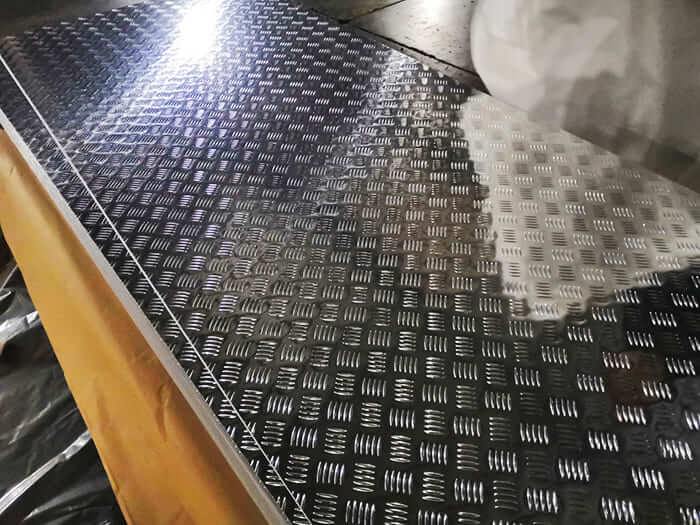
5754 aluminum tread checkered plate is a patterned aluminium plate produced from the 5754 alloy and supplied in a range of gauges and tread patterns (diamond/lozenge, 3-barra xí, 5-barra xí, round bosses).
Engineers design the product to deliver slip resistance, localized stiffness, and visual durability. Users commonly apply it to ship and boat decks, stair treads, vehicle flooring, access platforms, industrial walkways, and architectural finishes that demand corrosion resistance, Soldabilidad, and anti-slip performance.
This article gives designers and procurement teams practical, engineering-oriented information: composition and mechanical behavior, corrosion performance, manufacturing and surface pattern parameters, benefits and limitations, Aplicaciones, and how 5754 tread plate compares with alternative materials.
5754 Aluminum Tread Checkered Plate
Ar 5754 aleación aluminio is an aluminium–magnesium alloy (5xxx family). Typical composition ranges (be̲xu %) used for selection and specification are shown below.
Require Mill Test Certificates (MTCs) for acceptance values on every lot.
| 'Nar 'mu̲ | Typical range (wt%) |
|---|---|
| Ya ar (balance) | Equilibrar |
| Mg (magnesio) | 2.6 – 3.6 |
| Mn (manganeso) | 0.3 – 0.6 |
| Hää (silicio) | ≤ 0.40 |
| Nt'eme (hierro) | ≤ 0.40 |
| Cr (cromo) | ≤ 0.30 |
| Cu (cobre) | ≤ 0.10 |
| Zn (zinc) | ≤ 0.20 |
| Nu'i, others | Trace / controlled (≤ 0.15 Nu'bu̲) |
Notas: magnesium is the principal strengthening element and also contributes to seawater resistance. 5754 contains more Mg than 3003/1100 series and slightly less than high-strength marine alloys such as 5083.
Mechanical values depend strongly on temper and thickness. The table below provides representative engineering ranges for common tempers used in tread plate (H22, H111/H116 variants are used depending on mill practice and application):
| Ha̲i | Typical range (representative) |
|---|---|
| 0.2% proof / Rendimiento (Mpa) | ~120 – 185 |
| Ultimate tensile strength (UTS, Mpa) | ~220 – 290 |
| Alargamiento (%) | ~7 – 15 |
| Dureza Brinell (HB) | ~55 – 75 |
| Young’s modulus (E) | ≈ 69 GPa |
| Densidad | ≈ 2.66 – 2.70 g/cm³ |
Design advice: use the supplier’s guaranteed minima for strength design and verify temper (H22, H114, H116 etc.) on drawing callouts. For fatigue-sensitive or heavy structural decks prefer higher-strength 5xxx grades (hne ej.., 5083).
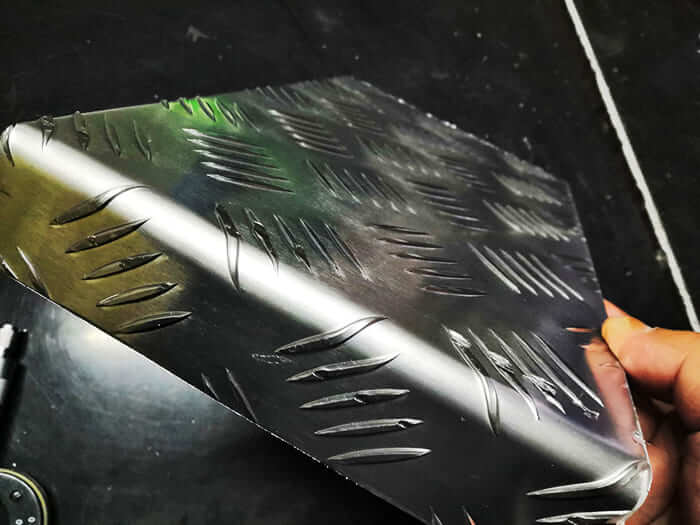
Bending test of 5754 Hoja aluminio
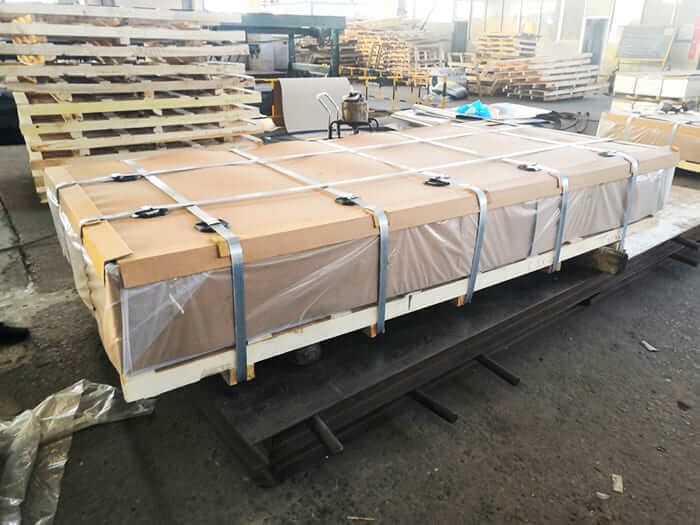
Huasheng Packaged 5754 Hoja aluminio
5754 aluminum tread checkered plate offers a well-balanced combination of mechanical performance, Resistencia ar corrosión, and functional surface design, making it a preferred material for marine, industrial, and transportation applications. Its key advantages include the following:
As an Al–Mg alloy, 5754 demonstrates strong resistance to atmospheric corrosion, seawater spray, and humid coastal conditions.
The naturally forming aluminum oxide film protects the surface from pitting and general corrosion, significantly extending service life in marine and offshore applications compared with carbon steel.
With a density of approximately 2.7 g/cm³ and tensile strength typically ranging from 220 Pa 290 Mpa (depending on temper), 5754 aluminum tread plate provides reliable structural performance while remaining substantially lighter than steel.
This advantage helps reduce overall structural weight, improving fuel efficiency and payload capacity in ships and vehicles.
The raised tread or checkered pattern (such as diamond, 3-barra xí, or 5-bar designs) enhances surface friction and slip resistance.
This feature is critical for walkways, Cubiertas, 'rede, and ramps, especially in wet, oily, or high-traffic environments, reducing the need for additional anti-slip coatings.
5754 aluminum tread checkered plate maintains good ductility and can be bent, cut, estampillado, and formed with standard fabrication equipment.
Compared with higher-magnesium alloys such as 5083, it offers easier forming while still maintaining sufficient strength for many structural and semi-structural uses.
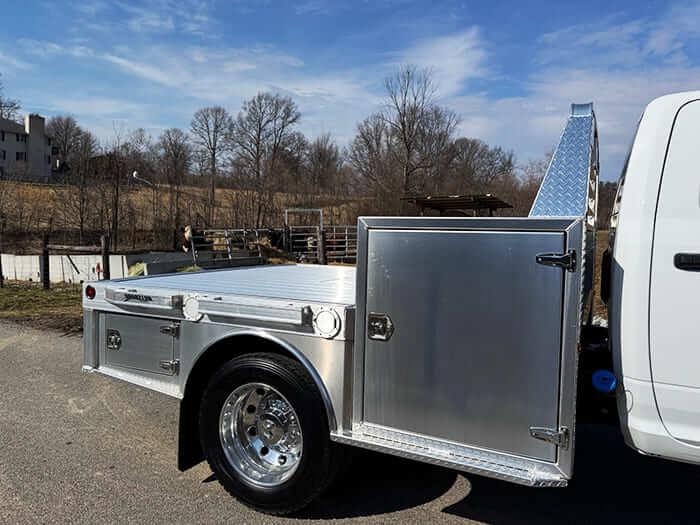
Truck Beds Used 5754 Placa aluminio
The alloy is highly compatible with common welding methods, da 'ñent'i soldadura MIG ne TIG.
Welded joints exhibit good mechanical integrity and corrosion resistance when proper filler metals and procedures are used, enabling efficient fabrication and on-site installation.
Thanks to its corrosion resistance and durable surface pattern, 5754 aluminum tread plate requires minimal maintenance over its lifetime.
This reduces inspection frequency, coating costs, and downtime, leading to lower overall lifecycle costs.
Ar aluminio ge 100% recyclable without loss of properties. Recycling aluminum consumes up to 95% less energy than primary production, fabricación 5754 aluminum tread checkered plate an environmentally responsible choice for modern engineering and construction projects.
5754 tread/checkered plate is widely used wherever a combination of anti-slip performance, Resistencia ar corrosión, weldability and low weight is required.
Below I list the principal application areas, give practical specification guidance (typical thickness/temper, pattern types and installation notes), and offer short worked examples you can use in design or procurement.
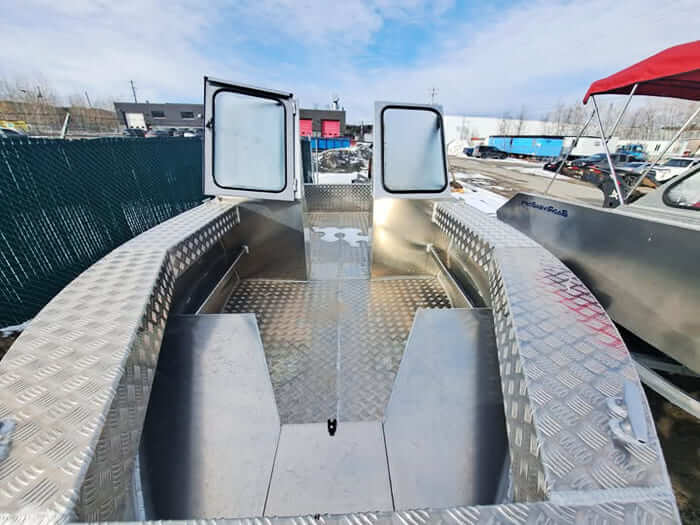
Why used: very good seawater/splash resistance, light weight and excellent weldability for ship superstructures, stairways and non-primary decks.
Espesor típico: 2.0–6.0 mm (2–4 mm for pedestrian decks; 4–6 mm for heavy foot-traffic or light service vehicles).
Typical temper: H22 / H114 / H116 depending on required formability and strength.
Hmu & boss height: diamond or 3-bar; boss height 0.8–1.6 mm.
5754 Aluminum Tread Checkered Plate for Decks
Why used: corrosion resistance and lower topside mass reduce structure costs and ease installation.
Espesor típico: 3.0–6.0 mm, heavier if vehicle access is required.
Hmu: 3-bar or 5-bar preferred on ramps for directional grip.
Why used: anti-slip surface, Facilidad fabricación, and resistance to industrial atmospheres (oil, mild chemicals).
Espesor típico: 2.0–4.0 mm for personnel walkways; 4.0–6.0 mm where light trolleys or pallet trucks operate.
Fastening: countersunk bolts with backing plates or blind rivets; use backing/saddles under thin sheets to prevent pull-through.
Why used: improves payload efficiency via weight reduction while providing durable anti-slip surfaces.
Espesor típico: 3.0–6.0 mm (depending on expected load: heavy forklift traffic → use thicker plate or alternative).
Hmu: diamond or 3-bar; consider welded ribs beneath the plate to increase load capacity without excessive thickness.
Wear strategy: fit replaceable sacrificial wear strips along wheel tracks.
Why used: attractive industrial look, slip resistance for public stairs and ramps, easy to finish (anodize/paint).
Espesor típico: 1.5–3.0 mm for cladding and ramps where loads are primarily pedestrian.
Finish: brushed or coated finishes for aesthetics; protective film during installation to avoid scratches.
The table below compares 5754 with commonly used alternatives.
| Ha̲i / Hñei | 5754 | 5052 | 5083 | 3003 | Stainless 316 |
|---|---|---|---|---|---|
| Alloy class | Al–Mg | Al–Mg | Al–Mg–Mn (marino) | Al–Mn | Austenitic SS |
| Typical yield (Mpa) | ~120–185 | ~110–170 | ~115–150 | ~80–110 | ~200–320 |
| UTS (Mpa) | ~220–290 | ~200–300 | ~275–350 | ~150–190 | ~520–700 |
| Seawater corrosion | Ar na za̲ | Ar na za̲ | Excelente | Xi hño | Excelente |
| Conformabilidad | Xi hño | Ar na za̲ | Fair–good | Excelente | Hingi ze̲di |
| Soldabilidad | Excelente | Excelente | Excelente | Xi hño | Xi hño |
| Wear / abrasion | Hingi ze̲di | Hingi ze̲di | Xi hño | Hingi ze̲di | Ar na za̲ |
| Relative cost | Nt'uni | Nt'uni | Mäs xi ngu | Hñets'i' | Hñets'i |
| Densidad (g/cm³) | ~2.66–2.70 | ~2.70 | ~2.66–2.70 | ~2.70 | ~7.9 |
Interpretation:
5083 is preferred for primary structural and highest seawater exposure;
5052 gives slightly better formability than 5754;
3003 is cheaper and more formable but lower strength; stainless steel offers wear and corrosion resistance but is heavy and costly.
5754 sits in a balanced mid-position for topside tread plates.
When specifying 5754 tread plate, require clear documentation and standards compliance:
Aluminio Huasheng — a manufacturer capable of delivering high-quality 5754 tread plate typically offers:
Buyer checklist: when evaluating suppliers like Huasheng Aluminum, ask for process descriptions (melt filtration, embossing roll tolerances), MTC samples, surface defect statistics and references from marine/transport projects.
5754 aluminum tread checkered plate is far more than a simple patterned sheet. It is a highly capable engineering material that offers a “no-compromise” solution for a wide range of medium- to heavy-duty applications.
It successfully bridges the gap between general-purpose and ultra-high-strength alloys, providing a unique and highly attractive combination of strength, marine-grade corrosion resistance, and excellent fabricability.
For designers and engineers seeking a durable, pädi xi hño, and lightweight material that can perform reliably under pressure, 5754 tread plate is the intelligent and strategic choice.
Q1 — Is 5754 suitable for ship hull plating?
'Nar: No — hull plating and primary structural plates generally require higher-strength marine alloys such as 5083/5086. 5754 is excellent for topsides, superstructures and non-primary decks.
Q2 — What pattern height should I choose for decking?
'Nar: Typical pattern heights range 0.8–1.8 mm. Choose lower heights where sealing/cleanability matters and higher for maximum grip under oily/rough conditions. Confirm with supplier pattern dimensions.
Q3 — Can 5754 tread plate be welded to stainless steel?
'Nar: Hä, pe isolate galvanically (insulating washers/seals) and design joints to avoid crevice corrosion. Use compatible filler metals and qualified welding procedures.
Q4 — How do I specify 5754 tread plate on a PO?
'Nar: Include alloy & atemperar (hne ej.., EN AW-5754 H22), espesor & tolerance, pattern type and boss height, sheet width/length, required MTC (JA 10204 3.1), finish, and any class-society requirements.
Q5 — What maintenance does 5754 tread plate need?
'Nar: Regular cleaning (removing salt, grit, oil), inspection of fasteners and sacrificial anodes (if used), and recoating where abrasive wear reduces thickness or protective properties.
1. Nthuts'i ñut'i 3003 aluminu……
1. Introduction As industrie……
Nthuts'i ñut'i jar ar ximha̲i ar......
8011 H18 blister aluminum fo……
Nthuts'i ñut'i ya 1050 Epoxy C……
1. Nthuts'i ñut'i 8011 Embosse……

Henan Huasheng Aluminio Co., Ltd (HHALU pa abreviar), establecida jar 2001, o jar Dähnini Huiguo, ar famosa capital ar aluminio ar provincia Henan, Ge 'nar fabricante xi hño ar tsa̲ ne da dedica ár nthoni, nte, producción, sales and service of aluminio placa chapa, bobina aluminio, he̲'mi aluminio, Tira aluminio ne círculo aluminio.
'Nehe, HHALU 'nehe vende placas aluminio pa ár nju̲ts'i ne ya barko, placa espejo aluminio, ne placa aleación aluminio automotriz.
No.53, 'Ñu Dongming, Zhengzhou, Henan, Ntxinä
'Mui autor © Huasheng Aluminium 2025. Nga̲tho ya mfats'i reservados.
