An der Welt vun der Al Fabrikatioun, the rolling process plays a crucial role in determining the final properties and quality of aluminum coils. This blog post delves into the different rolling methods of aluminum coils, focusing on continuous cast-rolling and continuous casting and rolling, as well as hot rolling and cold rolling.
Continuous cast-rolling: aluminum slab 7-8 millimeters coiled, then cold rolled to the desired thickness;
Kontinuéierlech casting a rullt: aluminum slab 15-20 millimeter, heated and three-stand hot rolled to 1-2 millimeter, finished or further cold rolled to thinner materials;
Waarme Finish rullt op 3-4 millimeter, cooled and coiled, then cold rolled to the desired thickness.
In terms of surface quality: continuous cast-rolling is superior to hot rolling, which is superior to continuous casting and rolling.
In terms of mechanical properties: hot rolling is superior to continuous casting and rolling, which is superior to continuous cast-rolling.
Products that have undergone cold rolling have a finer surface, méi präzis Dimensiounen, and a significant increase in tensile strength and elongation, making them indispensable for applications requiring large subsequent deformations.
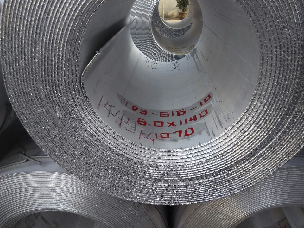
Kontinuéierlech Cast-Rolling
Continuous cast-rolling, also known as direct chill rolling or liquid rolling, is a process where liquid metal is directly poured into the roll gap to form semi-finished or finished products. The rolls act as crystallizers for the liquid metal and simultaneously apply pressure to deform the metal. As the liquid aluminum enters the casting and rolling zone through a feeding nozzle, it meets the rotating casting and rolling rolls.
The heat from the liquid aluminum is quickly absorbed by the cooling water in the rolls, causing a rapid temperature drop and solidification on the roll surface. The rolls then apply a certain amount of rolling reduction to form the cast-rolled coil. The input and output of metal in the casting and rolling zone are always balanced, ensuring a stable continuous casting and rolling process.
Typesch, the width of the slab is determined by the finished product width specified in the order. The conventional coiling thickness is 7-8 millimeter, with a maximum width of up to 2000 millimeter.
Since the process occurs at solid-state temperatures, the material produced has a larger grain structure. Allerdéngs, due to the low processing temperature, no oxide scale is formed on the surface, resulting in a high surface finish. But the ductility is relatively low.
Continuous Casting and Rolling
Continuous casting and rolling involves the solidification of liquid metal into a slab in the mold of a continuous caster, which is then directly rolled in a rolling mill while still hot, or after a slight reheating, to complete the deformation process. Unlike continuous cast-rolling, there is no cooling and coiling step in continuous casting and rolling.
The slab is directly heated and then rolled. The presence of the heating step affects the material’s properties, making it easier to undergo plastic deformation compared to continuous cast-rolling. The finished product has better ductility and is more stable in applications requiring subsequent deformation processing.
Momentan, only Longding and Ding Sheng (Inner Mongolia) factories produce continuous casting and rolling materials using Hazelett continuous casting and rolling technology. This technology was commercially applied in the 1960s, but its application and research in China have been relatively short.
In 2009, Longyang Yuguang Longquan High-Precision Aluminum Plate Co., Ltd. (now managed by Luoyang Longding Aluminum Industry) introduced China’s first Hazelett continuous casting and rolling line, which was put into production in March 2011. In 2013, Inner Mongolia Liansheng New Energy Materials introduced China’s second Hazelett continuous casting and rolling line, which was put into production in April 2018.
Both production lines have a design width of 2100 millimeters and a combined design capacity of 400,000 tonnen. In 2018, the two lines produced a total of 250,000 tonnen, and in 2019, 350,000 tonnen. In terms of product structure, Longding mainly produces various single-zero foil, cable belt, decorative plate belt, deep-drawing material, and automobile radiator material billets, with an annual output of about 180,000 zu 200,000 tonnen. Liansheng’s products mainly include double-zero foil, single-zero foil, air-conditioning foil, and automobile radiator material billets.
The composition of the continuous casting and rolling process includes a melting furnace group, an online degassing and dross removal device, a slab machine (the core process and the mark that distinguishes it from other process technologies), and hot three-stand rolling. The rectangular slab thickness is 15-20 millimeter, and the finished product thickness is 1-2 millimeter.
Temperature control is critical. Taking 8011 alloy as an example, the casting temperature is 690-700°C, the slab temperature is 450-550°C, the initial rolling temperature is 400-500°C, and the final rolling temperature is 120-250°C. The recrystallization temperature of 8011 alloy is generally 300-350°C. Under these process conditions, the production of 8011 aluminum strip has an effect similar to that of hot-rolled coils.
In terms of surface quality, compared to continuous cast-rolling, the slab surface has more pitting, and chemical composition segregation on the surface is caused by uneven cooling (the concentration of impurities at the interface is much higher than that in the body).
The main defects are manifested as poor surface gloss of the aluminum coil, obvious light and dark stripes, and in severe cases, the presence of black silk lines. An de leschte Joeren, through technological optimization, except for products with extremely strict surface requirements such as CTP plate base, mirror aluminum, and oxidation plate, most other product demands can be met.
Mechanical properties are between continuous cast-rolling and hot rolling. Since the slab temperature remains above the recrystallization temperature when entering the hot continuous rolling, it belongs to the hot rolling category, and the performance is close to hot rolling.

Hot Rolling
Hot rolling is the rolling process carried out above the recrystallization temperature. Simply put, an aluminum billet is heated and then rolled through several passes, followed by edge trimming and straightening to form an aluminum plate, which is called hot rolling.
During hot rolling, the metal has high plasticity and low deformation resistance, significantly reducing the energy consumption of metal deformation. Hot rolling can improve the processing performance of metals and alloys. It breaks up the coarse grains in the cast state, heals significant cracks, reduces or eliminates casting defects, and transforms the cast structure into a deformed structure, thereby improving the processing performance of the alloy.
The process flow is as follows: aluminum ingot – flat ingot – milling – uniform annealing (heen) – hot rough rolling – hot finish rolling – cooling and coiling.
During the heating process and transportation to the rough rolling mill, the flat ingot reacts with oxygen in the air, forming an oxide scale on the surface. If the oxide layer remains on the material during rolling, it can be rolled into the interior of the aluminum material, affecting the surface quality of the final product. Dofir, milling is necessary before rough rolling.
The heating temperature of the flat ingot before hot rough rolling is above 400°C.
From a conceptual point of view, the hot rolling process does not involve cold rolling. Allerdéngs, in actual production, factories often add a cold rolling step to minimize energy consumption, ensure the dimensional accuracy and surface quality of the finished product. Allgemeng, the thickness of the slab after finish rolling is controlled above 3.0/4.7 millimeter.
The size of the plate ingot is related to the order specifications, but the specific correlation is unknown.
Kale Rolling
Cold rolling refers to the rolling deformation of metal below the recrystallization temperature, generally meaning that aluminum coils are rolled directly at room temperature without heating.
The process flow is as follows: cast slab – cooling and coiling – hot finish rolling – cooling and coiling – kal Rolling.
Although the aluminum coil may be warm to the touch after cold rolling, it is still called cold rolling.
Compared to hot rolling, cold rolling has the following advantages:
Do you know the percentage of scrap aluminum in different alloy grades during the melting stage?
Most grades add scrap aluminum!
Thank you for your time and attention.

Henan Huasheng Aluminium Co., Ltd., Ltd (HHALU kuerz), etabléiert an 2001, ass an Huiguo Town etabléiert, déi berühmt Aluminium Haaptstad vun der Provënz Henan, Et ass e professionnelle Hiersteller an engagéiert sech an der Fuerschung, Entwécklung, Produktioun, Verkafs- a Service of Aluminium Blat Plaat, aluminium coil, Aluminiumfolie, Al Sträif an Al Krees.
Zousätzlech, HHALU verkafen och Aluminiumplack fir Bau a Schëffer, Aluminium Spigelplack, an Automotive Aluminiumlegierungsplack.
Nr 53, Dongming Strooss, Zhengzhou, Henan, China
Copyright © Huasheng Aluminium 2025. All Rechter reservéiert.
