In the realm of aluminum alloys, 5052 stands out as a popular choice due to its excellent corrosion resistance, katamtamang lakas, and remarkable workability.
Gayunpaman, a question that frequently arises among engineers, fabricators, and hobbyists alike is whether 5052 aluminum sheets are truly bendable without compromising their integrity.
This comprehensive guide aims to demystify this subject, providing you with deep insights into the bendability of 5052 mga sheet ng aluminyo, backed by data, teknikal na mga pagtutukoy, and practical considerations.

Ay 5052 Aluminum Sheet Bendable
Before diving into the bendability specifics, understanding the fundamental properties of 5052 aluminum is crucial.
This alloy belongs to the 5000 serye ng mga, which is aluminum alloyed with magnesium, offering excellent corrosion resistance, magandang weldability, and moderate-to-high strength.
| Pag-aari | Pagtutukoy |
|---|---|
| Komposisyon ng Kemikal | Aluminyo (Al) balance, Magnesium (Mg) 2.2-2.8%, Chromium (Cr) 0.15-0.35% |
| Lakas ng Paghatak | 228 MPa (33 ksi) typical |
| Yield Lakas | 193 MPa (28 ksi) typical |
| Pagpapahaba sa Break | 12-20% depending on temper |
| Paglaban sa kaagnasan | Napakahusay, lalo na sa marine environments |
| Workability | Napakaganda, kasama na ang pagbaluktot, pagbuo ng, at machining |
Bendability refers to the ability of a metal sheet to undergo plastic deformation—bending—without cracking or failure. It is influenced by several factors:
In numerous applications such as marine structures, mga bahagi ng sasakyan, at pandekorasyon na mga panel, the ability to bend aluminum sheets into complex shapes without damaging the material ensures both aesthetic appeal and structural integrity.
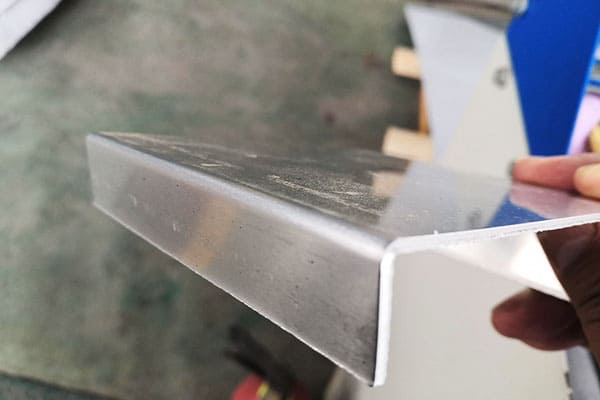
Bending Test of Huasheng 5052 Aluminum Sheet
| Pag-aari | Value/Range | Implication for Bending |
|---|---|---|
| Yield Lakas | ~193 MPa (in temper H32) | Determines the stress level during bending; higher strength requires careful control. |
| Lakas ng Paghatak | ~228 MPa | Reflects the maximum stress before failure; moderate for bending. |
| Pagpapahaba | 12-20% | Indicates ductility; higher elongation correlates with better bendability. |
| Ang katigasan ng ulo | Nag iiba sa temper; softer tempers are more ductile | Softer tempers (hal., H34, H32) are more suitable for bending. |
| Temper | Paglalarawan | Bendability | Mga Tala |
|---|---|---|---|
| O (Annealed na ang mga) | Fully annealed, malambot na, highly ductile | Napakahusay | Ideal for complex bending operations; mababa ang lakas. |
| H32 | Matigas na matigas ang ulo, stabilized (moderately hard) | Mabuti na lang | Suitable for general purpose bending, balances strength and ductility. |
| H34 | Matigas na matigas ang ulo, stabilized, more hardening | Katamtaman | Slightly less bendable than H32, but still workable with proper techniques. |
Tala: The softer the temper, the more bendable the sheet. Sa kabilang banda, harder tempers like H38 or H34 require more careful bending procedures and larger radii.
| Ang kapal (mm) | Bendability Rating | Mga Tala |
|---|---|---|
| 1-2 mm | Napakaganda | Easily bent with standard tools |
| 3-4 mm | Mabuti na lang | Requires controlled bending parameters |
| >4 mm | Moderate to Limited | May need specialized equipment or techniques |
Buod: Thinner sheets are inherently more flexible; as thickness increases, the risk of cracking or deformation increases unless proper procedures are followed.
Achieving a clean, crack-free bend involves choosing the right method and adhering to best practices.
| Paraan | Kaangkupan | Mga kalamangan | Limitations |
|---|---|---|---|
| Air Bending | Common in fabrication | Less force, simple setup | Larger bend radii, potential for springback |
| Bottoming Bending | Precise bends | Better control of bend radius | More force required |
| Rotary Bending | Curved, complex shapes | Suitable for tight curves | Equipment-intensive |
| Bending Radius | Recommended for 5052 H32 | Mga Tala |
|---|---|---|
| ≥ 1 x sheet thickness | Para sa 1 mm thick sheet, ≥ 1 mm | Prevents cracking and maintains ductility |
| < 1 x sheet thickness | Not recommended for harder tempers | Risk of cracking and deformation |
| haluang metal | Bendability | Paglaban sa kaagnasan | Lakas ng loob | Mga Karaniwang Aplikasyon |
|---|---|---|---|---|
| 5052 | Napakahusay (for soft tempers) | Napakahusay | Katamtaman | Marine, mga tangke ng gasolina, panels |
| 6061 | Mabuti na lang | Mabuti na lang | Mas Mataas | Istruktura, aerospace |
| 3003 | Napakaganda | Mabuti na lang | Mas mababa | Pandekorasyon, mga kagamitan sa pagluluto |
| 5052 (H32) | Mabuti na lang | Napakahusay | Katamtaman | Similar to above |
Insight: 5052’s superior corrosion resistance makes it particularly suitable for environments where exposure to moisture or salt is prevalent, and its bendability in soft tempers ensures ease of forming.
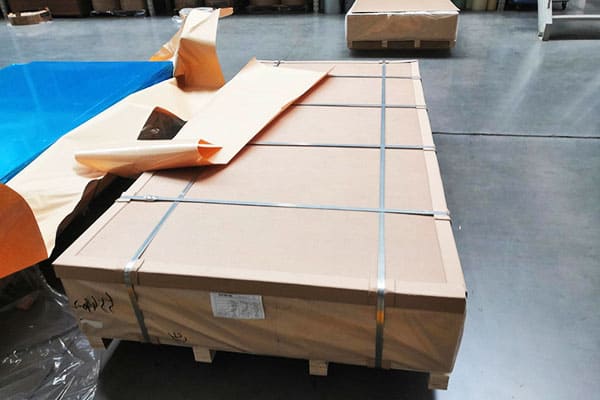
huasheng 5052 Aluminum Sheet Packaged
Scenario: Manufacturing a marine fuel tank panel with 3 mm thick 5052-H32 aluminum sheet.
Kinalabasan: The panel was successfully bent without cracks, maintaining structural integrity, owing to proper technique and understanding of material properties.
Huasheng Aluminum, a leading supplier in the aluminum industry, specializes in providing high-quality aluminum products, kasama na ang 5052 sheets suitable for various bending and forming applications. Their products boast:
By choosing Huasheng Aluminum, manufacturers can ensure the material’s reliability, which is crucial for critical applications requiring precise bending.
Sagutin: Oo nga, especially in softer tempers like O or H32, but repeated bending can cause work hardening, leading to cracking. It’s best to plan the bending sequence carefully.
Sagutin: It depends on the alloy’s temper and thickness. Karaniwan, a bend angle of up to 90° is achievable without cracking in soft tempers, but tighter bends should be tested.
Sagutin: Slight pre-heating (around 150°C) can enhance ductility, especially for thicker sheets or harder tempers, reducing the risk of cracking.
Sagutin: Not always. For soft tempers like O or H32, annealing is unnecessary; however, for harder tempers, annealing can improve bendability.
Sagutin: Aluminum’s elastic recovery causes springback. To compensate, over-bend slightly and use proper tooling to ensure accurate angles.
The bendability of 5052 aluminum sheets is a nuanced subject, heavily influenced by alloy temper, kapal naman, bending method, and tooling.
In general, 5052 aluminyo, particularly in softer tempers like O and H32, exhibits excellent ductility, making it suitable for a wide range of bending applications.
Gayunpaman, careful consideration of bend radii, force application, and process parameters is essential to prevent cracking or deformation.
Manufacturers and fabricators must adopt tailored techniques—such as selecting appropriate bending methods, using suitable tooling, and understanding material properties—to maximize success.
The choice of supplier, like Huasheng Aluminum, can further ensure quality and consistency, providing peace of mind in demanding applications.
Sa pagtatapos, with proper handling and process control, 5052 aluminum sheets are indeed truly bendable, offering both flexibility and durability for diverse industrial needs.
Tala: For specific applications, always perform preliminary tests and consult technical datasheets provided by manufacturers like Huasheng Aluminum to validate bend radii, force requirements, and temper suitability.
PDF Download:Download

Henan Huasheng Aluminyo Co., Ltd (HHALU para maikli), itinatag noong 2001, ay matatagpuan sa Huiguo Town, ang sikat na Aluminum capital ng Henan Province, Ito ay isang propesyonal na tagagawa at nakikibahagi sa pananaliksik, pag-unlad, produksyon ng, sales and service of aluminyo Plato ng Sheet, aluminyo likawin, aluminyo foil, aluminyo strip at aluminyo bilog.
Bukod pa rito, HHALU magbenta din ng aluminum plate para sa konstruksiyon at mga barko, aluminyo mirror plate, at automotive aluminyo haluang metal plate.
No.53, Dongming Road, Zhengzhou, Henan, Tsina
Copyright © Huasheng Aluminum 2025. Lahat ng karapatan ay nakalaan.
