Aluminium foil for chocolate packaging remains the industry standard for preserving flavor, structure and visual appeal across the supply chain.
Chocolate is highly sensitive to oxygen, kahalumigmigan, light and temperature excursions; the right packaging preserves aroma and texture, prevents fat bloom, and presents a premium brand impression.
This article delivers a deep, multi-disciplinary analysis — materials science, pagmamanupaktura, Pagganap ng Barrier, design choices, regulatory controls and sustainability — and includes quantitative data and practical recommendations for packaging engineers, brand product managers and co-packers.
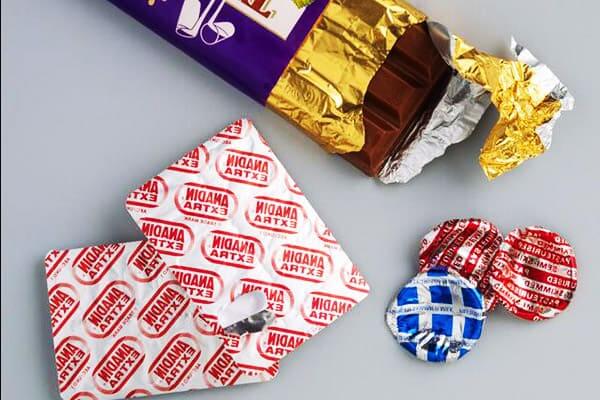
Aluminium Foil for Chocolate Packaging
Aluminium foil’s performance in chocolate packaging stems from its materials-science fundamentals, which define key characteristics such as barrier performance, pagiging formable, kaligtasan, and compatibility with industrial packaging lines.
AA1235 Aluminium Foil (Purity ≥ 99.35%)
AA1145 Aluminium Foil (Purity ≥ 99.45%)
AA8011 Aluminium Foil (Al-Fe-Si Alloy)
Thickness is a critical determinant of barrier level, mechanical performance, and cost. Standard thickness categories for chocolate packaging include:
6–9 μm (Ultra-Thin Foil)
10–12 μm (Premium Inner Wrap Foil)
12–20 μm (Decorative or Embossed Foils)
Thickness vs. Pagganap ng Barrier (Approximate)
| kapal ng foil | Oxygen Permeability | Water Vapor Transmission | Mechanical Strength | Pinholes per m² (typical) |
|---|---|---|---|---|
| 7 M | ~0 (perfect barrier) | ~0 | Mababa ang | 250–350 |
| 10 M | ~0 | ~0 | Katamtaman | 150–220 |
| 12 M | ~0 | ~0 | Mas Mataas | 80–150 |
| 18 M | ~0 | ~0 | Napakataas na | <80 |
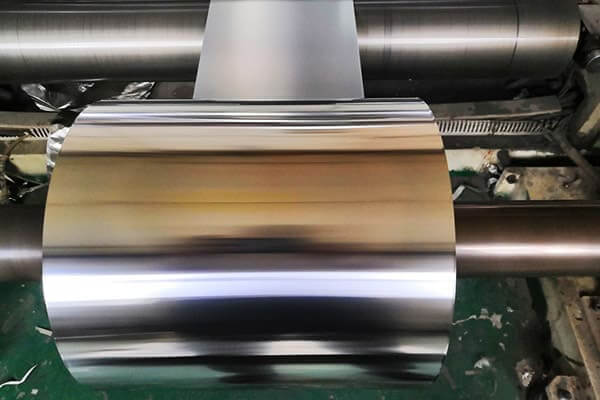
1235 Aluminium Foil Production
Aluminium foil used for chocolate packaging must comply with:
Data point: A continuous aluminium layer can reduce oxygen transmission to effectively 0 cm³/m²·day (practically immeasurable), whereas typical polymer films may have OTRs orders of magnitude higher (hal., PET ~1–10 cm³/m²·day depending on thickness).
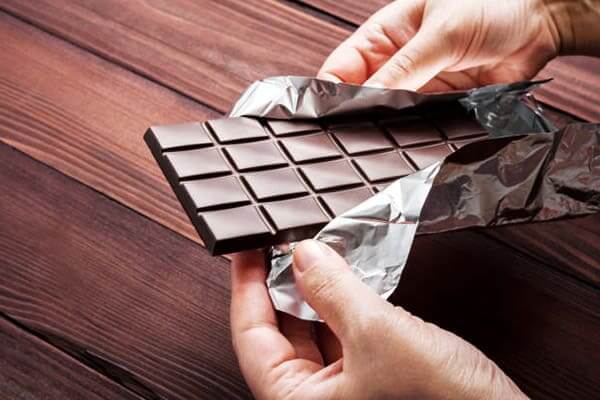
Advantages of Aluminium Foil for Chocolate Packaging
Chocolate packaging requires precise control of Pagganap ng Barrier, mechanical strength, pagiging formable, at aesthetic presentation.
Because pure aluminium foil is extremely thin and delicate at typical chocolate-packaging gauges (6–20 μm), manufacturers often combine it with paper, polymer films, or special coatings to create optimized laminates.
Engineers design these structures to provide multi-functional protection during production, distribution, and retail display.
| Laminate Type | Typical Structure | Kabuuang kapal | Mga Pangunahing Bentahe | Mga Karaniwang Aplikasyon |
|---|---|---|---|---|
| Plain Aluminium Foil | 6–20 μm Al | 6–20 μm | Perfect barrier, great folding | Inner wrap for bars, pralines |
| Paper/Aluminium Laminate | Paper (20–40 μm) + Al (7–12 μm) | 30–60 μm | Traditional look, good stiffness | Classic chocolate bar wrapping |
| Paper/Aluminium/PE | Paper + 7–12 μm Al + PE (15–30 μm) | 50–90 μm | Heat sealability, improved barrier | High-speed bar packaging |
| PET/Aluminium/PE | Alagang Hayop (12 M) + Al (7–12 μm) + PE | 40–80 μm | Excellent mechanical strength | Premium chocolates, long shelf life |
| Metallized Film Laminates | MetPET + PE | 40–60 μm | Low cost, magaan ang timbang | Low-barrier candies |
| Embossed Coloured Foil | 10–16 μm Al + mga patong na patong | 10–20 μm | Premium aesthetics, luxury packaging | Pralines, seasonal chocolates |
| Aluminyo Foil + Lacquer Coatings | 8–12 μm Al + heat-seal lacquer | 8–15 μm | For hermetic seals, inner wraps | Truffle and praline inner wrap |
Used for truffles, pralines, and bonbons. 6-8 micron wax-coated 1235 aluminyo foil is standard, as it wraps tightly around irregular shapes and peels cleanly.
Brands like Godiva use gold-embossed foil for individual truffles, enhancing gifting appeal. This application accounts for 35% of chocolate foil usage (Confectionery Packaging Association).
Chocolate bars and tablets use foil as an inner barrier layer, paired with paperboard outer packaging. 10-12 mikron 8011 aluminyo foil (PVdC-coated) is common, providing moisture protection while the paperboard offers structural support and branding space.
Examples include Cadbury Dairy Milk (Al/Paper laminate) and Hershey’s Milk Chocolate (Al/PET/PE laminate).
High-end assortments (hal., Lindt Excellence, Neuhaus) use 12-15 micron foils in laminates with embossed or colored finishes.
Foil liners in gift boxes prevent moisture intrusion from cardboard, while metallic foils on outer boxes convey luxury.
The luxury segment drives 40% of chocolate foil revenue, despite accounting for only 15% of volume (Euromonitor).
| Pamantayan | Aluminyo Foil | Metallised PET | Paper | Plastic Films (PET/OPP/PE) |
|---|---|---|---|---|
| Light barrier | 100% | Partial | Mga Maralita | Mga Maralita |
| Oxygen barrier | Near-zero | Katamtaman | Mga Maralita | Low–Moderate |
| Hadlang sa kahalumigmigan | Near-zero | Katamtaman | Mga Maralita | Katamtaman |
| Aroma retention | Napakahusay | Katamtaman | Mga Maralita | Katamtaman |
| Mechanical robustness | Katamtaman (depends on gauge) | Mataas na (Alagang Hayop) | Mababa ang | Variable na |
| Kakayahang i-print | Mababa ang (papel de liha) / Mataas na (outer web) | Mataas na | Mataas na | Mataas na |
| Recyclability | High for mono-foil; complex for laminates | Katamtaman | Mataas na | Katamtaman |
| Gastos | Katamtaman | Low–Medium | Mababa ang | Low–Medium |
Aluminium foil continues to dominate chocolate packaging due to its unique combination of Pagganap ng Barrier, kakayahang umangkop, kaligtasan ng pagkain, aesthetic versatility, at recyclability.
From individual bonbons to luxury boxed chocolates, its ability to protect against oxidation, moisture ingress, aroma loss, and physical damage significantly extends shelf life and ensures consistent product quality.
Backed by robust materials science, advanced manufacturing technologies, and sustainable innovations, aluminium foil remains an indispensable material in the global chocolate industry.
As consumer expectations rise and brands seek high-quality packaging solutions, aluminium foil will continue to provide unmatched value and performance.
Q1 — Is aluminium foil safe in direct contact with chocolate?
Oo nga. Food-grade aluminium foil manufactured and coated per regional food-contact regulations (hal., EU Regulation EC 1935/2004, FDA food-contact guidance) is safe for direct contact with chocolate. Ensure coatings/lacquers and adhesives are tested for migration into fatty foods.
Q2 — What foil thickness prevents punctures in automated lines?
There is no universal thickness — line parameters and product geometry matter — but 8–12 μm is common for inner wraps on high-speed lines; for fragile or heavily handled items, 12–16 μm reduces puncture probability.
Q3 — Can aluminium foil stop fat bloom?
Foil reduces environmental triggers for fat bloom by blocking light and oxygen; however, bloom prevention depends primarily on correct tempering, formulation, and temperature control during storage and transport.
Q4 — Are foil laminates recyclable?
Pure aluminium foil is recyclable. Composite laminates (foil bonded to paper or multiple plastics) are harder to recycle and often require specialized streams; choosing mono-material laminates improves circularity in many markets.
Q5 — What testing should be done on chocolate packs using foil?
Recommend: seal integrity, oxygen & moisture transmission (where measurable), migration testing with fatty simulants, puncture/tear testing, accelerated shelf-life testing (elevated T and RH), and sensory panels for off-flavor detection.
Q6 — Why is foil better than plastic for chocolate?
Foil’s near-zero OTR and MVTR extend shelf life by 2-4 times, prevents bloating and rancidity, and blocks light—issues plastic films (even metallized ones) cannot fully address.
Q7 —Can aluminium foil be printed with food-grade inks?
Oo nga. Flexographic printing uses FDA-compliant water-based or solvent-based inks, with primers ensuring ink adhesion and no migration to chocolate.

Henan Huasheng Aluminyo Co., Ltd (HHALU para maikli), itinatag noong 2001, ay matatagpuan sa Huiguo Town, ang sikat na Aluminum capital ng Henan Province, Ito ay isang propesyonal na tagagawa at nakikibahagi sa pananaliksik, pag-unlad, produksyon ng, sales and service of aluminyo Plato ng Sheet, aluminyo likawin, aluminyo foil, aluminyo strip at aluminyo bilog.
Bukod pa rito, HHALU magbenta din ng aluminum plate para sa konstruksiyon at mga barko, aluminyo mirror plate, at automotive aluminyo haluang metal plate.
No.53, Dongming Road, Zhengzhou, Henan, Tsina
Copyright © Huasheng Aluminum 2025. Lahat ng karapatan ay nakalaan.
