8011-H18 Aluminum Foil for Pharmaceutical Packaging is a widely adopted primary packaging material for blister lidding, sachet lidding, and laminated foil structures used in the pharmaceutical industry.
In the H18 (full-hard) temper, this alloy delivers high tensile and puncture resistance, excellent dimensional stability on high-speed packaging lines, and an essentially impermeable barrier to oxygen, water vapor, and light—key factors in protecting drug stability and extending shelf life.
Overall, 8011-H18 aluminum foil represents a balanced solution that integrates robust barrier performance, mechanical reliability, and regulatory acceptance, making it a preferred choice for manufacturers seeking dependable, scalable, and compliant pharmaceutical packaging across a wide range of solid and semi-solid dosage forms.
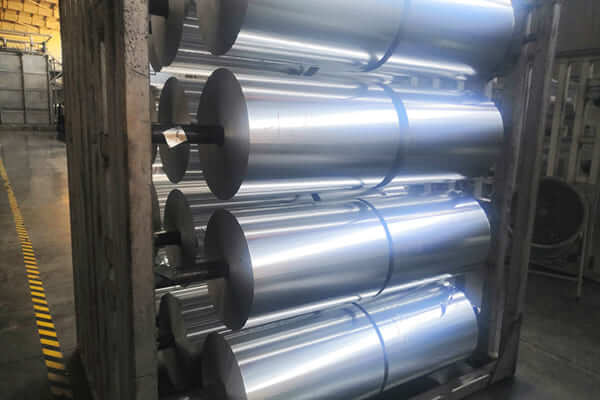
8011-H18 Aluminum Foil
8011-H18 is a commercially-rolled 8000-series aluminium foil alloy, supplied in the fully cold-worked H18 (full-hard) temper, engineered for high-speed pharmaceutical converting (blister lidding, sachet lidding and laminated foil) where a continuous metal barrier plus high puncture/tear resistance at very thin gauges is required.

Huasheng Aluminum Foil Thickness Measurement
| Element | Typical range (wt %) | Role / comment |
|---|---|---|
| Aluminium (Al) | Balance (~ ≥ 98.0 %) | Bulk matrix — provides barrier and formability. |
| Iron (Fe) | ~0.50 – 1.2 | Common impurity from rolling alloys; controlled for foil quality. |
| Silicon (Si) | ~0.20 – 0.80 | Impurity; influences rolling behavior and mechanicals. |
| Manganese (Mn) | ~0.05 – 0.30 | Small addition for grain control and strength stability. |
| Magnesium (Mg) | ≤ 0.10 | Typically very low in 8011 (unlike 5xxx alloys). |
| Copper (Cu) / Zinc (Zn) | Trace (≤ 0.10) | Kept minimal to preserve corrosion and barrier properties. |
| Titanium (Ti), others | Trace | Controlled to maintain foil surface and mechanical consistency. |
Practical note: 8011 is engineered to be a low-impurity foil alloy; the precise limits depend on the mill and product spec. For pharmaceutical use, require the full elemental report on the CoA.
For ultra-thin foil gauges the standard tensile/yield tests are performed on strip/coupon specimens; mechanical behavior is strongly affected by gauge and rolling history.
| Property | Typical range / example |
|---|---|
| Ultimate tensile strength (UTS) | ~180 – 260 MPa (higher values for thinner, more heavily worked foil) |
| Yield strength (if reported) | Typically high; in many cases foil suppliers report “proof strength” or rely on UTS & elongation data |
| Elongation (A) | ~0.5 – 3 % (H18 is full-hard — low ductility) |
| Tear / puncture resistance | Good — significantly higher than soft tempers at equivalent gauge |
| Hardness | Not commonly used for foil acceptance, but full-hard foils show elevated microhardness vs annealed foil |
Engineering implication: H18 foil is strong and resists pinhole formation during converting and filling, but it cannot be deep drawn — it is optimized for lidding (flat foils) rather than forming into cavities.
| Property | Typical value / note |
|---|---|
| Density | ≈ 2.70 g·cm⁻³ (same as general aluminium) |
| Thermal conductivity (approx.) | ~230 – 240 W·m⁻¹·K⁻¹ (bulk aluminium range) |
| Specific heat | ~880 – 900 J·kg⁻¹·K⁻¹ |
| Gauge (thickness) — typical for pharma lidding | ~20 – 40 µm (20–25 µm common for single-layer lidding; thicker gauges used for additional puncture resistance or cold-form lamination) |
| Surface finish | Mill finish, matt or bright depending on rolling and anneal practice; lacquered for sealability and printing |
Note: thickness tolerance, surface roughness and flatness are critical for blister machines — specify per-reel thickness profile and allowed out-of-flat area.
Aluminium foil provides an essentially continuous metal barrier.
Performance is determined by foil integrity (absence of pinholes), lacquer/laminate system and defects.
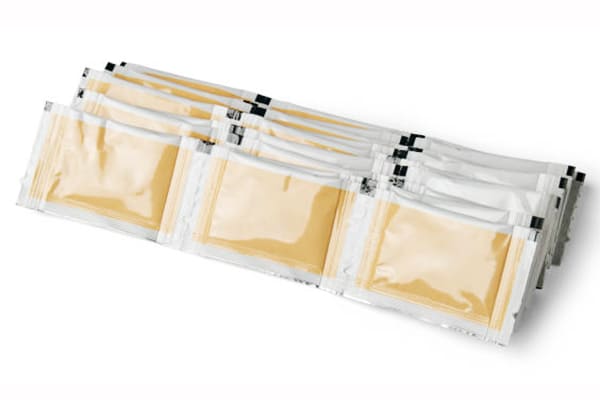
Sachets for Pharmaceutical
8011-H18 is a workhorse foil for pharmaceutical primary packaging because it combines an essentially impermeable metal barrier with high puncture/tear resistance at very thin gauges and stable web behaviour on high-speed converting lines.

8011-H18 Aluminum Foil for Blister Packaging
Push-through blisters require a lidding material that will stay intact during filling/handling but permit the patient to push a tablet through without tearing the laminate unpredictably.
8011-H18 is often the lidding foil of choice because H18’s high cold-work strength reduces pinhole incidence and resists puncture by tooling, tablet edges and transport stress.
Typical construction & gauges
Coatings and seal interface
Heat-seal lacquer (PVdC, acrylic, or specialized pharma lacquers) is applied to the foil to enable hermetic sealing to forming web (PVC, PVC/PVdC, PVdC coated films).
Coat weights typically range from ~1–6 g/m² depending on lacquer chemistry and required seal strength.
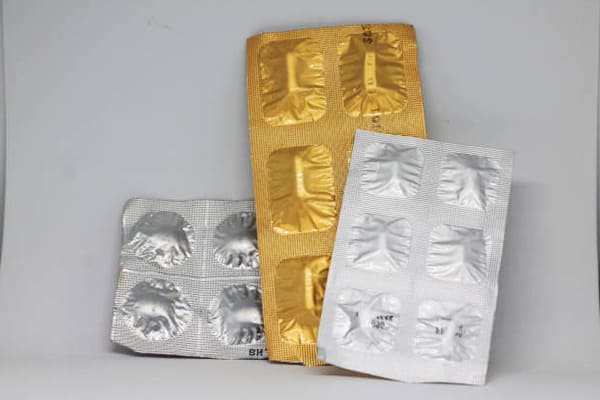
Aluminum Foil Strip Packaging
Strip packaging refers to continuous strips of blister cavities and lidding that may be used in unit-dose dispensing systems or where multiple doses are packaged in a continuous band.
Engineering choices
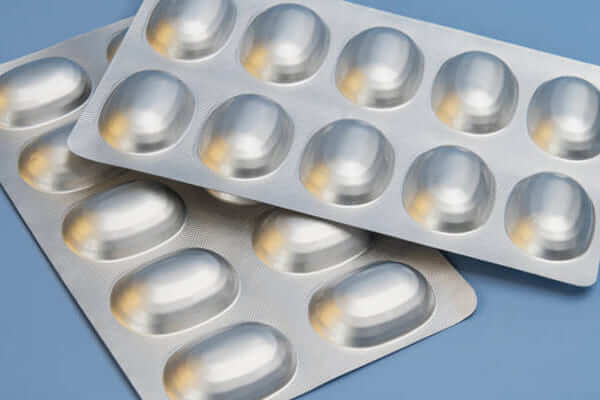
“Alu-Alu” (cold-form foil) normally refers to multi-layer aluminium foil constructions used both as forming web and as lidding in fully aluminium (foil/foil) blister packs.
True cold-form foils are produced with alloys and tempers selected for high ductility to permit deep drawing into cavities (e.g., softer alloy or softer tempers than H18).
A typical Alu-Alu pack may have two aluminium layers bonded with sealant layers.
Where 8011-H18 belongs
Cold-Form 8011-H18 Aluminum Foil
Unit-dose sachets for powders, granular drugs, semisolids and topical preparations. Foil may be used as a direct lidding layer or as a core barrier layer in laminates.
Common laminate constructions
Foil liners that seal bottle mouths (screw caps, dropper bottles) and container openings to indicate tamper evidence and preserve freshness.
These are common for nutraceuticals and some pharma liquid/semisolid containers.
Engineering choices
The manufacturing process is highly specialized to meet pharmaceutical requirements:
1. Casting and Hot Rolling: The 8011 alloy is cast into ingots and hot-rolled into thick coils.
2. Cold Rolling: The material is repeatedly cold-rolled to achieve the final thin gauge (typically 20𝜇m to 40 𝜇m ).
3. Annealing and Tempering: The foil is annealed to the desired temper (H18) through controlled cold work.
4. Surface Treatment: The foil undergoes degreasing and cleaning to ensure a pharmaceutical-grade surface.
5. Coating: A heat-seal lacquer is precisely applied to one side, and a protective primer/print lacquer is applied to the other side for printing.
6. Slitting and Quality Inspection: The finished foil is slit to customer specifications and subjected to rigorous pinhole and surface quality checks.
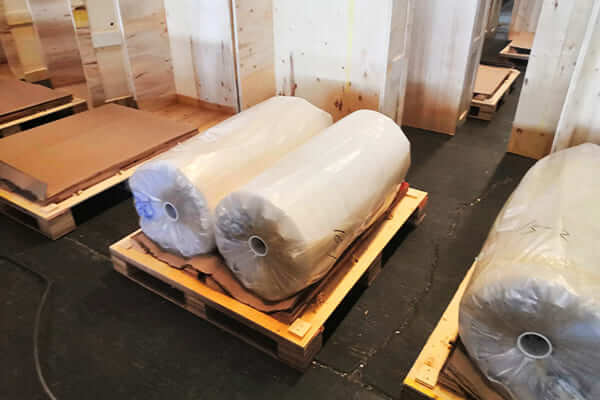
Export packaging for large rolls of aluminum foil
Pharmaceutical packaging materials must adhere to strict international regulations to ensure patient safety and drug efficacy.
•FDA (U.S. Food and Drug Administration): Requires materials to be safe for direct contact with drugs.
•USP (United States Pharmacopeia) ⟨662⟩: Provides standards for metal packaging components, including functional tests.
•EP (European Pharmacopoeia): Sets standards for materials used in pharmaceutical containers.
•ISO 15378: Specifies requirements for primary packaging materials for medicinal products, incorporating GMP (Good Manufacturing Practice).
| Comparison item | 8011-H18 | 8021 / 8079-H18 | 1235-O | Cold-form foil | 8011-based laminated foil |
|---|---|---|---|---|---|
| Typical pharma gauge (µm) | 20–40 (20–25 common for PTP) | 20–40 | 20–60 | 40–150 (forming layer thicker) | Foil layer 20–40 (total laminate varies) |
| Tensile strength / elongation (typ.) | 180–260 MPa; elong. <3% | UTS ~170–240 MPa; elong. <3% | UTS ~70–140 MPa; elong. ~20–45% | UTS ~80–200 MPa; elong. >15–30% | Depends on laminate; foil provides rigidity |
| Formability | Lidding only; not drawable | Lidding only; not drawable | Very good drawability | Excellent deep cold-form capability | Lidding excellent; forming depends on design |
| Barrier to O₂ / H₂O / light | Essentially impermeable metal barrier | Essentially impermeable | Impermeable | Full metal-to-metal barrier | Dominated by foil layer (very high barrier) |
| Sealability / coating compatibility | Good with pharma lacquers (validated) | Good; lacquer history supplier-dependent | Requires lacquer for sealing | Via internal sealant layers | Excellent; polymer layers tailor seal/peel |
| Sterilization compatibility | Gamma / EtO good (lacquer-dependent); autoclave depends on system | Similar to 8011 | Similar; coatings must be validated | Generally good; validate full laminate | Depends on polymer & lacquer system |
| Typical pharma applications | PTP blister lidding, sachet lidding, foil liners | Alternative blister lidding | Cold-form cavities, some lidding | Alu-Alu blisters (forming + lidding) | Sachets, peelable blisters, pouches |
| Key advantages | High puncture resistance at thin gauge; web stability; proven pharma use | Comparable to 8011; supplier flexibility | Excellent ductility; deep draw capability | Maximum barrier + deep draw | Combines barrier with seal/peel & printability |
| Key limitations | Very low ductility; not for forming | Similar limits as 8011 | Lower puncture resistance at same gauge | Heavier, higher cost, complex converting | Recycling complexity; more validation work |
8011-H18 Aluminum Foil for Pharmaceutical Packaging when they need a metal barrier and high mechanical strength at thin gauges.
Its advantages — impermeable barrier, high puncture resistance, dimensional stability and suitability for high-speed converting — make it the default choice for push-through blister lidding and many lidding/laminate applications.
To use it successfully in pharma, procurement teams must insist on supplier GMP documentation, extractables and sterilization data, tight thickness and surface specifications, validated lacquer/film pairings and thorough process validation (seal strength, integrity, patient usability).
Always embed mill certificates and validation reports into the regulatory dossier for finished products.
Q1 — What gauge of 8011-H18 is typical for tablet blister lidding?
Typical single-layer push-through lidding gauges are ~20–30 µm, with 20–25 µm common for many oral solid dose packs. Thicker gauges (30–40 µm) are used when higher puncture resistance is required or for specialty applications.
Q2 — Is 8011-H18 suitable for cold-form blisters?
No — H18 is full-hard and not suitable for deep cold forming. Cold-form blister cavities require softer, more ductile alloys or different tempers. For lidding over cold-form blisters, 8011-H18 is appropriate as the lidding, but the forming web must be chosen separately.
Q3 — How does sterilization affect 8011-H18 laminate packs?
The metal layer is stable under gamma and EtO sterilization, but lacquers, inks and polymer sealants must be validated. Autoclaving (steam) can compromise some lacquer/laminate systems — perform process-specific validation.
Q4 — What documentation should I demand from a foil supplier?
At minimum: mill test certificate (chemical + tensile), lacquer/coat technical data and extractables report, evidence of GMP/ISO15378 or equivalent, and lot traceability. For regulated products, include sterilization compatibility data.
Q5 — How do I control pinholes and ensure barrier integrity?
Specify acceptable pinhole limits, require in-coming visual and integrity inspection (pin-hole detectors), mandate in-process vision inspection on converting lines and validate finished pack leak/integrity tests (e.g., vacuum decay, dye ingress where applicable).

Henan Huasheng Aluminum Co., Ltd (HHALU for short), established in 2001, is located in Huiguo Town, the famous Aluminum capital of Henan Province, It's a professional manufacturer and engages in the research, development, production, sales and service of aluminum sheet plate, aluminum coil, aluminum foil, aluminum strip and aluminum circle.
In addition, HHALU also sell aluminum plate for construction and ships, aluminum mirror plate, and automotive aluminum alloy plate.
No.53, Dongming Road, Zhengzhou, Henan, China
Copyright © Huasheng Aluminum 2025. All rights reserved.
