6061 (Al-Mg-Si) alloy offers a unique combination of strength, thermal performance and dimensional stability that—when processed correctly—can be formed into wrinkle-free foil containers for premium, ovenable and technical packaging applications.
Achieving consistently wrinkle-free walls with 6061 foil requires deliberate material selection (kapal naman, Pamahiin), tool and die engineering, precise process control (blank-holder force, lubrication, multi-stage drawing) and robust quality assurance (optical inspection, thickness gauging, mechanical verification).
Compared with commodity foil alloys (3003, 8011, 5052), 6061 is a premium option: higher cost and more demanding forming, but superior post-form stiffness, shape retention and thermal behavior.
Aluminum foil containers are ubiquitous in catering, consumer convenience foods, industrial packaging and specialized technical uses.
“Wrinkle-free” containers — containers with smooth, uniform wall and flange surfaces free of buckling, micro-folds or localized thinning — are important where automated sealing, attractive branding, predictable heat transfer and stackability are required.
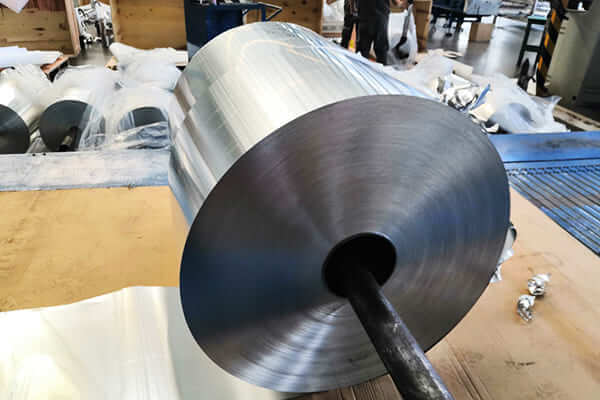
6061 Aluminum Foil Wrinkle-Free Container
6061 is a heat-treatable wrought aluminum alloy in the Al–Mg–Si family.
It is widely used where a balance of moderate-to-high strength, magandang paglaban sa kaagnasan, weldability and predictable heat-treating response are required.
Key practical implications for foil/container engineers:
| Elemento | Nilalaman (wt%) | Function / Impluwensya |
|---|---|---|
| Aluminyo (Al) | Balanse | Base metal |
| Magnesium (Mg) | 0.8 – 1.2 | Primary strengthening element (Mg₂Si formation) |
| Silicon (Si Si) | 0.4 – 0.8 | Works with Mg for precipitation hardening |
| Tanso (Cu) | 0.15 – 0.40 | Increases strength, slightly reduces corrosion resistance |
| Chromium (Cr) | 0.04 – 0.35 | Grain structure control, improves toughness |
| Bakal na Bakal (Fe) | ≤ 0.7 | Impurity, affects ductility and surface quality |
| Mga mangganeso (Mn) | ≤ 0.15 | Minor strengthening, grain refinement |
| Sink (Zn) | ≤ 0.25 | Residual element |
| Titanium (Ti) | ≤ 0.15 | Grain refinement |
| Iba pa (bawat isa ay) | ≤ 0.05 | Residuals |
| Iba pa (kabuuan) | ≤ 0.15 | Residuals |
Relevance to foil containers:
Low impurity levels and controlled Mg–Si balance help ensure uniform deformation during drawing and reduce the risk of localized wrinkling or surface defects.
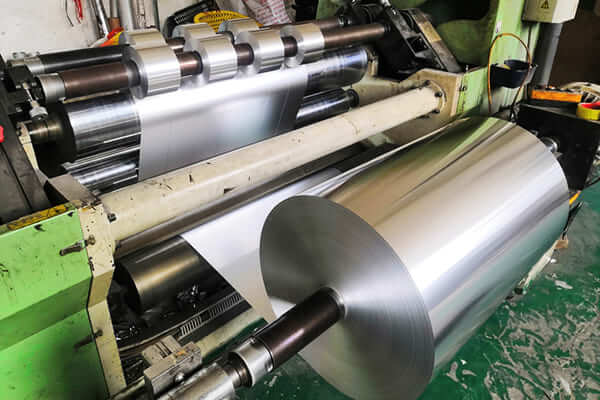
6061 Aluminum Foil Production
| Pag-aari | Karaniwang Halaga | Unit | Relevance to Containers |
|---|---|---|---|
| Densidad ng katawan | ~2.70 | g/cm³ | Lightweight packaging |
| Ang Modulus ni Young (E) | ~68–69 | GPa | Influences springback and wall straightness |
| Gupitin ang Modulus (G) | ~25–26 | GPa | Related to torsional stiffness |
| Ang Ratio ni Poisson | ~0.33 | — | Elastic deformation behavior |
| Thermal kondaktibiti | ~140–170 | W/m·K | Efficient heat transfer in ovenable use |
| Tiyak na Kapasidad ng Init | ~880–900 | J/kg·K | Thermal energy absorption |
| Koepisyent ng Thermal Expansion | ~23–24 ×10⁻⁶ | 1/K | Dimensional change during heating |
| Saklaw ng Pagtunaw (Mga patlang.) | 580–655 | °C | Upper thermal limit |
| Electrical kondaktibiti | Katamtaman | % IACS | Secondary relevance |
Implication:
The combination of relatively high thermal conductivity and predictable thermal expansion supports consistent heating and cooling behavior, critical for wrinkle-free performance during thermal cycles.
| Pag-aari | 6061-O (Annealed na ang mga) | 6061-T4 | 6061-T6 |
|---|---|---|---|
| tunay na lakas ng paghatak (Mga UTS) | ~110–130 | ~240 | ~290–310 |
| Yield Lakas (0.2% offset) | ~55–65 | ~145 | ~240–276 |
| Pagpapahaba sa Break | Mataas na (≥18%)* | ~14–16% | ~8–12% |
| Brinell tigas na tigas | ~30 HB | ~65 HB | ~90–100 HB |
| Lakas ng Pagkapagod (Mga patlang.) | Low–Moderate | Katamtaman | Moderate–High |
| Formability | Napakahusay | Mabuti na lang | Limitado |
Elongation values in thin foil gauges are typically lower than bulk sheet values but follow the same relative trend between tempers.
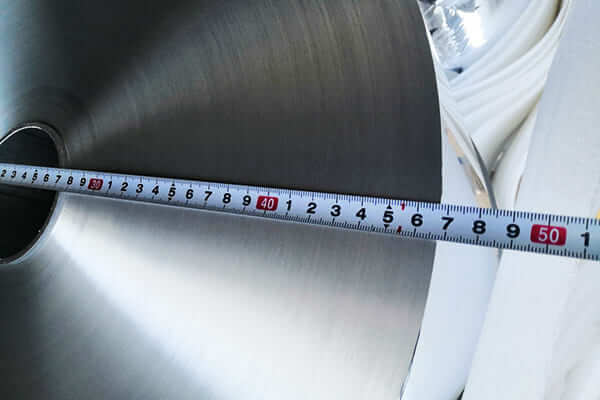
6061 Aluminum Foil Quality Inspection
| Parameter | Typical target / pagtutukoy (example) | Rationale |
|---|---|---|
| Nominal foil gauge | 40–60 µm (select per function) | Good balance of stiffness and formability for ovenable trays |
| Thickness tolerance (incoming coil) | ±3–10% (or ±2–5 µm for tight controls) | Controls final wall uniformity and sealing performance |
| Wall thickness uniformity (formed part) | ±8–12% across functional walls | Limits thinning and local overstress |
| Maximum acceptable thinning (local) | <20–30% (application/temper dependent) | Reduces risk of tears and leakage |
| Tapos na ang ibabaw (incoming foil) | Fine roll finish; target Ra — supplier to specify (prefer low Ra) | Minimizes visible micro-wrinkles and improves seals |
| Visual surface acceptance | No visible wrinkles across 100% of sealing/branding area under standard inspection | Consumer and sealing reliability criteria |
| Flange flatness (sealing area) | Target: minimal deviation; typical industry aim <0.5 mm across sealing band (confirm with sealing vendor) | Ensures reliable automated lid sealing |
| Mechanical verification | Sample tensile/elongation per lot; hardness checks | Confirms temper and forming safety margin |
| Process capability | Cp, Cpk targets per customer; aim for Cpk ≥ 1.33 on critical dimensions | Ensures consistent wrinkle-free yield |
| Defect / scrap rate | Production target <2–5% for mature lines; higher during trials | Economic benchmark; depends on geometry complexity |
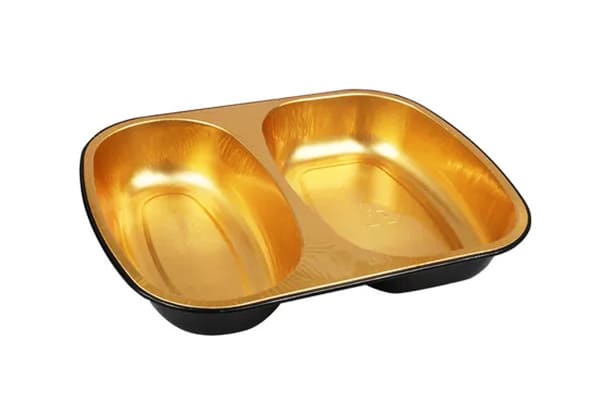
Wrinkle-Free Container for Foodservice
Wrinkling is a stability problem. The principal process levers:
Why use 6061: superior shape retention, improved stacking and consistent heat transfer yield better reheating uniformity and fewer lid-seal failures during automated filling and transport.
Typical functional requirements: oven/reheat temperature up to ~200–220 °C for short intervals; robust flange for automated lid sealing; stackability for palletized transport.
Recommended starting spec: 6061 in O or T4 temper, foil gauge 40–60 µm (select thicker for higher loads).
Why use 6061: premium retail products benefit from wrinkle-free appearance, tight tolerances for printed/embossed branding, and superior oven performance (less warping, consistent browning).
Functional requirements: consumer aesthetics, automated lidding compatibility, clear labeling/printability, ovenability (home ovens, toaster ovens).
Recommended starting spec: 6061-O or T4, 40–60 µm, with fine roll finish for surface quality. For trays that demand very high shape retention, evaluate controlled post-form aging or thicker gauges.
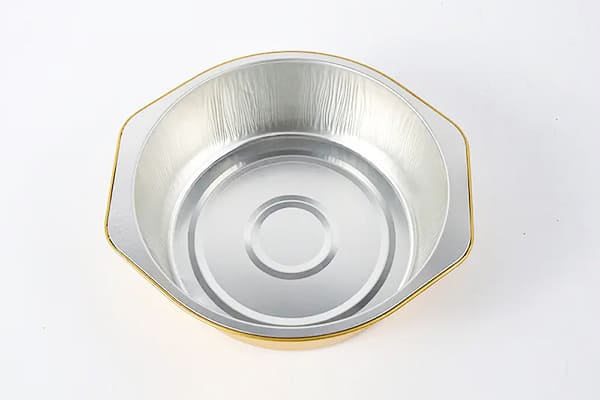
6061 Aluminum Foil Container
Why use 6061: airline and similar institutional customers require trays that withstand vibration, stacked handling and aggressive logistics while maintaining seal integrity and flatness. Higher stiffness reduces deformation in loading/unloading.
Functional requirements: high stacking strength, resistance to mechanical shocks, excellent flange flatness for sealing under constrained line speeds.
Recommended starting spec: 6061-T4 formed, 50–70 µm for trays subject to heavy stacking; evaluate hybrid designs (reinforced flanges or integrated stiffening beads).
Why use 6061: thermal stability, predictable dimensional behavior and metal barrier properties are useful for sample containers, chemical kits, thermal shields, or lab consumables where metallic barrier and heat tolerance are needed.
Functional requirements: chemical compatibility, dimensional precision, potential sterilization compatibility (dry heat, not typically autoclave for thin foil).
Recommended starting spec: 6061-O or T4, gauge selected by mechanical requirement (often 40–80 µm). Consider conversion coatings for aggressive chemistries.
Why use 6061: stable thermal and mechanical properties, EMI/thermal conduction when used as a shield or heat spreader. Wrinkle-free surfaces help in pick-and-place and automated component handling.
Functional requirements: low surface deviation for robotic handling, grounded/treated surfaces for EMI, dimensional stability in temperature cycles used during board reflow.
Recommended starting spec: 6061 in temper matched to process (often formed in softer temper), gauge often 50–80 µm for mechanical handling; consider conductive coatings or grounding strategies.
Why use 6061: smoother, stiffer walls accept embossing, selective finishing and high-quality printing better than more compliant alloys; wrinkle-free geometry preserves brand appearance.
Functional requirements: high aesthetic finish, retention of embossed details, consistent surface for inks and laminates.
Recommended starting spec: 6061-O/T4, 40–60 µm, extra attention to incoming roll finish (low Ra) and clean lubrication removal processes.
Why use 6061: when a tray is intended for multiple uses (rental/hospitality insert) rather than single use, 6061’s higher strength and thermal stability extend life and reduce deformation over cycles. Wrinkle-free walls reduce wear points and improve cleaning.
Functional requirements: repeated thermal cycles, mechanical washing (compatibility with detergents), resistance to denting and deformation.
Recommended starting spec: 6061 in a temper and thickness appropriate for repeated service—often 60–120 µm depending on reuse frequency. Consider hardening or backing structures for durability.
| Materyal / Konstruksyon | Typical foil / sheet gauge (M) | Formability (deep draw) | Lakas ng loob & stiffness (relative) | Thermal suitability (ovenable) | Kaagnasan / food-contact behavior | Relative cost | Recyclability |
|---|---|---|---|---|---|---|---|
| 6061 Aluminum Foil | 40–70 | Katamtaman (better in O/T4; limited if T6) | High — good stiffness and shape retention | Very good for oven/reheat (typical consumer ovens) | Good general resistance; may need conversion coating for acidic foods | Premium | Mataas na (aluminum recycling stream) |
| 3003 Aluminum Foil | 30–60 | High — excellent drawability | Low–Medium (more compliant than 6061) | Good for ovenable uses (thin applications) | Very good corrosion resistance for food contact | Mababa ang (commodity) | Mataas na |
| 8011 Aluminum Foil | 30–80 | Very high — optimized for foil forming | Low–Medium | Mabuti na lang (widely used in food foil) | Mabuti na lang; widely accepted for food contact | Mababa ang | Mataas na |
| 5052 Aluminum Foil | 30–70 | High — good ductility | Medium — good corrosion resistance and moderate strength | Mabuti na lang | Napakahusay na paglaban sa kaagnasan (marine/acidic) | Low–Medium | Mataas na |
| Aluminyo + polymer laminate (hal., Al foil bonded to film) | Metal layer 10–60 + polymer 20–200 | Laminated formability depends on combination | Composite stiffness — often lower than pure metal of same thickness | Good if polymer and adhesives rated for oven temps | Interface chemistry critical; film layers may restrict food contact applications | Katamtaman | Variable na (recycling more complex) |
| Alagang Hayop (thermoformed) | 200–800 (thermoform sheet) | Good for thermoforming (not deep-drawn like foil) | Mababa ang (flexible) | Limited — most PET grades not suitable for high-temp oven use (some ovenable PET exist) | Good inertness for many foods; check migration at elevated temps | Low–Medium | Variable na (recyclable streams) |
| PP (polypropylene, thermoformed) | 200–1000 | Good for thermoforming | Low–Medium | Good for many ovenable grades (microwave/ovenable PP) | Good food contact performance; can be printed/laminated | Mababa ang | Variable na (recyclable in many streams) |
| Hindi kinakalawang na asero (304/430 thin foil) | 50–200+ | Low — limited deep draw for very thin foils; heavier tooling | Very high stiffness and strength | Napakahusay (high temperature, reusability) | Napakahusay na paglaban sa kaagnasan; robust for repeated use | Mataas na (materyal na bagay & pagproseso ng) | Mataas na (pwede na ba mag recycle) |
| Composite metal (Al-Mg alloys, specialty) | 30–100 | Varied — engineered blends for targeted formability | Tunable — can approach 6061 stiffness or remain more ductile | Good to very good | Tunable with coatings | Medium–High | Mataas na (depends on alloy separation) |
6061 aluminum foil wrinkle-free container offer a technically sound, albeit premium, option where higher stiffness, surface finish and thermal reliability provide measurable value.
Success depends on close coordination between material specification, tooling design, process capability and quality assurance.
For many commodity uses, more ductile and lower-cost alloys remain optimal; however, where time-in-oven, automated sealing integrity, stacking strength or premium presentation are design drivers, 6061—formed and controlled correctly—delivers clear advantages.
1. Why isn’t 6061 alloy used for all foil containers?
The primary reason is cost. The multi-stage manufacturing process, especially the energy-intensive heat treatment, is significantly more expensive and slower than the single-step stamping of standard foil containers. Its use is only justified for high-value products.
2. Is the 6061 container safe for use in a microwave?
Like most metal containers, it is generally not recommended for use in a microwave oven, as metal can cause arcing. It is designed for use in conventional and convection ovens.
3. Does the heat treatment process affect the food-safe nature of the aluminum?
Hindi. Aluminyo haluang metal 6061 is inherently non-toxic and food-safe. The heat treatment is a purely thermal process that alters the metal’s crystalline structure to increase strength; it does not add any chemicals or affect its food-grade status.

Henan Huasheng Aluminyo Co., Ltd (HHALU para maikli), itinatag noong 2001, ay matatagpuan sa Huiguo Town, ang sikat na Aluminum capital ng Henan Province, Ito ay isang propesyonal na tagagawa at nakikibahagi sa pananaliksik, pag-unlad, produksyon ng, sales and service of aluminyo Plato ng Sheet, aluminyo likawin, aluminyo foil, aluminyo strip at aluminyo bilog.
Bukod pa rito, HHALU magbenta din ng aluminum plate para sa konstruksiyon at mga barko, aluminyo mirror plate, at automotive aluminyo haluang metal plate.
No.53, Dongming Road, Zhengzhou, Henan, Tsina
Copyright © Huasheng Aluminum 2025. Lahat ng karapatan ay nakalaan.
