5083 H116 Aluminum for Boat Hull represents the pinnacle of material selection in modern marine construction. The decision to use this specific alloy and temper combination is a critical engineering choice, balancing strength, peso, durabilidad, and cost.
In the realm of high-performance and commercial marine applications, AA 5083 H116 aluminum alloy stands as the industry benchmark.
This material is not merely a choice but a strategic necessity for hulls that must withstand the relentless corrosive forces of saltwater while delivering superior performance.

5083 H116 Aluminum for Boat Hull
5083-H116 aluminum is a non-heat-treatable marine-grade alloy belonging to the 5000-series of aluminum alloys, where magnesium (Mg) serves as the primary alloying element.
The designation “5083” refers to its specific chemical composition, standardized by global bodies such as the American Society for Testing and Materials (ASTM) and the European Committee for Standardization (CEN).
The “H116” temper is a critical characteristic that defines its mechanical state: it denotes a material that has been strain-hardened (cold-worked) and then stabilized at a temperature between 100–150°C.
This stabilization process relieves residual stresses from cold working, improves dimensional stability, and enhances resistance to stress corrosion cracking (SCC)—a vital attribute for large, load-bearing structures like boat hulls.
Unlike heat-treatable alloys (p'el ej.., 6061), 5083 gains strength through mechanical deformation rather than heat treatment, ensuring consistent properties across thick sections.
For boat hull applications, 5083-H116 is typically supplied in plate form, with thicknesses ranging from 4 milímetro (small recreational boats) Utia'al 50 milímetro (heavy-duty commercial vessels), making it versatile across vessel sizes and types.
The chemical composition of 5083-H116 is tightly regulated to optimize its marine performance.
Below is the composition as specified by ASTM B209 (Especificación estándar yo'osal láminas yéetel placas aluminio yéetel aleación aluminio), the most widely adopted standard for this alloy:
| Elemento | Rango composición (%) | Primary Function |
|---|---|---|
| Aluminio (Ti' le) | ≥ 92.0 | Base metal |
| Magnesio (Mg) | 4.0–4.9 | Primary strengthener; enhances corrosion resistance |
| Manganeso (Mn) | 0.40–1.0 | Grain refiner; improves weldability and toughness |
| Cromo (Cr) | 0.05–0.25 | Inhibits recrystallization; boosts SCC resistance |
| Hierro (Fe) | ≤ 0.40 | Impurity control; minimizes brittle intermetallics |
| Silicio (Wa) | ≤ 0.40 | Impurity control; avoids strength reduction |
| Cobre (Cu) | ≤ 0.10 | Minimizes galvanic corrosion risk |
| Zinc (Zn) | ≤ 0.25 | Impurity control |
| Titanio (Teechi') | ≤ 0.15 | Grain refiner during casting |
The H116 temper is a key differentiator for 5083 in boat hull applications, as it is specifically engineered for thick-section marine structures.
The temper designation follows the ASTM B290 standard (Standard Specification for Aluminum and Aluminum-Alloy H temper Designations) and breaks down as follows:
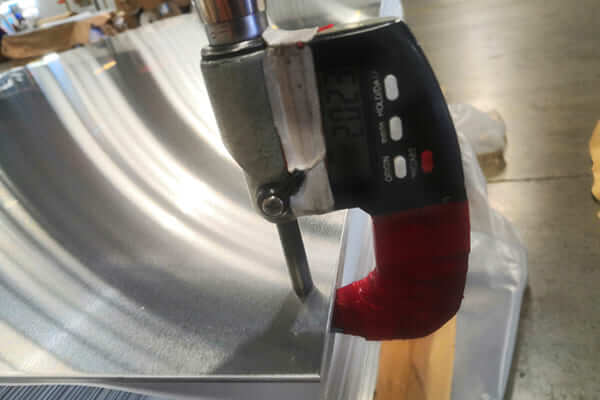
Huasheng 2mm 5083 Le' aluminio
The mechanical and physical properties of 5083 H116 aluminum for boat hull performance with values consistent across industry standards (ASTM B209, TI' 573-3).
Below is a summary of key properties for 6–25 mm thick plate:
| Propiedad | Ku | Test Standard |
|---|---|---|
| Densidad | 2.66 g leti' cm³ | ASTM B328 |
| Resistencia le tracción (σᵦ) | 310–380 MPa | ASTM E8/E8M |
| Límite elástico (σ₀.₂) | 240–310 MPa | ASTM E8/E8M |
| Alargamiento le rotura (δ) | ≥ 10% (25.4 mm gauge length) | ASTM E8/E8M |
| Xook elasticidad | 70 GPa | ASTM E111 |
| Dureza Brinell (HB) | 85–100 | ASTM E10 |
| Resistencia le fatiga (10⁷ cycles, R=0.1) | ~110 MPa | ASTM E466 |
| Conductividad térmica (25° C) | 120 W/m· K'uj | ASTM D1772 |
| Atemperar | Descripción | Límite elástico (Mpa) | Resistencia le tracción (Mpa) | Alargamiento (%) | Resistencia le corrosión | Marine Suitability |
|---|---|---|---|---|---|---|
| O (Recocido) | Fully annealed, softest condition | 110–125 | 240–290 | 18–25% | Jach ma'alo'ob | Good for forming; not used for hulls |
| H111 | Slightly strain-hardened | 125–180 | 275–330 | 14–20% | Jach ma'alo'ob | Suitable for plates & general marine parts |
| H116 | Strain-hardened, marine-grade stabilized | 215–240 | 300–350 | 10–16% | Jach ma'alo'ob (exfoliation-resistant) | Ideal for hull plating & structure |
| H321 | Strain-hardened, thermally stabilized | 200–230 | 290–340 | 12–18% | Superior SCC resistance | Best for tanks, internal stressed components |
Aluminum 5083-H116 offers a high strength-to-weight ratio, making it ideal for fast-moving and fuel-efficient vessels.
5083’s magnesium content provides superior resistance to:
The H116 process ensures stable microstructure, reducing the chance of stress corrosion cracking.
Compared to heat-treatable alloys (p'el ej.., 6061), 5083 maintains better strength in the HAZ.
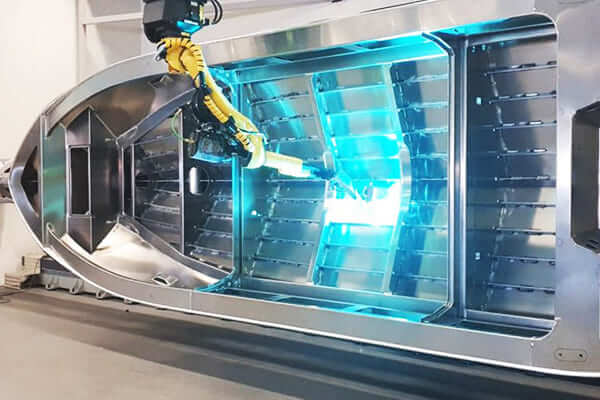
5083 H116 Aluminum Welding
Prior to fabrication, 5083-H116 plates must be cleaned to remove oils, oxides, ka contaminantes. Use a solvent (p'el ej.., isopropyl alcohol) for degreasing, followed by a non-abrasive alkaline cleaner.
Avoid using steel wool or wire brushes, as they can leave iron particles that cause galvanic corrosion.
Edge preparation for welding is critical—bevel thick plates (≥10 mm) to a 30–45° angle for full penetration, and ensure edges are smooth and free of burrs.
5083-H116 exhibits good formability for a high-strength alloy. Cold forming (p'el ej.., press braking, roll forming) is preferred for hull curves, with a minimum bend radius of 3× the plate thickness (p'el ej.., 24 mm radius for 8 mm plate) to avoid cracking.
For complex shapes (p'el ej.., hull transoms), hot forming at 200–250°C can be used, but must be followed by a stabilization heat treatment to restore the H116 temper.
Compliance with industry standards and classification society rules is mandatory for boat hull construction to ensure safety and performance. Below are key standards and practical guidance:
Major classification societies (ABS, DNV GL, Lloyd’s Register) have specific rules for aluminum boat hulls. Practical notes include:
5083-H116 aluminum has become one of the most important materials in the modern marine industry due to its exceptional strength-to-weight ratio, Resistencia le corrosión, ka soldabilidad.
These capabilities make it not only a structural mainstay for boat hulls but also a versatile material used across multiple marine and industrial sectors.
Beyond technical performance, 5083-H116 delivers significant economic advantages in manufacturing, operation, and long-term lifecycle management.

Hull Structure 5083 H116 Aluminum
| Propiedad / Métrico | 5083-H116 Aluminum | 5086-H116 Aluminum | Marine Steel (AH36) | FRP (Fiberglass Reinforced Plastic) |
|---|---|---|---|---|
| Densidad (g leti' cm³) | 2.66 | 2.65 | 7.85 | 1.7–2.0 |
| Weight vs. Acero | ~65% lighter | ~65% lighter | K'a'ana | ~70–75% lighter |
| Resistencia le tracción (Mpa) | 275–350 | 240–300 | 400–550 | 100–250 |
| Límite elástico (Mpa) | 215–240 | 125–190 | 235–350 | 60–150 |
| Alargamiento (%) | 10–16 | 12–20 | 20–22 | 1–3 |
| Xook elasticidad (GPa) | 70 | 69 | 210 | 10–30 |
| Corrosion Resistance in Seawater | Jach ma'alo'ob | Jach ma'alo'ob | Yáanal (requires coating + CP) | Jach ma'alo'ob |
| Typical Hull Plate Thickness (milímetro) | 4–8 | 4–8 | 6–12 | 6–20 |
| Pitting Corrosion Rate (mm/year) | <0.015 | <0.015 | >0.10 (unprotected) | N/A |
| Fuel Consumption Impact | –8% to –20% | –8% to –18% | K'a'ana | –5% to –12% |
| Soldabilidad | Jach ma'alo'ob | Jach ma'alo'ob | Moderado | Óotsil (requires laminating) |
| Resistencia le impacto | Ka'anal (ductile) | Ka'anal | Ka'anal | Moderado (brittle fractures possible) |
| Maintenance Cost (20-year) | Yáanal | Yáanal | Ka'anal | Ka'a |
| Service Life (ja'abo'ob) | 25–40 | 25–35 | 15–25 | 20–30 |
| Resistencia le k'áak'o' | Ma'alob | Ma'alob | Jach ma'alo'ob | Óotsil |
| Fabrication Complexity | Yáanal | Yáanal | Moderado | Moderate–High |
| Repair Difficulty | Yáanal | Yáanal | Ka'a | Ka'anal |
| Material Cost | Ka'a | Ka'a | Yáanal | Yáanal |
| Lifecycle Cost Efficiency | ★★★★★ (Highest) | ★★★★☆ | ★★★☆☆ | ★★★★☆ |
| Aplicaciones típicas | Hulls, Cubiertas, Superstructures | Hulls, Marcos | Cargo ships, tankers | Recreational boats, canoes |
5083 H116 aluminum for boat hull construction, offering a unique blend of mechanical strength, weight efficiency, Resistencia le corrosión, and weldability that addresses the demanding needs of the marine environment.
Its carefully controlled chemical composition—with magnesium as the primary alloying element—and the H116 temper’s stabilization process ensure superior performance in thick-section structures, from small recreational boats to large commercial vessels.
Real-world applications and data confirm its durability, with hulls lasting 20–30 years and delivering significant lifecycle cost savings through reduced fuel and maintenance expenses.
While alternative materials like steel and FRP have lower upfront costs, they cannot match 5083-H116’s overall balance of properties.
As the marine industry continues to prioritize sustainability and performance, 5083-H116 will remain a cornerstone material, driving innovation in boat design and construction for years to come.
Q: Can 5083-H116 be used in saltwater for extended periods?
Un: Je'el. Its corrosion rate in saltwater is ≤0.02 mm/year, and it resists SCC and crevice corrosion, making it suitable for permanent saltwater service. Proper maintenance (p'el ej.., anti-fouling paint, sacrificial anodes) extends its lifespan further.
Q: What is the maximum thickness of 5083 H116 aluminum for boat hull?
Un: Commercial suppliers offer 5083-H116 plate up to 50 mm thick, suitable for heavy-duty commercial vessels (p'el ej.., ferries, offshore support boats).
Q: Is 5083-H116 more difficult to weld than steel?
Un: No—while aluminum requires different techniques (p'el ej.., argon shielding), 5083-H116’s weldability is excellent. Certified aluminum welders can achieve strong, corrosion-resistant joints with standard GTAW/GMAW equipment.
Q: How does 5083-H116 perform in cold marine environments?
Un: It maintains excellent toughness at low temperatures (-50°C to 0°C), with no significant reduction in tensile strength or elongation. This makes it suitable for polar or cold-water applications.
Q: Can 5083-H116 hulls be repaired if damaged?
Un: Je'el. Minor dents can be cold-worked, while cracks or holes can be welded using 5356 filler metal. Damaged paint or coating should be touched up promptly to prevent corrosion.

Henan Huasheng Aluminio Co., Ltd (HHALU utia'al u abreviar), establecida ti' 2001, Kula'an tu kaajil Huiguo, le famosa capital u aluminio u provincia u Henan, Leti' jump'éel fabricante ku yéetel ku meentik le investigación, ma'alo'ob, producción, sales and service of aluminio sheet plate, bobina aluminio, ju'un aluminio, Ch'íin aluminio yéetel wóoliso' aluminio.
Beey xan, HHALU xan ku placas aluminio yo'osal le construcción yéetel le chéem, placa néeno' aluminio, ka placa aleación aluminio automotriz.
No.53, Bejo' u Dongming, Zhengzhou, Henan, China
P'iskambal autor © Huasheng Aluminium 2025. Tuláakal le p'iskambal reservados.
