3105-O Aluminum Roll for cake tray is a specialized, high-performance raw material engineered for the manufacturing of premium-quality aluminum cake trays and bakeware.
As a 3xxx series aluminum-manganese-magnesium (Al Mn-Mg) haluang metal, 3105 offers a significant upgrade in strength and rigidity compared to common foil alloys like 8011.
Ang ‘O’ (fully annealed) Pamahiin is a critical specification, endowing the material with maximum ductility and excellent formability, which is essential for the high-speed stamping process that creates the tray’s complex shape.
This combination of moderate strength (tensile strength of ~115-155 MPa) and superior workability, along with aluminum’s inherent high thermal conductivity and food-safe nature, makes it the ideal substrate.
It allows for the production of durable, warp-resistant cake trays that provide uniform heat distribution for perfect baking results, positioning it as the material of choice for high-quality disposable and reusable bakeware.
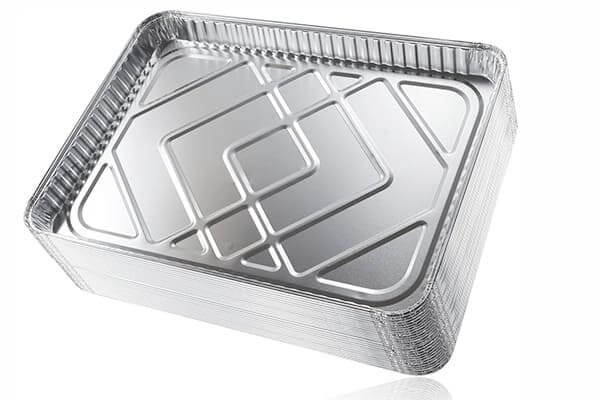
3105-O Aluminum Roll for Cake Tray
The designation “3105-O” is a precise technical specification that defines both the material’s chemistry and its mechanical state.
The O temper condition delivers the specific mechanical profile required for cake tray manufacturing:
| Pag-aari | Pagtutukoy | Pamamaraan ng Pagsubok | Cake Tray Manufacturing Relevance |
|---|---|---|---|
| Lakas ng Paghatak | 110–145 MPa (16–21 ksi) | ASTM E8 | Sufficient strength for handling; moderate spring-back during forming |
| Yield Lakas | 40–48 MPa (5.8–7.0 ksi) | ASTM E8 | Low yield enables complex forming without excessive force |
| Pagpapahaba | 16–20% (A50mm) | ASTM E8 | Critical for deep drawing without edge cracking |
| Ang katigasan ng ulo | 28–29 HB | ASTM E10 | Soft surface prevents scratching during forming |
| Lakas ng Paggupit | 75–84 MPa | ASTM B831 | Punching and blanking compatibility |
| Lakas ng Pagkapagod | 50–52 MPa | ASTM E466 | Durability under thermal cycling |
These properties position 3105-O between pure aluminum (1050-O: 60–80 MPa tensile) and work-hardened tempers (3105-H14: 150–200 MPa).
Ang 20% elongation specifically enables the 2.0:1 draw ratios required for deep cake pans, while the 110–145 MPa tensile strength ensures structural stability during handling and shipping.
| Pag-aari | Halaga | Unit | Baking Performance Impact |
|---|---|---|---|
| Densidad ng katawan | 2.71 | g/cm³ | 67% lighter than steel; reduces shipping costs |
| Punto ng Pagtunaw | 643–657 | °C | Safe for all domestic and commercial baking (max 300°C) |
| Thermal kondaktibiti | 160 | W/m·K | Even heat distribution; eliminates hot spots |
| Specific Heat | 0.214 | Btu/lb·°F | Rapid temperature response; energy efficient |
| Pagpapalawak ng Thermal | 23.1 | ×10⁻⁶/K | Dimensional stability during thermal cycling |
| Electrical Resistivity | 0.034 | μΩ·m | Enables eddy current testing for quality control |
Ang thermal kondaktibiti ng 160 W/m·K proves particularly critical for cake tray performance.
This value—approximately half that of pure aluminum (237 W/m·K) but double that of stainless steel (16 W/m·K)—ensures rapid, uniform heat distribution across the baking surface.
Cakes bake evenly without the burning or undercooking associated with hot spots in lower-conductivity materials.
Ang 3105 alloy naturally forms a protective aluminum oxide (Al₂O₃) layer approximately 4–10 nanometers thick. This passive film provides:
The production sequence begins with direct chill (D at T) casting of 6–8mm thick sheet ingots. Quality producers implement:
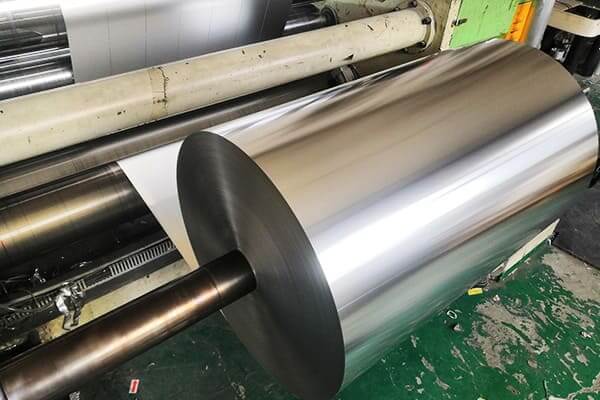
3105-O Aluminum Roll Production
Multi-stand tandem cold mills achieve precise thickness control for cake tray applications:
| Target Thickness | Paglalapat | Cold Reduction | Intermediate Annealing |
|---|---|---|---|
| 0.4–0.6mm | Light-duty round pans, tart molds | 75–80% | Required at 0.8mm |
| 0.6–0.8mm | Standard cake pans, roasting trays | 70–75% | Required at 1.0mm |
| 0.8–1.2mm | Commercial baking sheets, bundt pans | 60–70% | Required at 1.5mm |
The critical transformation to O temper occurs in continuous annealing furnaces:
Post-annealing processes prepare the coil for cake tray stamping:
The selection of 3105-O aluminum roll as the base material for cake trays is not an arbitrary decision but a strategic choice aimed at elevating the final product’s performance, user experience, and market competitiveness.
Its core advantages are multi-dimensional, collectively forming a powerful value proposition.
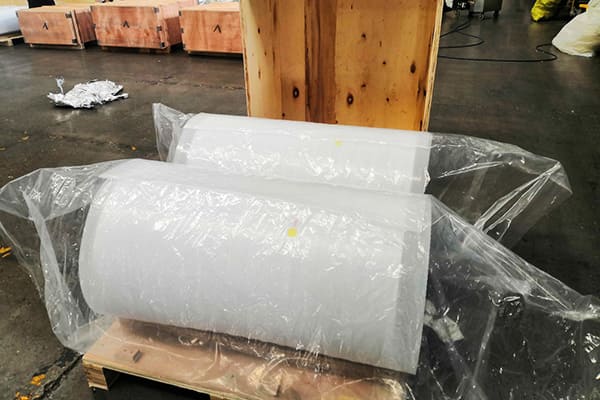
3105-O Aluminum Roll Packaged by Huasheng
This is the most significant advantage of 3105 over softer alloys like 8011 or pure aluminum.
The physical nature of aluminum provides this advantage, and the selected thickness ensures it.
In any food-contact application, safety is the non-negotiable bottom line.
Ang ‘O’ Pamahiin is the key to achieving this advantage.
High-quality bakeware is not just a tool; it is part of the kitchen’s aesthetic.
The versatility of 3105-O aluminum roll stems from its balance of formability, kalidad ng ibabaw, thermal performance and food compatibility.
In practice, this allows the same base material to serve a wide range of baking, storage and specialty food applications with only changes in gauge, forming design and surface treatment.
The most common application of 3105-O aluminum roll is in the production of disposable and semi-rigid cake trays and baking molds used by bakeries, food manufacturers and retailers.
Typical products
Typical thickness range
Beyond baking, 3105-O aluminum roll is widely used in food storage and packaging formats where barrier performance, appearance and handling strength are required.
Common applications
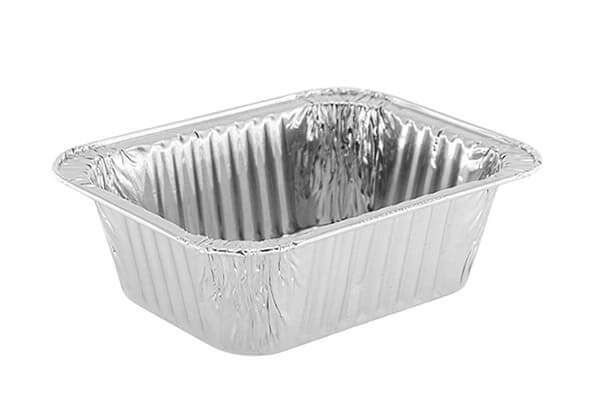
Food Storage used 3105-O Aluminum Roll
3105-O aluminum roll is also chosen for niche or higher-performance baking and confectionery applications where standard materials are insufficient.
Mga Halimbawa
When specifying and procuring 3105-O material and finished trays, reference common standards and certifications:
| Pag-aari / Metriko | 3105-O (Al) | 3003-O (Al) | 8011 / Foil-type Al | Coated Steel (tinplate / CRC) | PP (polypropylene) |
|---|---|---|---|---|---|
| Typical composition | Al + ~0.8–1.3% Mn (Al base) | Al + ~1.0% Mn | Al alloy optimized for foil production (iba iba ang) | Fe + C; surface-coated (tin/organic) | Polymer (polypropylene homopolymer/copolymer) |
| Common tempers supplied | O (annealed na nga ba) | O (annealed na nga ba) | O / foil tempers | CR / T-tempers | Molded/annealed grades |
| Formability (qualitative) | Napakahusay (deep draw, hemming) | Napakahusay | Excellent for embossing/lamination (papel de liha) | Katamtaman (mas matigas; needs higher forming forces) | Mabuti na lang for thermoforming; maganda ang tigas |
| Typical UTS (indicative, MPa) | ≈ 90–150 MPa (supplier/ thickness dependent) | ≈ 90–150 MPa | ≈ 80–220 MPa (very process dependent) | ≈ 270–550 MPa | ≈ 30–40 MPa |
| Typical elongation (%) | Mataas na (madalas na >20% sa O temper) | Mataas na (>20%) | High for foil | Variable na (10–30% depending on grade) | Katamtaman hanggang sa mataas (100–300% in some grades) |
| Densidad ng katawan (g·cm⁻³) | 2.70 | 2.70 | 2.70 | ≈ 7.85 | ≈ 0.90–0.95 |
| Thermal kondaktibiti (W·m⁻¹· K⁻¹) | ~200 (3xxx series slightly lower than pure Al) | ~200 | ~200 (foil similar) | ~45–60 | ~0.1–0.25 |
| Food-contact suitability | Napakahusay (with food-grade lacquers as required) | Napakahusay | Excellent for foil applications (check coatings) | Good if coated / lined for food | Mabuti na lang (widely used for food containers) |
| Typical tray gauge (mm) | 0.18–0.60 (0.20–0.40 common for disposables) | Similar | Very thin for foil layers; not usually primary structural tray | ~0.12–0.40 (depends on application) | 0.25–1.2 |
| Relative cost (typical) | Med | Med | Med (for foil supply) | Med–High | Mababa ang |
| Recyclability | Napakahusay (aluminum stream) | Napakahusay | Napakahusay | Napakahusay (steel stream) | Maaaring i-recycle (but recycling rates vary) |
| Best use cases for cake trays | Drawn disposable & premium trays, ovenable with right coating | General tray manufacture where similar properties required | Foil barrier layers, decorative necking/lamination | Rigid trays where higher stiffness needed or where metal feel is wanted | Low-cost thermoformed/stackable trays |
3105-O Aluminum Roll for Cake Tray is a pragmatic, widely-used material for cake trays that combines excellent formability, attractive surface finish options, reasonable cost and compatibility with food-grade coatings and processing.
For manufacturers, the keys to success include careful incoming material checks (MTCs), correct tooling and lubrication practices, staged forming where necessary, and validation of coating adhesion and oven performance where required.
By balancing gauge selection (hal., 0.20–0.50 mm depending on product and handling) against design stiffness requirements, tray producers can optimize cost, weight and consumer experience.
Q1 — What gauges of 3105-O are commonly used for cake trays?
Common nominal gauges range from ~0.18 mm to 0.6 mm, with many disposable trays in the 0.20–0.40 mm band. Choose thicker gauges for heavy loads or stacking strength; choose thinner gauges to save cost and weight for shallow or decorative trays.
Q2 — Is 3105-O suitable for oven use?
The alloy itself tolerates typical reheating temperatures; however, the critical point is the coating or lacquer used for finishing. Only use coatings rated for the target oven temperature and validate tray performance through thermal cycling tests.
Q3 — What are the principal QA checks when sourcing 3105-O coil?
Request MTC (chemical and mechanical), check thickness tolerance, surface finish and presence/condition of any primer/lacquer. Specify acceptable limits for coil geometry and pinholes/defects if visible finish is critical.
Q4 — How does changing gauge affect tray mass?
Because mass scales linearly with thickness, reducing sheet thickness from 0.50 mm sa 0.30 mm for the same tray area reduces aluminum mass by roughly 40% (example: a 0.05 m² tray would fall from ~67.5 g → ~40.5 g). Balance weight reduction against stiffness and dent resistance requirements.
Q5 — How recyclable are cake trays made from 3105?
Ang aluminyo ay mataas na recyclable. Uncoated or simply lacquered aluminum trays are usually accepted in aluminum recycling streams. Complex laminates or mixed-material coatings can complicate recycling — prefer mono-material or easily separable coatings where recycling is a priority.

Henan Huasheng Aluminyo Co., Ltd (HHALU para maikli), itinatag noong 2001, ay matatagpuan sa Huiguo Town, ang sikat na Aluminum capital ng Henan Province, Ito ay isang propesyonal na tagagawa at nakikibahagi sa pananaliksik, pag-unlad, produksyon ng, sales and service of aluminyo Plato ng Sheet, aluminyo likawin, aluminyo foil, aluminyo strip at aluminyo bilog.
Bukod pa rito, HHALU magbenta din ng aluminum plate para sa konstruksiyon at mga barko, aluminyo mirror plate, at automotive aluminyo haluang metal plate.
No.53, Dongming Road, Zhengzhou, Henan, Tsina
Copyright © Huasheng Aluminum 2025. Lahat ng karapatan ay nakalaan.
