The humble aluminum beverage can stands as an icon of modern convenience, a vessel we interact with billions of times a day.
We recognize its satisfying “psst” as the sound of refreshment and appreciate its lightweight, easy-to-cool nature.
Yet, beneath this familiar exterior lies a masterpiece of material science and high-speed manufacturing.
Manufacturers engineer the can not as a single, uniform piece of metal, but as a system, where they craft each part—the body, the lid, and the bottom—from a specific aluminum alloy, precision-engineered for its unique role.
At the very foundation of this structure lies the can bottom, a component that endures immense forces and requires perfect performance. The material of choice for this critical application is 3004 aluminum coil for cans bottom.
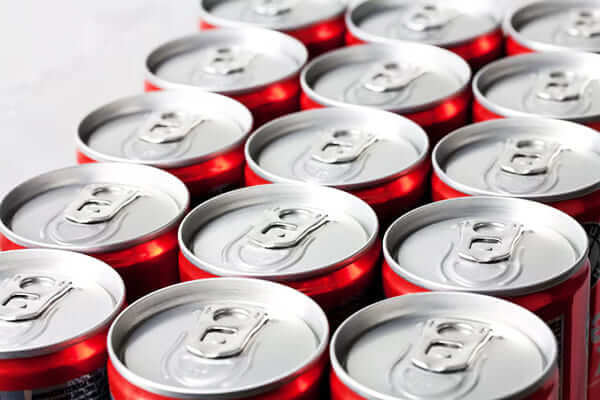
3004 aluminum coil for cans bottom
This guide will take you on a deep dive into this unsung hero of the packaging world. We will explore the extreme engineering challenges a can bottom faces, decode the specific metallurgy of the 3004 aleación, and understand why the properties of 3004 aluminum coil for cans bottom make it the perfect candidate.
Furthermore, we’ll journey through the manufacturing process, compare it to other can alloys, and highlight the vital role premier suppliers play in a supply chain that churns out billions of cans a year.
Prepare to gain a new appreciation for the sophisticated engineering at the bottom of your favorite beverage.
A carbonated beverage can acts as a pressure vessel. The dissolved CO2 can exert pressures up to 90 pounds per square inch (Psi) o 6.2 bar, a force equivalent to more than three times the pressure in a typical car tire.
This pressure increases significantly if someone agitates the can or leaves it in a warm environment.
The bottom must withstand this constant force without bulging, deforming, or failing.
The iconic concave dome shape serves a functional, not aesthetic, purpose.
This geometry, which designers borrowed from architectural principles, distributes the immense internal pressure evenly across the structure, preventing the bottom from becoming a convex bulge.
It also provides a stable base and creates a recessed rim that allows cans to stack securely in vending machines and on store shelves.
Can manufacturing lines operate at mind-boggling speeds, producing up to 2,000 cans per minute.
The aluminum coil that manufacturers feed into these machines must be able to be blanked, drawn, and formed into its complex final shape in a fraction of a second without cracking or failing.
The material must remain completely inert and resist corrosion from the beverage inside, which can be quite acidic (p'el ej.., colas, fruit juices).
This attribute is essential for preserving the flavor, purity, and safety of the product over its entire shelf life.
Every gram of weight adds to shipping costs and environmental impact.
The material must provide the required strength using the absolute minimum amount of material, making the strength-to-weight ratio a paramount consideration.
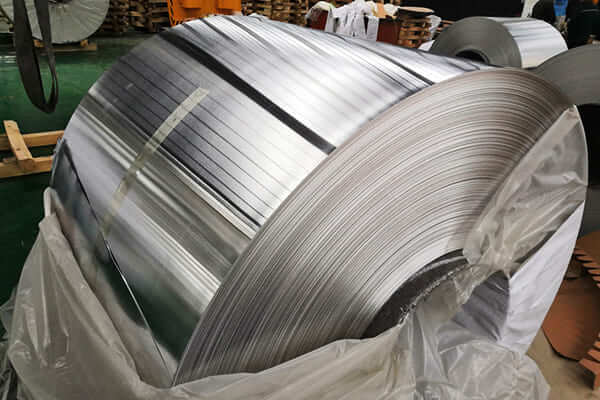
3004 aluminum coil display
The designation “3004” is a specific code from the Aluminum Association that tells us about the alloy’s chemical makeup.
This alloy belongs to the 3xxx series of aluminum alloys, which feature manganese as their primary alloying element.
The outstanding properties of 3004 bobina aluminio for cans bottom stem directly from its carefully controlled composition.
It’s not pure aluminum, but a sophisticated blend designed for peak performance.
| Elemento | Symbol | Typical Percentage (%) | Role in the Alloy |
| Aluminio (Ti' le) | Ti' le | Equilibrar (~95-97%) | The primary base metal, providing lightness and corrosion resistance. |
| Manganeso (Mn) | Mn | 1.0 – 1.5% | Primary Strengthening Agent. Significantly increases strength through solid solution strengthening without seriously compromising ductility. |
| Magnesio (Mg) | Mg | 0.8 – 1.3% | Secondary Strengthening Agent. Works with manganese to provide a substantial boost in strength, especially after work-hardening. |
| Hierro (Fe) | Fe | 0.7% K'aas | An impurity that manufacturers control to maintain formability. |
| Silicio (Wa) | Wa | 0.3% K'aas | An impurity, also controlled to optimize performance. |
The synergy between manganese and magnesium reveals the secret to the 3xxx series’ success.
Manganese provides a foundational level of strength, while the addition of magnesium elevates it to the levels required for high-pressure applications found in beverage cans.
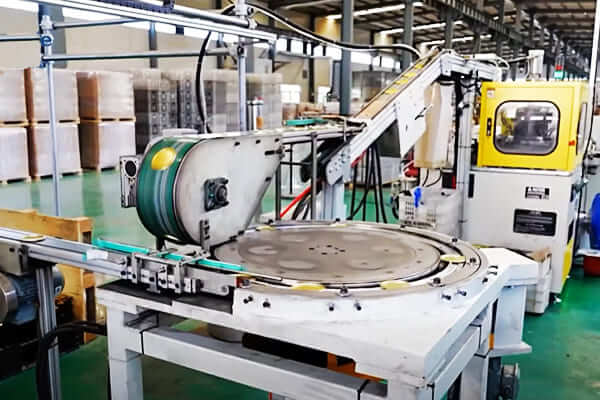
Aluminum cans bottom production
When specifying 3004 aluminum coil for cans bottom, engineers almost always pair the alloy with the H19 temper. This code is just as important as the alloy number.
Manufacturers achieve the H19 temper by subjecting the aluminum coil to a massive amount of cold reduction in the rolling mill.
This process elongates the grain structure of the metal, creating a highly stressed internal state that is incredibly resistant to deformation—exactly what is needed to make a reliable 3004 aluminum coil for cans bottom.
Now, let’s connect the material’s properties to the engineering challenges we outlined earlier.
Leti'e' 3004 aluminum coil for cans bottom matches these demands perfectly.

Aluminum cans bottom dispaly
In a high-volume, high-performance application like can manufacturing, consistency is everything.
The properties of the 3004 aluminum coil for cans bottom are only reliable if its dimensions, particularly its thickness (or gauge), are perfectly uniform.
The coil’s thickness is a tightly controlled specification, typically around 0.20-0.25 milímetro.
This obsession with dimensional accuracy represents a universal principle in material science. To understand the level of precision required, it’s helpful to look at another high-performance aluminum product: ju'un aluminio.
While can stock is measured in fractions of a millimeter, high-barrier foil is measured in microns.
For such a delicate material, quality control technicians must often calculate thickness of aluminum foil using an indirect method to ensure accuracy.
This calculation relies on the fundamental physical relationship: Densidad = juuch' / Volumen.
Because the volume of a flat sheet is its Area × Thickness, one can rearrange the formula to solve for thickness:
Thickness = Mass / (Area × Density)
This same dedication to precision applies to the 3004 aluminum coil for cans bottom.
In the rolling mill, advanced non-contact sensors like X-ray or laser micrometers continuously monitor the gauge across the entire width of the coil, ensuring every square meter meets the exacting standards the can-making industry requires.
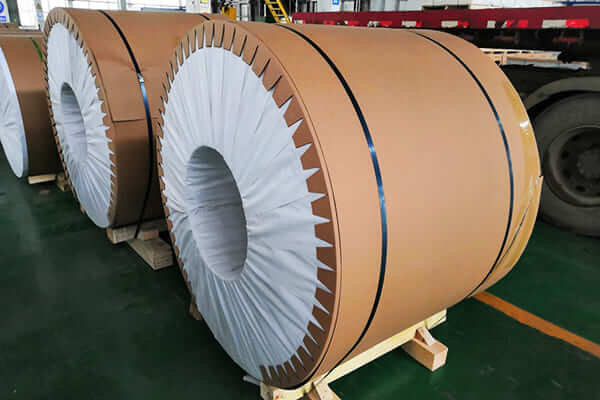
Huasheng Packaged 3004 bobina aluminio
The beverage can is a system, yéetel le 3004 aluminum coil for cans bottom is just one part of the orchestra.
To appreciate its specific role, we must compare it to the other specialized alloys used.
| Componente | Typical Alloy | Key Alloying Elements | Primary Role & Required Properties |
| Can Body | 3104-H19 | Higher Mg than 3004 | Embutición taam & Ironing. Needs slightly more ductility to be drawn from a shallow cup into a full-height, thin-walled can body without tearing. |
| Can Bottom (End) | 3004-H19 | Mn, Mg | Pressure Resistance & Conformabilidad. Leti'e' 3004 aluminum coil for cans bottom is optimized for the strength to contain high pressure after being formed into the dome shape. |
| Can Lid (Top End) | 5182-H48 o H19 | High Mg (~4.5%) | Scoring & Tearing. High strength is needed for the intricate score line that allows the tab to open the can cleanly and reliably without detaching. |
| Stay-On-Tab | 5042 or similar | Mg | Formando & Riveting. Must be formable into the tab shape and strong enough to act as a lever to break the score on the lid. |
Producing billions of identical can bottoms requires a supply chain of unparalleled reliability.
Can manufacturers cannot afford any variation in the quality of their incoming 3004 aluminum coil for cans bottom.
Leading global suppliers like Henan Huasheng Aluminio Co., Ltd. are essential partners in this ecosystem.
They provide far more than just metal; they deliver consistency and quality on a massive scale.
Sourcing from a proven, high-quality supplier represents more than just a good business practice; it’s the only way to ensure the safety, reliability, and economic viability of modern beverage can production.
Ku k'áatik 1: Do companies use materials other than 3004 aluminum for can bottoms?
Leti'e' 3004 aluminum coil for cans bottom is the dominant and industry-standard choice for aluminum beverage cans worldwide because it offers the optimal balance of strength, Conformabilidad, costar, ka resistencia u corrosión.
K'áatik 2: Do manufacturers coat the 3004 aluminum coil before making it into a can?
Ma', suppliers typically provide the coil uncoated. The forming, trimming, cleaning, and coating processes all happen inside the can manufacturing plant.
Manufacturers coat the inside of the can bottom with a protective polymer lacquer after they form it and attach it to the can body.
Ku k'áatik 3: Can a can bottom made from 3004 aluminum be recycled with the rest of the can?
Absolutamente. One of the greatest advantages of the aluminum can is that all its components (3104 body, 3004 bottom, 5182 lid) are aluminum alloys that can be melted down and recycled together in a highly efficient, closed-loop process.
Ku k'áatik 4: What is the main difference between the alloy for the can body (3104) and the can bottom (3004)?
The main difference is a slightly higher magnesium content in the 3104 body stock.
This provides the extra ductility needed for the severe stretching and ironing process that forms the tall, thin walls of the can.
Leti'e' 3004 aluminum coil for cans bottom is specifically optimized for the higher strength and forming requirements of the bottom end.
The next time you pick up a beverage can, take a moment to look at its base. That simple, concave dome is the result of decades of innovation in material science and manufacturing.
It is a structure that withstands incredible forces, formed in a blink of an eye from a material engineered for perfection.
Leti'e' 3004 aluminum coil for cans bottom, in its extra-hard H19 temper, is the unsung hero of this story.
Its unique blend of manganese and magnesium provides an unparalleled combination of strength and formability, delivering safety, efficiency, and reliability on a global scale.
From the metallurgical precision of expert suppliers like Huasheng Aluminum to the high-speed presses on the factory floor, every step testifies to the engineering that underpins our modern lives.
The can bottom is more than just a base; it is the unseen, unyielding foundation of an icon, expertly crafted from 3004 aluminum coil for cans bottom.

Henan Huasheng Aluminio Co., Ltd (HHALU utia'al u abreviar), establecida ti' 2001, Kula'an tu kaajil Huiguo, le famosa capital u aluminio u provincia u Henan, Leti' jump'éel fabricante ku yéetel ku meentik le investigación, ma'alo'ob, producción, sales and service of aluminio sheet plate, bobina aluminio, ju'un aluminio, Ch'íin aluminio yéetel wóoliso' aluminio.
Beey xan, HHALU xan ku placas aluminio yo'osal le construcción yéetel le chéem, placa néeno' aluminio, ka placa aleación aluminio automotriz.
No.53, Bejo' u Dongming, Zhengzhou, Henan, China
P'iskambal autor © Huasheng Aluminium 2025. Tuláakal le p'iskambal reservados.
