Aféierung
In the modern building envelope market, the demand for materials that combine aesthetic appeal, Haltbarkeet, and cost efficiency is higher than ever. Among the leading choices for exterior cladding and curtain walls today is the 3003 Fluorocarbon Beschichtete Aluminiumplack fir Gebai.
This material couples the excellent formability and corrosion resistance of 3003 aluminum with the superb weather resistance and color stability of fluorocarbon (PVDF) Beschichtungen.
The result is a versatile solution that can meet the rigorous demands of commercial high-rise facades, architektonesch Akzenter, and signage, while offering reliable long-term performance and life-cycle cost advantages.
This comprehensive guide explores the fundamentals of 3003 fluorocarbon-coated aluminum plates, explains why they perform well in building applications, examines technical specifications and standards, and provides practical guidance for designers, Fabrikateuren, contractors, and building owners.
It also features a supplier spotlight on Huasheng Aluminum, a well-regarded manufacturer with a track record of delivering high-quality aluminum products for architectural use.
Iwwerall, you’ll find data-driven insights, case-study examples, and actionable recommendations to help you make informed procurement and design decisions.
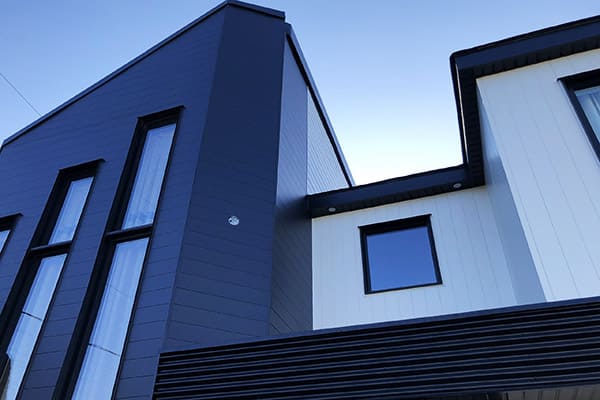
3003 Fluorocarbon Beschichtete Aluminiumplack fir Gebai
Wat mécht 3003 Fluorocarbon Coated Aluminum Plate for Building unique?
In the building sector, the coating that protects the substrate is just as important as the substrate itself.
Déi 3003 fluorocarbon coated aluminum plate stands out for its particular combination of material properties and coating performance that translate to dependable exterior performance.
The key advantages include:
- Excellent corrosion resistance in a wide range of environments, including industrial and coastal atmospheres.
- Good formability that enables complex panel shapes, tight radii, and efficient fabrication without cracking.
- Superior UV resistance and color stability due to the fluorocarbon PVDF coating, which helps maintain appearance over time.
- Broad color and finish options, enabling architects to realize bold aesthetics or subdued, timeless looks.
- Long service life with predictable maintenance requirements, contributing to lower life-cycle costs.
Why choose fluorocarbon-coated aluminum for building facades?
Key structural and performance considerations
- Formability and ductility: 3003 aluminum is a non-heat-treatable alloy known for its superb formability. This makes it suitable for curved façades, komplizéiert Profiler, and architectural features that require bending or rolling without cracking.
- Korrosiounsbeständegkeet: The alloy itself offers good corrosion resistance, which is augmented by the PVDF fluorocarbon coating. The coating acts as a barrier against moisture, pollutants, and chlorides in coastal and industrial environments.
- UV resistance and color stability: PVDF coatings, especially those meeting stringent industry standards, display excellent resistance to UV radiation, Wiederwelt, and chalking. Colors remain vibrant with minimal fading over time.
- Low maintenance: The exterior surface resists dirt accumulation and can be cleaned with conventional methods. PVDF-coated panels typically do not require frequent repainting, contributing to maintenance savings.
- Aesthetic versatility: The coating system supports a wide color range, including metallic, satin, and matte finishes, enabling designers to pursue contemporary or classic looks.
How it compares with alternative cladding approaches
- Steel or stainless-steel panels: While very durable, these materials can be heavier and more expensive. They may require corrosion protection and cladding systems that are less forgiving in terms of thermal expansion and installation costs.
- Polyester or SMP coatings on aluminum: Polyester coatings are cheaper but offer less UV resistance and color stability than PVDF coatings. For high-visibility exteriors and long-term color retention, designers generally prefer PVDF coatings.
- Fiberglass-reinforced polymers or composite panels: These can offer excellent lightweight performance and design flexibility but may require different maintenance regimes and environmental considerations. PVDF-coated aluminum remains a familiar choice for many architects who want a metal look with proven exterior longevity.
Area-focused considerations for building envelopes
- Coastal or industrial environments: The combination of aluminum substrate and PVDF coating provides strong resistance to chloride attack and weathering while preserving appearance.
- High-traffic architectural zones: The hard, durable coating resists scratches and abrasions, maintaining aesthetics under repeated contact and cleaning cycles.
- Curtain-wall and cladding systems: The consistent flatness and uniform coating thickness aid in achieving precise panel alignment, glazing interfaces, and installation tolerances.
- Customization and BIM compatibility: Manufacturers offer PVDF-coated aluminum panels in a range of standard thicknesses, Breet, an Längt, along with BIM libraries and installation guidelines to support efficient design and construction.
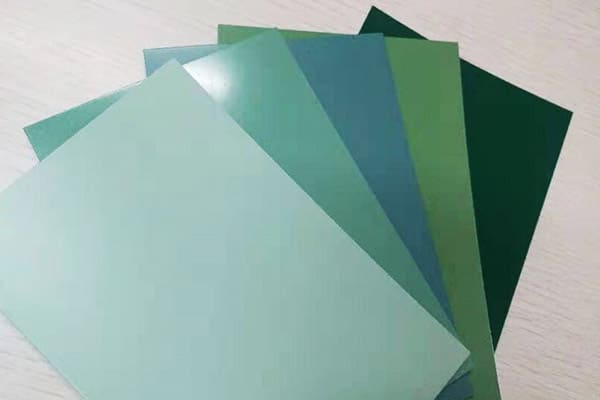
3003 Fluorocarbon Coated Aluminum Plate Display
Technical specifications and standards
Alloy and temper options
- Substrate alloy: 3003 Aluminium, an Al-Mn alloy known for good formability and corrosion resistance.
- Common temper ranges: H14, H16, H24, an h18, depending on yield strength and formability requirements. The temper selection affects bend radius, flattening behavior, and mechanical performance under service conditions.
- Coating system: PVDF fluorocarbon coating, typically with a topcoat color layer and a protective clear backing or primer as part of a coil coating process.
Coating thickness and color range
- PVDF coating thickness: 25–35 micrometers for typical exterior use, with primer or back coat contributing to the overall film stack.
- Color and finish options: A wide palette of standard RAL colors, metallics, and textured finishes, including matte, satin, and gloss options. The color range supports architectural branding, wayfinding, and design aesthetics.
- Gloss and texture control: Surface finish can vary from high-gloss to satin, depending on coating formulation and topcoat. Texture can include subtle grains or more pronounced patterns for visual interest and reduced glare.
Mechanical properties and performance indicators
- Formbarkeet: Excellent bendability and formability enable complex panel geometries without cracking or weakening the coating.
- Adhäsioun: PVDF coatings typically pass rigorous adhesion tests (z.B., ASTM D3359) to ensure robust adhesion to aluminum substrates under field and fabrication conditions.
- Impakt Resistanz: Coated panels maintain surface integrity under typical wind and debris impacts encountered on building envelopes.
- Thermal expansion compatibility: Aluminum has a relatively high coefficient of thermal expansion; PVDF coatings and properly designed panel joints accommodate expansion and contraction while minimizing coating fatigue.
Weathering and durability benchmarks
- UV Resistenz: PVDF 70% resin systems deliver superior UV stability, reducing chalking and color fade over decades.
- Salt spray resistance: Coated panels withstand salt spray and coastal exposure better than many other coatings, contributing to long-term performance in harsh environments.
- Chalk rating and color retention: High-performance PVDF coatings maintain color and sheen with minimal chalking in most climates.
- Feier Leeschtung: Aluminum by itself is non-combustible; coating systems add a fire performance layer that should conform to local building codes and fire safety standards.
Surface preparation and substrate compatibility
- Uewerfläch Propretéit: Aligned with coil coating practices, the substrate must be free of oils, oxiden, and contaminants to ensure coating adhesion.
- Surface roughness: A controlled roughness profile on the aluminum surface supports coating adhesion and longevity.
- Joint design and sealants: Architectural panel joints should be designed to manage thermal movement and moisture while preserving coating integrity.
Manufacturing and coating process
Substrate preparation
- Cleaning and degreasing: The aluminum substrate undergoes degreasing to remove oils and contaminants.
- Surface pretreatment: Anodizing or chemical pretreatments may be used depending on the coating system and performance requirements.
- Drying and inspection: The substrate is dried and inspected for defects prior to coating.
PVDF coating process
- Primer and adhesion promotion: A primer may be applied to enhance adhesion of the PVDF topcoat and improve corrosion protection in certain environments.
- PVDF topcoat application: The PVDF-based coating is applied via a continuous coil coating line, achieving uniform thickness and consistent color.
- Baking and cure: The coated panels are baked at controlled temperatures to cure the coating, achieving chemical cross-linking, Haftung, and weather resistance.
- Color and finish verification: Post-coating inspection ensures color consistency, gloss uniformity, and surface integrity.
Qualitéitssécherung an Testen
- Coating thickness measurements: Non-destructive measurement tools verify uniform film thickness across panels.
- Adhäsioun Tester: Cross-cut (ASTM D3359) or pull-off tests verify coating adhesion to the substrate.
- Gloss and color fastness: Spectrophotometer measurements ensure color accuracy and consistency across production lots.
- Weathering and durability tests: Accelerated weathering, UV Beliichtung, and salt spray tests evaluate performance under simulated service conditions.
Tolerances and dimensional control
- Thickness tolerances: Aluminum sheets and panels are produced with tight thickness tolerances suitable for architectural applications.
- Flatness and bow/warp tolerances: Flatness and dimensional stability are controlled to ensure proper fit and alignment in cladding systems.
- Cut-to-size and fabrication tolerances: Panels are supplied to standard or customized sizes with precise tolerances to accommodate installation requirements.
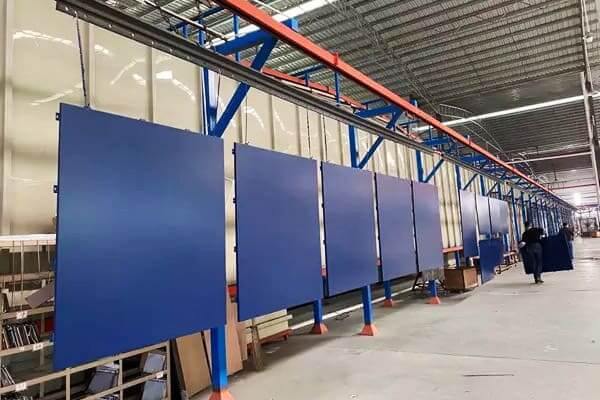
Huasheng Production of 3003 Fluorocarbon Coated Aluminum Plate
Fournisseur Spotlight: Huasheng Aluminium
Firma Profil
- Industry focus: Huasheng Aluminium specializes in the production of aluminum plates, Blieder, and coil-coated products for architectural applications, including fluorocarbon-coated panels for building façades.
- Global erreechen: The company serves customers across Asia, Europa, the Middle East, an d'Amerika, delivering reliability and consistent quality to large-scale construction projects.
- Core capabilities: In addition to substrate alloys like 3003, Huasheng Aluminum offers a comprehensive coating portfolio, finishing options, and customization services to meet project requirements.
Capabilities and value proposition
- Coating expertise: The company emphasizes PVDF fluorocarbon coating systems with proven weather resistance, color stability, and adherence to industry standards.
- Personnalisatioun: Huasheng Aluminum supports customized panel sizes, Dicken, Faarwen, and surface finishes to align with architectural design intent.
- Certification and quality: The supplier maintains quality management systems and material certifications to meet international project standards.
- R&D and collaboration: The company emphasizes research and development collaborations with customers and design teams to optimize material performance for specific projects.
Zertifizéierungen an Normen
- ISO 9001 for quality management systems.
- Additional certifications related to environmental management, Sécherheet, and product compliance typical for a leading manufacturer in the architectural aluminum sector.
- PVDF coating system certifications aligned with AAMA standards and local building code requirements where applicable.
Collaboration and support
- Technesch Ënnerstëtzung: Huasheng Aluminum provides design guidance, material specifications, and installation considerations to help project teams achieve success.
- Supply chain reliability: The company emphasizes dependable lead times, skalierbar Produktiounskapazitéit, and consistent product quality to support large, multi-site projects.
- Warranty and service: Depending on the project and coating system, warranties for PVDF-coated aluminum can range from 10 zu 20 years or longer, offering long-term performance assurances.
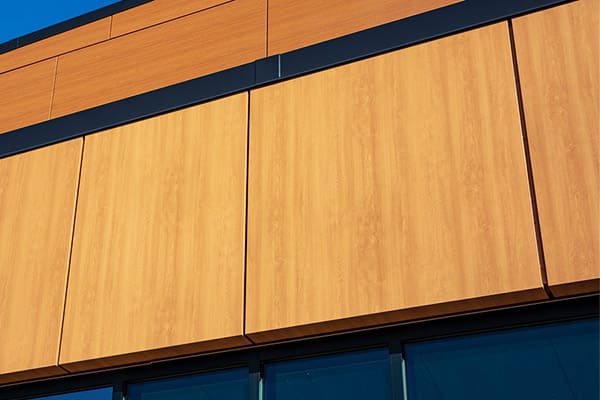
Fluorocarbon Coated Aluminum Plate Application
Applications in building envelopes and case studies
Exterior cladding and curtain walls
- Cladding systems: 3003 fluorocarbon coated aluminum panels are ideal for rainscreen cladding, Kolonn deckt, and curtain wall façades where aesthetics and long-term durability matter.
- Architectural accents: These panels enhance feature walls, soffits, canopies, and decorative panels by combining light weight with easy fabrication.
- Installation considerations: Proper panel alignment, attachment methods, thermal expansion accommodation, and joint detailing are essential to maximize performance and minimize coating degradation at seams.
Interior applications
- Interior architectural panels: Although PVDF coatings perform best in exterior applications, fluorocarbon-coated aluminum also serves well in selected interior applications, including high-end signage and durable wall panels that require excellent color retention.
- Signage and wayfinding: Haltbar, weather-resistant panels perform well in entry signage, lobby accents, and wayfinding plaques for outdoor and semi-outdoor environments.
Comparisons and decision-making
| Material / Beschichtung |
Substrat |
Typical Purpose |
Weathering Performance |
Ënnerhalt |
Cost Range (relativ) |
Typical Life Expectancy (outdoor, with maintenance) |
| 3003 Fluorocarbon coated aluminum plate (PVDF) |
3003 Al alloy |
Exterior cladding, Ridenain Maueren, Schëlder |
Excellent UV resistance, high color stability, gutt corrosion Resistenz |
Mëttelméisseg; periodic cleaning, less frequent repainting |
Mëttelméisseg bis héich |
15-30+ years depending on climate and maintenance |
| 5052/5083 aluminum alloys with PVDF coating |
5052/5083 Al |
Exterior cladding, maritime environments |
Ganz gutt Korrosioun Resistenz, PVDF coating enhances durability |
Moderate to low with proper maintenance |
Mëttelméisseg |
20-40+ years in favorable climates |
| Polyester-coated aluminum plate |
3003 oder 5052 Legierung |
Cheaper exterior cladding, Schëlder |
Moderate UV resistance, color stability lower than PVDF |
Higher repaint frequency in harsh climates |
Niddereg bis moderéiert |
8-15+ years depending on climate |
| Fiber-reinforced polymer (FRP) Panneauen |
Composite substrate |
Facade panels with varied aesthetics |
Excellent impact resistance; color stability depends on coating |
Varies by system; some require sealing |
Variabel |
15-25+ years depending on system and maintenance |
| Steel panels with protective coating |
Steel substrate |
Industrial façades; structural accents |
Gutt Kraaft; corrosion protection depends on coating system |
Higher maintenance in corrosive environments |
Méi héich |
20-40+ years with proper coating and maintenance |
Notizen:
– PVDF stands for polyvinylidene fluoride, commonly used in high-performance fluorocarbon coatings.
– AAMA 2604/2605 are widely recognized performance standards for fluorocarbon coatings used on exterior architectural metal surfaces. PVDF coatings meeting AAMA 2605 offer advanced color retention and weather resistance.
– Life expectancy estimates depend on climate (coastal, polluted urban, desert, etc.), installation quality, and maintenance practices.
Practical considerations for selecting 3003 fluorocarbon coated aluminum
- Climate and environment: In coastal or industrial environments, the corrosion protection provided by PVDF-coated aluminum is particularly valuable, reducing maintenance costs and ensuring long-term aesthetics.
- Architectural impact: The ability to produce complex shapes and consistent finishes supports distinctive architectural character, Branding, and wayfinding strategies.
- Fabrication and installation: The ductility of 3003 aluminum and the coating’s strong adhesion facilitate bending, schneiden, and panel assembly when designers incorporate appropriate allowances for thermal expansion and joint detailing.
- Liewenszyklus Käschten: Although initial material costs may be higher than some alternatives, reduced maintenance requirements and extended service life often result in favorable total cost of ownership over the building’s life span.
Environmental and sustainability considerations
Sustainability advantages
- Material Effizienz: Aluminum’s lightweight nature reduces structural support requirements compared to heavier metals, translating to lower foundation loads and reduced structural costs.
- Longevity and reduced maintenance: Long service life minimizes replacement cycles and associated environmental impacts from manufacturing and transportation.
- Verwäertbarkeet: Aluminum’s high recyclability makes it a favorable choice within circular economy frameworks.
Potential environmental considerations
- PVDF coatings: PVDF chemistry involves resin systems that require proper handling and waste management. Reputable suppliers implement recycling and waste-control procedures to minimize environmental footprint.
- Transportation and logistics: Shipping large panels can have a significant environmental impact, so efficient logistics and regional production facilities help reduce transportation-related emissions.
FAQs
Wat ass 3003 Aluminium, and why is it used for building plates?
3003 aluminum is an alloy with magnesium content and manganese additions that improve formability and corrosion resistance. It is non-heat-treatable and achieves its strength through work hardening. For building plates, 3003 provides excellent forming capability, making it suitable for curved façades and complex panel shapes, while offering adequate resistance to corrosion when paired with a robust fluorocarbon coating.
What does PVDF mean, and why is it used for exterior coatings?
PVDF stands for polyvinylidene fluoride, a fluorocarbon resin known for outstanding weather resistance, UV stability, and color retention. PVDF coatings, particularly when formulated to meet high-performance standards like AAMA 2605, provide long-lasting color and gloss retention, making them ideal for exterior cladding in diverse climates.
How long do PVDF-coated aluminum panels typically last outdoors?
Service life varies with climate and maintenance, but PVDF-coated panels commonly last 15–30+ years outdoors with proper care and installation. In favorable climates, proper maintenance helps preserve color and surface quality for many decades.
What standards apply to PVDF-coated aluminum for building exteriors?
Common standards include AAMA 2604 and AAMA 2605 for coating performance on exterior architectural metals. These standards address color retention, chalking, gloss retention, an Zucherung. Factory quality assurance often includes adherence to ISO 9001 an Zesummenhang Zertifizéierungen.
How should I evaluate whether 3003 fluorocarbon coated aluminum is suitable for my project?
- Assess environmental exposure (coastal, industriell, or rural) and expected maintenance requirements.
- Consider architectural requirements: Faarf Optiounen, fäerdeg ass, and the ability to realize complex panel geometries.
- Review ballast and structural considerations: attachment methods, joint designs, and tolerance to movement.
- Consult with the supplier on coating warranties, tested performance data, and service life projections for your climate.
- Compare total cost of ownership: initial material cost, Streag. Fënner, installation, Ëm deenhalt, and potential repaint/replacement costs over the building’s life.
Conclusioun
Déi 3003 Fluorocarbon Coated Aluminum Plate for Building represents a mature, reliable solution for exterior architecture that demands durability, Ästhetesch Versuergung, and long-term performance.
By combining the excellent formability and corrosion resistance of 3003 aluminum with the robust weather resistance and color stability of fluorocarbon PVDF coatings, this material delivers predictable performance across a wide range of climates and project types.
It performs particularly well in coastal and industrial environments, maintaining coating integrity and long-term color retention while providing the design flexibility required for contemporary façades and architectural accents.
For project teams seeking a dependable supply partner, Huasheng Aluminum offers a credible path to high-quality 3003 fluorocarbon coated aluminum panels.
With a focus on quality, Personnalisatioun, and customer collaboration, Huasheng Aluminum can support architects, Fabrikateuren, and contractors from specification through installation and ongoing maintenance.
Whether you are designing a new high-rise façade, renovating an existing building, or specifying signage and lightweight exterior elements, den 3003 fluorocarbon coated aluminum plate provides a compelling balance of performance, Ästhetik, and value.
By leveraging the material’s advantages, aligning with established standards, and partnering with a capable supplier like Huasheng Aluminum, you can achieve a durable, visually striking building envelope that stands the test of time.
Deelt mat PDF: Eck erofgesat