5052 and 6061 are two of the most widely used aluminum alloys, yet they serve quite different purposes. 5052 (an Al‑Mg alloy) offers superior corrosion resistance, fatigue strength and formability but cannot be heat‑treated, making it ideal for sheet‑metal and marine applications.
6061 (an Al‑Mg‑Si alloy) is heat‑treatable, has higher yield strength and better machinability, suiting structural, machining and heat‑exchanger uses. Cost‑wise, 5052 is generally less expensive, while 6061’s more complex processing commands a premium.
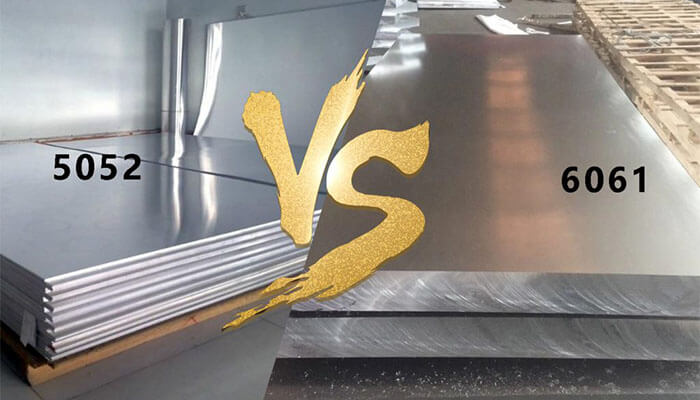
Understanding the elemental differences is key to why these alloys behave so differently.
| Element | 5052 Alloy (%) | 6061 Alloy (%) | Effect of Difference |
|---|---|---|---|
| Si | 0.25 max | 0.40–0.80 | Si in 6061 enables Mg₂Si precipitates for heat‑treatment strengthening |
| Fe | 0.40 max | 0.70 max | Slightly higher Fe in 6061 can form intermetallics affecting toughness |
| Cu | 0.10 max | 0.15–0.40 | Cu adds strength in 6061 but reduces corrosion resistance |
| Mn | 0.10 max | 0.15 max | Mn aids grain structure; similar low levels in both |
| Mg | 2.2–2.8 | 0.8–1.2 | High Mg in 5052 gives superior work‑hardening and corrosion resistance |
| Cr | 0.15–0.35 | 0.04–0.35 | Cr stabilizes Mg in 5052, enhancing strength and anti‑corrosion |
| Zn | 0.10 max | 0.25 max | Zn minor; negligible effects in both alloys |
| Ti | — | 0.15 max | Ti in 6061 refines grain during heat‑treatment |
| Others | 0.15 total | 0.15 total | Standard impurity cap in both |
| Al | Remainder | Remainder | Base metal |
| Property | 5052‑H32 | 6061‑T6 | Notes |
|---|---|---|---|
| Yield Strength (MPa) | 193 | 276 | 6061 is ~43% stronger |
| Elastic Modulus (GPa) | 70.3 | 68.9 | 5052 is slightly stiffer—better for bending |
| Fatigue Strength (MPa) | 117 | 96.5 | 5052 endures more cycles before failure |
| Thermal Conductivity | 138 W/m·K | 167 W/m·K | 6061 preferred in heat‑exchanger roles |
| Machinability | Poor | Good | 6061 chips finer, easier on tools |
| Alloy | Heat‑Treatable? | Common Tempers | Hardening Mechanism |
|---|---|---|---|
| 5052 | No | O, H111, H32, H34 | Cold work / strain hardening |
| 6061 | Yes | T4, T6, T651, T6511 | Solution heat‑treat + quench + aging |
| Characteristic | 5052 | 6061 |
|---|---|---|
| Forming/Bending | Excellent—high elongation | Poor—more brittle when formed |
| Welding | Very good (sheet welding) | Good (requires pre‑heat sometimes) |
| Machining | Difficult—large chips wear tools | Easy—small chips, smooth finish |
| Sector | Example Uses |
|---|---|
| Marine | Hulls, fuel tanks, LNG carriers |
| Architecture | Curtain walls, roofing, louvers |
| Transportation | Aircraft fuel tanks, bus bodies, signage |
| Electronics | Enclosures, chassis, heat sinks (sheet form) |
| Sector | Example Uses |
|---|---|
| Structural | Frames, bridges, scaffolding |
| Automotive & Aerospace | Chassis components, aircraft fittings |
| Machinery | Gears, shafts, hydraulic components |
| Thermal Equipment | Radiators, heat exchangers |
| Alloy | Relative Market Price | Reason |
|---|---|---|
| 5052 | Lower | Simpler processing, non‑heat‑treatable |
| 6061 | Higher | Heat‑treatment steps add cost |
Choose 5052 when you need excellent corrosion resistance, formability and fatigue life at a lower cost—especially for sheet and marine uses. Opt for 6061 when higher strength, machinability and heat‑treatable properties are paramount—typical in structural frames, machined components and thermal equipment. Always match alloy selection to your project’s mechanical demands, environmental exposure and budget constraints.

Henan Huasheng Aluminum Co., Ltd (HHALU for short), established in 2001, is located in Huiguo Town, the famous Aluminum capital of Henan Province, It's a professional manufacturer and engages in the research, development, production, sales and service of aluminum sheet plate, aluminum coil, aluminum foil, aluminum strip and aluminum circle.
In addition, HHALU also sell aluminum plate for construction and ships, aluminum mirror plate, and automotive aluminum alloy plate.
No.53, Dongming Road, Zhengzhou, Henan, China
Copyright © Huasheng Aluminum 2025. All rights reserved.
